
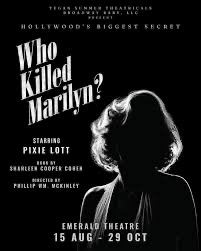
Theatre Review by Steven Smith
Acting is reacting. It is one of the fundamental principles of the craft, and something the legendary acting coach Lee Strasberg, one of the leading figures in bringing Method acting to America, understood better than most.
Marilyn Monroe, arguably one of the greatest screen icons of all time, studied under Strasberg in New York at the Actors Studio. He once spoke movingly about her ambition:
“Marilyn always dreamt of being an actress. She didn’t, by the way, dream of being just a star. She dreamt of being an actress.”
He went on to explain that despite becoming one of the most extraordinary stars in Hollywood history, Marilyn was never entirely satisfied. She wanted to be taken seriously as an actress, to explore her craft and to be recognised for something beyond her extraordinary beauty and magnetic screen presence.
Many of the great actors of that generation also studied with the formidable Stella Adler, adding another string to their theatrical bows. Between them, these influential teachers helped shape some of the finest acting talent of the twentieth century.
In Who Killed Marilyn?, Strasberg is referenced several times, although his wife, Paula Strasberg, also played a significant role in Marilyn’s development as an actress and became one of her closest professional confidantes.
All of which makes the central performance in this production rather important.
The show stars Pixie Lott, although the Saturday matinee I attended featured an understudy in the role of Marilyn Monroe.
Now, I couldn’t help feeling that had either Lee Strasberg or Marilyn herself witnessed this particular performance, they might well have been turning in their graves. And not simply because of the dreadful wig and unfortunate costume.
Let me be clear: Who Killed Marilyn? is a terrific theatrical concept. In fact, there is a great deal to admire here. The script is imaginative, the set is superb, and the supporting cast delivers some tremendous performances. Much of the costume design is also impressive,.
There is clearly talent, imagination and considerable hard work behind this production.
But there is one rather substantial problem.
Without a convincing Marilyn Monroe, the entire production loses its heart.
Marilyn was never simply a blonde bombshell with a breathless voice and a collection of seductive poses. She was an extraordinarily complicated woman. Beneath the carefully constructed Hollywood image was someone of great intelligence, humour, sensitivity and vulnerability. She could be fragile yet fiercely determined, insecure yet remarkably strong.
That contradiction was part of her magic.
To portray Marilyn successfully requires far more than copying her mannerisms. An actress must find the woman behind the legend, bringing light and shade, emotional depth and genuine humanity to the role.
Unfortunately, that was precisely what I felt was missing.
What should have been a fascinating portrayal of one of the world’s most misunderstood women became, at times, little more than a camp impersonation. The exaggerated delivery, the mannerisms and the overall presentation occasionally made the performance feel more suited to an episode of RuPaul’s Drag Race than a serious theatrical exploration of Marilyn Monroe.
And I can almost guarantee that the wig and costume would have been better on Drag Race.
There were moments when the performance simply fell flat, while others veered uncomfortably close to cringe-inducing caricature.
This is particularly frustrating because the material offers so much potential. Marilyn’s life was filled with extraordinary contradictions: fame and loneliness, glamour and insecurity, ambition and exploitation. Her relationships with powerful men, her determination to be respected as an actress and her tragic early death provide enough dramatic material to fill several productions.
The audience needs to believe, even if only for a fleeting moment, that Marilyn is standing before them.
For me, that moment never arrived.
I must, however, give credit to the understudy for taking on such a demanding role and remembering what is clearly a substantial amount of dialogue. Stepping into the shoes of one of the most recognisable women in history is no small undertaking, particularly when audiences arrive with such strong expectations.
My criticism is of the performance I witnessed, not of the actress’s dedication or effort. Nevertheless, I felt the characterisation was a considerable distance from the standard one would expect of a polished West End production.
It is also important to point out that I did not see Pixie Lott in the role, so my observations should not be taken as a judgement of her interpretation.
As for the venue, the Emerald Theatre is an interesting space with a past life as a club. It certainly has atmosphere and character, although prospective theatregoers should be warned that I found the seating extremely uncomfortable. Theatre is meant to challenge the mind and stir the emotions, not leave the audience desperate to stand up simply to relieve their backsides.
Ultimately, Who Killed Marilyn? is a production with considerable promise. There is an excellent concept, an engaging script, an impressive set and a supporting company that deserves recognition.
But when your entire story revolves around one of the most iconic women of the twentieth century, getting Marilyn right is not merely important. It is essential.
Marilyn Monroe spent much of her life fighting to be recognised as a serious actress rather than simply a beautiful movie star.
How ironic, then, that a production exploring her life should, in the performance I witnessed, reduce her to the very caricature she spent so many years trying to escape.
The question may be Who Killed Marilyn?, but on this particular afternoon, I was left wondering: where on earth was Marilyn?
Venue: Emerald Theatre, London
Website: https://emerald.london

