
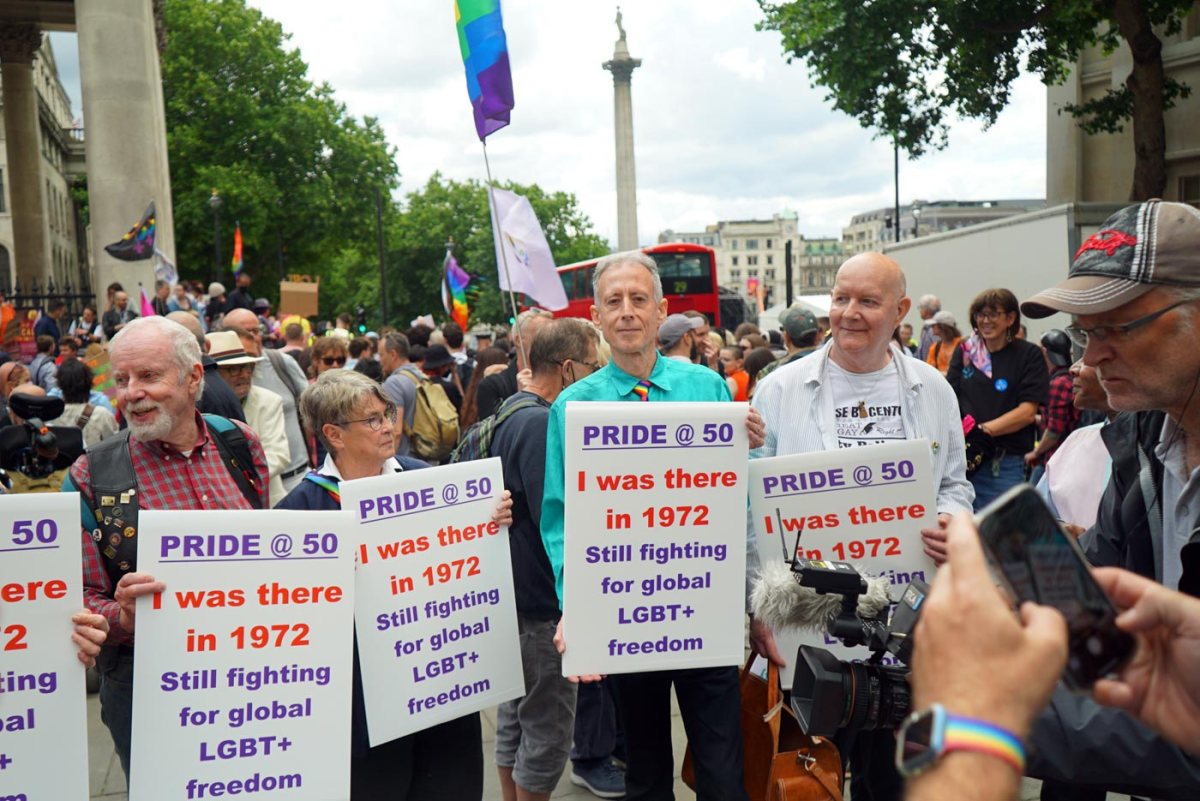
Last week, I joined some of the legendary children from the original Pride at the Curzon Cinema Bloomsbury to watch the powerful documentary Legendary Children (All of Them Queer), directed by Rob Falconer.
The film had its highly anticipated London premiere, playing to a an enthusiastic audience. Serving as the closing event for LGBT+ History Month, the screening was followed by an engaging Q&A session featuring renowned human rights activist Peter Tatchell.

Tatchell expressed his hope that the film would serve as both a historical reflection and a call to action for new generations of activists.
“I hope this film demonstrates that real social change is possible and inspires others to take up activism,” Tatchell stated. “It’s a story of then and now. I always say, even if you can’t be on the front lines, you can still make an impact—just by amplifying the struggles and voices of LGBT+ people across the world.”
His remarks followed a strong statement from the International Committee for LGBTQ+ History Months, a coalition representing 16 such initiatives globally. The committee issued a scathing condemnation of the U.S. government’s recent efforts to systematically remove LGBTQIA+ resources, educational materials, and visibility from schools.
“The erasure of books, knowledge, historical records, and community groups has never led to anything positive,” they wrote, warning that “the actions of the Trump administration are emboldening other governments and institutions to follow suit.”
Filmed over two years, Legendary Children chronicles the lives and activism of the pioneers who helped establish the first UK Pride in 1972. Director Rob Falconer reflected on the film’s profound relevance, not only in light of the growing wave of anti-LGBTQIA+ sentiment in the United States but also due to the loss of many of the trailblazers featured in the documentary.
“We won’t see their like again,” Falconer said, acknowledging the passing of numerous activists who fought to carve out a space for LGBTQ+ rights in Britain and beyond. The film stands as both a tribute to their courage and a reminder of the ongoing fight for equality—one that remains as urgent today as it was five decades ago.
The second film, The Fragility of Freedom, follows an inspiring group of humanitarian secondary school students from Essex, Suffolk, and Vancouver, Canada, as they participate in The Dora Love Prize 2024.
Since its inception, The Dora Love Prize has engaged over 1,500 secondary school and college students in Essex, Suffolk, and beyond in a unique, youth-driven human rights initiative. Inspired by Holocaust survivor Dora Love, the project continues her lifelong mission to educate young people about the atrocities of the Nazi Holocaust. Dora’s goal was simple: to empower students with this knowledge so they could challenge identity-based prejudice, discrimination, marginalization, and violence in today’s world.
Founder Rainer Schulze explains, “The Dora Love Prize provides young people with knowledge beyond the school curriculum and the confidence to create positive change in the world around them. We invite you to ‘see the world differently.’”

I am not always on the same page as the wonder that is Peter Tatchell, but I am in awe of him and his work. His speech about stepping into other organizations and being a shining light is so important that 2Shades has decided to print it as a landmark speech.
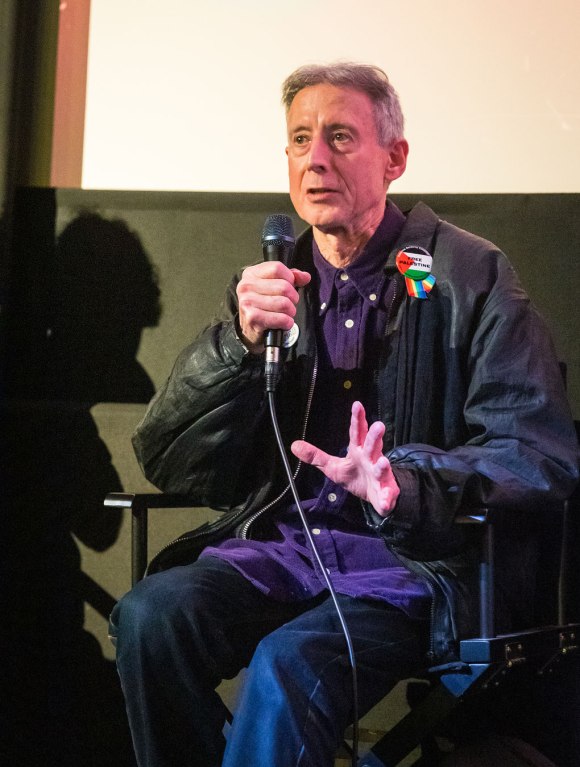
Peter Tatchell – March 5, 2025, Curzon Bloomsbury, London
*”To start with, I’d like to say that I had a very difficult choice tonight. I was also asked to speak at the U.S. Embassy in the solidarity protest with Ukraine and against Donald Trump’s withdrawal of aid from that country’s battle for self-determination.
What we are witnessing now is the rise of Russian and U.S. imperialism in alliance with each other to carve up Ukraine. Putin wants the territory; Trump wants the minerals. That is the new imperialism.
For LGBT+ Ukrainians, a Russian victory would be a devastating blow. It would mean the imposition of Russian-style laws on LGBT+ Ukrainians, never mind all the other civic and political repressions that would follow. The trade union movement in Ukraine would be dismantled, women’s rights campaigners would face severe repression, and so on. This is a critical moment where we must show the kind of international solidarity that the Gay Liberation Front demonstrated in the early 1970s. Back then, we stood with the people of Vietnam against U.S. aggression, with the people of Greece battling the Colonels’ junta, and with the people of Spain fighting the Franco dictatorship.
We saw our struggle as international, not just limited to LGBT+ rights but part of a broader democratic human rights movement.
So, to go back to your question—history shows that if you care about something, don’t just care, do something. Action equals life; silence equals death. We must get organized.
For young people who feel passionate, get involved with an organization that is making a difference. Many groups across Britain and around the world need financial support, online campaigners, and solidarity. Some young people I know make a point of attending Pride parades in repressive European countries like Georgia, Hungary, and Poland. They do this to show their support, and no one should underestimate the power of solidarity.
For people living under dictatorship or repression, knowing that others care is a massive morale boost. It’s psychologically uplifting.
The other thing I’d say is—don’t feel confined to LGBT+ movements. A lot of my work isn’t LGBT+ focused. I support the liberation movements in Indonesian-occupied West Papua, the Balochistan freedom struggle against Pakistan’s occupation, and the fight of the Arab Ahwazis in Iran against subjugation by Tehran. I don’t do this for LGBT+ reasons—I do it because they have a just freedom struggle, just like the people of Ukraine, Palestine, or anywhere else.
Because I’m openly gay, my support has forced many people in these communities to rethink their attitudes toward LGBT+ people.
Take Balochistan—it’s a very tribal, patriarchal, and, frankly, ‘backward’ society in terms of LGBT+ rights. But because I’ve been one of the champions of their freedom cause for the last two decades—getting them huge media coverage—I’m now well known there. Many people have told me, ‘I used to hate homosexuals. I believed all the propaganda. But you stood with us, and now I’m rethinking my attitude.’
That’s incredibly important.
The same applies across the board. I’ve been campaigning for 50 years in support of Palestine’s right to a homeland. Again, as an openly gay man, I’ve had countless Muslim people tell me, ‘I used to hate gays, but your support over the decades has changed my mind.’
So, if you’re young, get involved in these movements as an openly LGBT+ person. Show that we stand with them. At first, they may not stand with us, but if you persist, not only will you be supporting a just cause, but you’ll also be changing hearts and minds along the way.”*

 2Shades Magazine
One reply on “2025 UK LGBT+ History Month Finale: Legendary Children [All of Them Queer]”
It’s clear from the UK Supreme Court ruling that we can neverassume we’re winning in the fight against bigotry.
LikeLiked by 1 person