

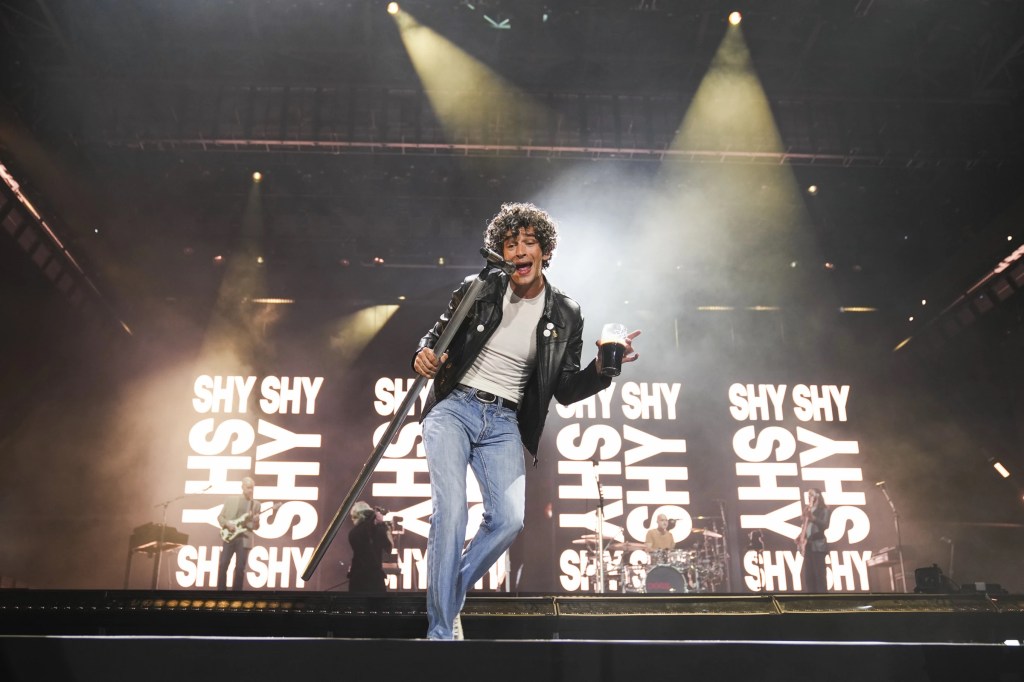
When you tune in to watch The 1975 perform live, you’re not just listening to a concert—you’re boarding an electrifying emotional rollercoaster. From the first beat to the final bow, Matty Healy doesn’t just sing; he commands, provokes, and enchants. At Glastonbury, he led his band into the annals of festival history with a performance that was nothing short of spellbinding—part protest, part performance art, and all heart.
There’s no doubt that watching The 1975 live is like being caught in a storm of sound and sentiment. Healy, a vocal advocate for mental health awareness, brings his audience on a journey that often feels bipolar in nature—veering from euphoric highs to moments of raw, painful vulnerability. One moment, you’re leaping in unison with thousands, lost in the pulse of a synth-heavy anthem; the next, you’re hushed and still, listening as he declares, “I’m bleeding for you.” Behind him, haunting visuals flash—images of human suffering, environmental destruction, animal cruelty—reminding the audience that this isn’t just music, it’s a call to consciousness.
“It’s not about politics anymore,” Healy said mid-set. “It’s about love. It’s about being kind. Only with that will we ever make a real difference.” It’s these moments of candour that transform his concerts from simple entertainment into deeply moving communal experiences. In an industry where many shy away from difficult truths, Healy walks straight into them, arms wide open.

His onstage persona oscillates between bravado and vulnerability. “I’m the greatest poet,” he quips with a grin—only to retract with a shrug in the next breath, “No, I’m an idiot.” The line between jest and confession blurs. It’s this constant tension—between confidence and self-doubt, performance and honesty—that makes him so captivating. Matty Healy was born for the stage, but it’s his disbelief in his own myth that makes the myth so powerful.
Critics often compare him to rock legends—Jagger, Iggy Pop, maybe even Bowie—but the truth is, Healy defies easy classification. He’s original, carving out a space that feels entirely his own. Perhaps the closest parallel is Marc Bolan, who stunned a generation with “Ride a White Swan,” opening the doors for glam rock and gender fluid performance styles. Bolan didn’t just sing songs—he shaped culture. Healy is doing the same, one provocative, glittering, gut-punch of a show at a time.
Musically, The 1975 occupy a unique space in modern rock. Their sound is a kaleidoscope—one moment polished pop, the next raw post-punk, with forays into jazz, soul, and experimental electronica. Healy’s songwriting is equally diverse. At times playful and catchy, at others profound and searching, he writes like someone trying to make sense of the world in real time. His voice—distinctly androgynous—is now fully formed. It’s a sound that feels both masculine and feminine, emotionally expressive without relying on the grit or aggression often associated with male rock vocalists.
Unlike performers such as Eminem or Macklemore, who often lean on female vocalists to soften or elevate their songs, Healy’s voice stands entirely on its own. There’s no need for a counterbalance. His vocal tone is rich, resonant, and complete. If a perfectly dressed salad needed no extra dressing, then Healy’s voice is that seasoned dish—balanced, flavorful, and satisfying all on its own.

And while Matty Healy is the band’s lightning rod, The 1975 is far more than just one man. The musicianship within the group is extraordinary. Drummer George Daniel is a master of rhythm—an innovator whose work deserves to be ranked alongside legends like Keith Moon and Ginger Baker. His beats are not just background; they are the spine of every song. Then there’s saxophonist John Waugh, whose solos are so expressive and vital that it’s easy to imagine David Bowie himself swooping in to steal him for a side project. Guitarist Adam Hann is no less impressive, crafting intricate textures and soaring riffs that elevate every performance.

Together, they’re a cohesive force, a band in the truest sense. At Glastonbury, they played not like hired hands or background musicians, but like brothers—a family bound by the music they make. It was Healy, of course, who brought them all together, and it is his vision that they continue to follow. But it’s the synergy of all four that gives the band its power.

The Glastonbury crowd, thousands strong, didn’t just watch—they listened. When Healy pleaded with them to “be kind” and to “make a difference,” they responded not with cheers but with thoughtful silence, a stillness that only true impact can elicit. Few performers have that kind of power. It’s the rare ability to hush a festival crowd, not with volume but with vulnerability.
And already, there are imitators—artists scrambling to mimic his stage presence, his fashion, his lyrical style. We won’t name names—let’s be kind, as Healy would urge—but the influence is undeniable. The 1975 are not just leading; they’re redefining the genre.
As the final chords rang out into the Glastonbury night, one thing became clear: this was a moment that would be remembered. The band could have easily played for another hour, and no one would have left. But sometimes, leaving them wanting more is the mark of a true master. And Matty Healy, for all his self-doubt and sarcasm, is exactly that—a master performer, a cultural touchstone, and yes, perhaps the Pied Piper of modern rock.
The world will keep watching. The arenas will fill. And The 1975 will continue to evolve, to provoke, and to inspire. Glastonbury may be behind them, but their story is far from over.
END
Why The 1975 and Matty Healy Support LGBTQ+ Rights and Fund Them

In an era where performative allyship is all too common in pop culture, The 1975 have carved out a reputation for genuine advocacy—particularly when it comes to LGBTQ+ rights. Fronted by the passionate and outspoken Matty Healy, the Manchester-based band not only vocalizes support but backs it with real action and funding.
Healy and his bandmates—George Daniels, Adam Hann, and Ross MacDonald—aren’t just a group with a large LGBTQ+ following; they’ve actively embraced and empowered the community. Their hit “Loving Someone” has become something of a modern gay anthem, resonating deeply with queer fans for its themes of identity, love, and resistance to conformity.
But their commitment goes well beyond lyrics. In a tangible display of support, The 1975 donated £16,000 to help create an LGBTQ+ centre in London—a meaningful contribution aimed at fostering safe spaces and community resources. As Healy himself said, “You might wonder why this is needed and ask what exactly everyone is still scared of, but sadly stigma still exists.” It’s clear he understands the ongoing challenges faced by LGBTQ+ individuals and refuses to remain silent.
Healy’s activism isn’t just about charity—it’s also about calling out injustices. At the BRIT Awards, he used his platform to highlight misogyny in the music industry, quoting journalist Laura Snapes to critique the double standards applied to male and female artists. This kind of intersectional awareness is why his advocacy rings true.
Part of Healy’s inclusive worldview stems from his upbringing. With a gay icon for a mother—actress Denise Welch—and a father known for playing drag characters on TV, he grew up immersed in queer culture. Labels never mattered in his household, and that open-mindedness clearly carries into both his personal life and public platform.
What truly sets The 1975 apart, though, is how authentic and accessible they remain despite global fame. Backstage at a packed O2 concert, Healy was more concerned about making sure a guest had a drink than what he was going to wear on stage. That sincerity, that desire to connect rather than dominate, defines their relationship with fans—especially LGBTQ+ fans who have long searched for artists that don’t just exploit queer culture but stand alongside it.
In short, The 1975 aren’t just the band everyone’s talking about because of their catchy songs or chart success. They matter because they’re using their platform with genuine purpose—offering representation, safe spaces, and support for those who need it most.

 2Shades Magazine
3 replies on “The Pied Piper of Rock: Matty Healy Leads The 1975 Into Glastonbury History”
Brilliantly described Steven!! You truly captured the essence of The 1975 beautifully!
LikeLike
Brilliantly described Steven!! You truly captured the essence of The 1975 beautifully!
LikeLike
Just wow Steven.
you captured everything perfectly about Matty and The 1975.
Emotional , articulate just perfect.
thank you.
LikeLike