

In conversation with Michelle Jeram who discusses career shifts and the infinite spectrums of neurodiversity
After a casual arrest gone painfully wrong, Michelle reflects on a series of changes that opened up her life

Michelle said, “You know as a police officer, you always have this sort of authoritative nature about you. Every job you go to, you have to be a different person. Delivering a death message, or making an arrest, my voice will have to change, it’s a different persona.
A lot of it is listening and communication. The listening part is also in acting because you’re reacting to what is being said to you. It’s kind of transferable skills that way”
After facing a tragic incident whilst making an arrest resulting in 5 knee surgeries, Michelle was forced to end her career as a copper.
She continued as a consultant with the police after her recovery but she had an inkling that she had more to life than this.
Michelle decided to relive her childhood dream of becoming an actress. Urging her to train herself through acting classes online during the pandemic.
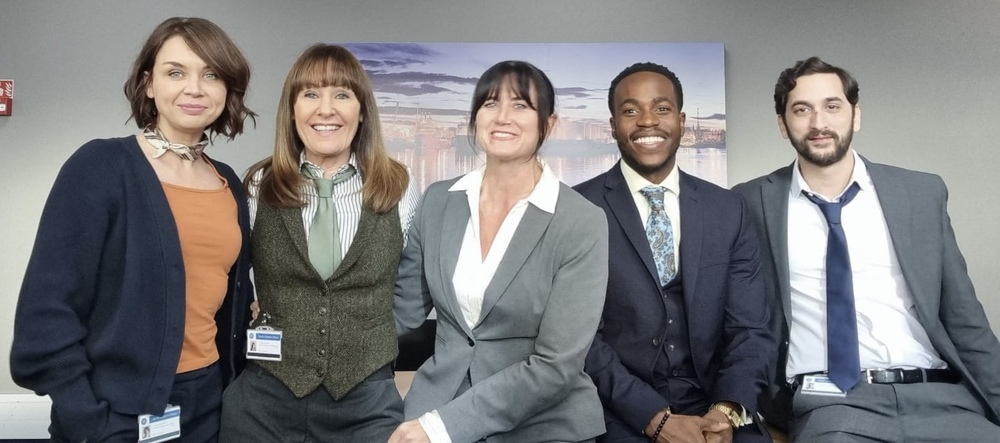
After a year and a half, she secured the role of DS Simone ‘Monty’ Montrose on BBC’s Granite Harbour as an investigator in the series.
While this was a breakthrough moment for her acting career, she enlightened us on the conditions faced in the acting industry.
Michelle said, “As an actor, we audition for way more than we ever get. It’s just ridiculous the amount of no’s and or the amount of you don’t hear anythings. You can audition for 20 roles and just get one and I think coming into the industry later in life, I can handle that.
If I was 18 or in my 20s, I’d probably find the constant rejection really difficult. It’s very competitive, not everyone can afford a ticket to London for an audition, put a day aside just for that. I do this full time now but there are so many people who have other jobs and have to take time off for this.”
I could feel the amount of empathy she holds for people. Having been a police officer and now an actress, she wishes to do her job with conviction and not for any kind of recognition.

I imagine being a police officer is far from easy and the unpredictability requires a lot of courage to deal with every day.
I sensed a grimness as she said the words, “There are some things you should never see.”
It transported me briefly to the times she might’ve had to go back home and process the horror she witnessed.
The mental health of police officers is frequently overshadowed by the government’s control over them. There are a handful who seem to exploit their powers to fulfil a demonic agenda.
But for the good ones who are human beings just like the rest of us, they have to play a role that provides a thankless service to others and hardly for themselves.
Michelle said, “When I joined in 1991, there wasn’t any counselling support. You’d sort of have this dark humour, not demeaning but to sort of cope with it yourself. There is counselling and things like that now but I think it’s the numbers in policing that are so few that they’re being single-crewed it shouldn’t be like that.
It’s a sorry state of affairs unfortunately but, I loved my 23 years and I’m very proud of it.”
Her enthusiasm as a police officer reflects greatly on screen as she now takes on detective roles to structure her brand as a newbie in the industry.
She dives into research and curates a background story for each of her characters to bring them to life.
She draws inspiration from her experience as a copper to understand the depth of her character. Which helps her react to her coworkers cues and mediate the necessary emotion.
Her personal experience also helped with roles where she was required to improvise and be as authentic as she could be.
She said, “Granite Harbour allowed us to do that for example, and I’m like, I don’t think Monty would actually say it like that so I might change it slightly. Similarly with Queen At Sea, the director wanted me to be as authentic as possible. He didn’t care if the person had acting experience, he preferred someone who knew the procedure.
For instance a rape incident, if you’ve never dealt with that, you don’t know the process and what’s being said, it would be quite difficult.”
We both agreed that it’s not to say that actors don’t have the capability to tap into those raw emotions required for a scene, but a past experience could definitely provide an edge.
As we continue to speak, I was curious to know how being autistic blended with such contrasting careers.
However, Michelle is a doer and for her the process of creation and the contribution of each soul towards the art mesmerised her.
Michelle explained, “You know that’s what fascinates me I think, the whole process of how a show is really put together. The set design, sound, electricians, the runners, everything. I remember on my first week in Granite Harbour in series one, when it was appropriate, I went around to everyone and asked them what they did. To tell me exactly what they did.
I remember watching Charlie and the Chocolate Factory and Bugsy Malone, you know the original one with Jodie Foster. I was fascinated, it stayed with me. And I think what it is about acting for me is the whole creative process. And you see the finished product, you’re like, cool!”
The creation of art can sometimes be viewed from a superficial lens, I personally forget that it takes a collective of talent to put together a refined piece of work.
The creative choices, the artistic direction, the lines, the emotions everyone face through the day in the process of making it.
Michelle said it perfectly when she said to me that a good crew can always help make the process easier. She added, “You have better chances if you’re nice to the people you work with and it helps if you’re not a d*ck.”
She adores the cast of Granite Harbour and whoever she has worked with so far. Sharing a bond beyond the set aided in finding a flow for a seamless production and on screen chemistry.
We delved a little deeper into the networking and socialising aspect of being a neurodivergent actor and former police officer.
She said, “As a police officer, I realised after a while that nothing really bothered me. I’d see horrific things and go okay, then on to the next job. I felt quite unfazed by things. I’m still unfazed, I don’t particularly get emotional. I don’t remember the last time I cried, I’m quite a black and white person. There are no grey areas with me and that obviously served me well as a police officer.”
Neurodiverse individuals are often misunderstood as emotionless or apathetic. Or that they’re rude and unappreciative of the world around them.
It’s quite an unfair assumption that seems to be getting a lot more attention now, to reeducate people on their innate ability to feel.
As someone who struggled with social anxiety, I did feel like I played a role to feel accepted. Social gatherings can be overwhelming, you either love it, learn how to love it or hate it.
I’ve felt disconnected on multiple occasions whilst trying to build meaningful connections spontaneously. It takes time for me to truly connect but it can often be misunderstood as aloofness.
Michelle said, “When it comes to social gatherings, I never really love it. I’m quite a solitary person, I find the social side of it quite difficult but I understand the necessity of it because we need to work together and when we hang out, we learn a lot more about each other and that shows on screen. There’s a shorthand when it comes to who you’re acting with because they’re your friend.”
It makes me wonder if we’ve followed a society that depends on instant gratification and phrases to fit in. And how it’s often a recycle and reuse behaviour that keeps us afloat.
It’s hard to find connections that sustain in the world we live in where the walls within us are higher than a tower.
Attempting to narrow an infinite spectrum of neurodiverse people and urging them to be ‘normal’ only pushes them further away from their truth.
Michelle said, “A friend of mine called Sam Grieson wrote and directed a short film called “The Programme” to smash down barriers to say that it’s actually just a different way of processing. It’s a film about Drum, my character being interviewed by this robot in order to train the future AI on how to respond to human emotions. It’s about identity grief and how one deals with an autistic mind because we’re always told that we don’t feel, which is not true.”
I’ve had the opportunity to watch The Programme before it’s launch in October and it worries me for the future.
Emotions are such an individual and private journey- it’s not shaped to be predictable, it’s meant to be unique.
The AI robot in the film in many ways reflects the mentality of some people who box neurodivergent individuals as “odd”.
But have we as human beings wondered if the system of normalcy provided to us has perhaps limited the expansive view of our species?
Pushing us towards judgement of the other for their inability to match up to the standards of what is expected?

We arrived at an intriguing discussion soon after that reaffirmed my spirituality. We talked about how spiritual language can help us cope and focus on our vision towards our dreams.
In the age of spirituality where everyone seems to be talking about growth, we find ourselves using manifestations to align us to a vision. Michelle confidently said, “The weird think about Granite Harbour was, I knew I was going to get it. I read a lot about manifestations and it’s not just about visualising it, I also put it into action.”
Awareness of ones presence and potential can help structure a foundation to start with but there’s a certain amount of hard work and determination that needs to support it.
Michelle agreed and added, “I do hear people give advice to actors, they say ‘Stick with it! Your time will come!’ But I don’t think that’s entirely true. You have to know how to act as well, And there are a lot of people that I’ve done acting classes with or seen. And you know, it’s almost like I’m sure that they can act with the right guidance.
Telling somebody, keep going, keep going. Well, if nothing changes, nothing changes. You know, there’s got to be a change if you’re not getting anywhere.”
We do require a system upgrade even as human beings. Adding new skills, renewing a resume, whatever it may be, it gives us an opportunity to present ourselves as proactive and seeking growth in our reality.
Michelle continued, “They might be new headshots. Do you still look like your headshots? It might be a new show. It might be creating your own work. It might be getting some acting coaching. And a lot of these things cost money. But you know, one job will pay for that.You can reinvest and then go, right, I’m going to get some more acting coaching and get a job, reinvest.
And I think that just telling somebody to keep going on the same line that they’re on, if they’re getting anywhere, I’m not entirely sure that that’s the best advice to give. It’s no good your nan telling you she thinks you’re fantastic. Because my mum loves everything that I’ve done. And I’m like, mum, it was rubbish. Mums and dads, they just see you as this beautiful child. And they’ll say everything is amazing. But it’s not always helpful. It’s not constructive.”
At the end of the day, everyone deals with life in a way that makes sense to them. We are habituated to function from a place of safety and protection of our energy to identify the roles we play in our lives that feels most fullfilling.
The reality is that change is constant, the methods of achieving it are endless and the inspiration is subjective. Resistance to change breeds contempt and embracing all kinds of change can open pathways that achievers like Michelle have openly invited into their existence.
To reach out to Michelle for enquires, go here.
To connect with her, this is her Instagram.
For more information about The Programme by Sam Grieson, visit https://www.crabandbull.com/theprogramme


 2Shades Magazine