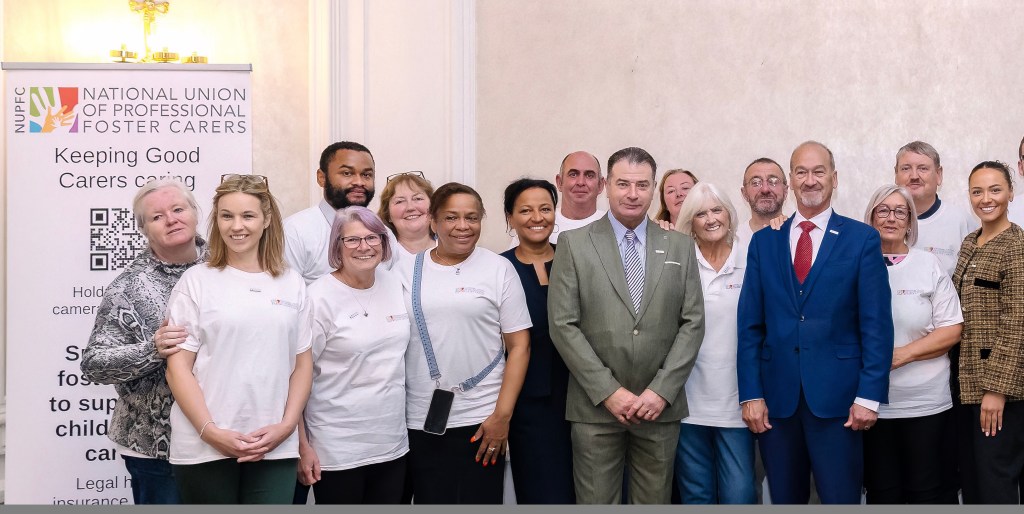
2Shades is delighted to announce the National Union of Professional Foster Cares as a sponsor of The Autism Hero Awards .
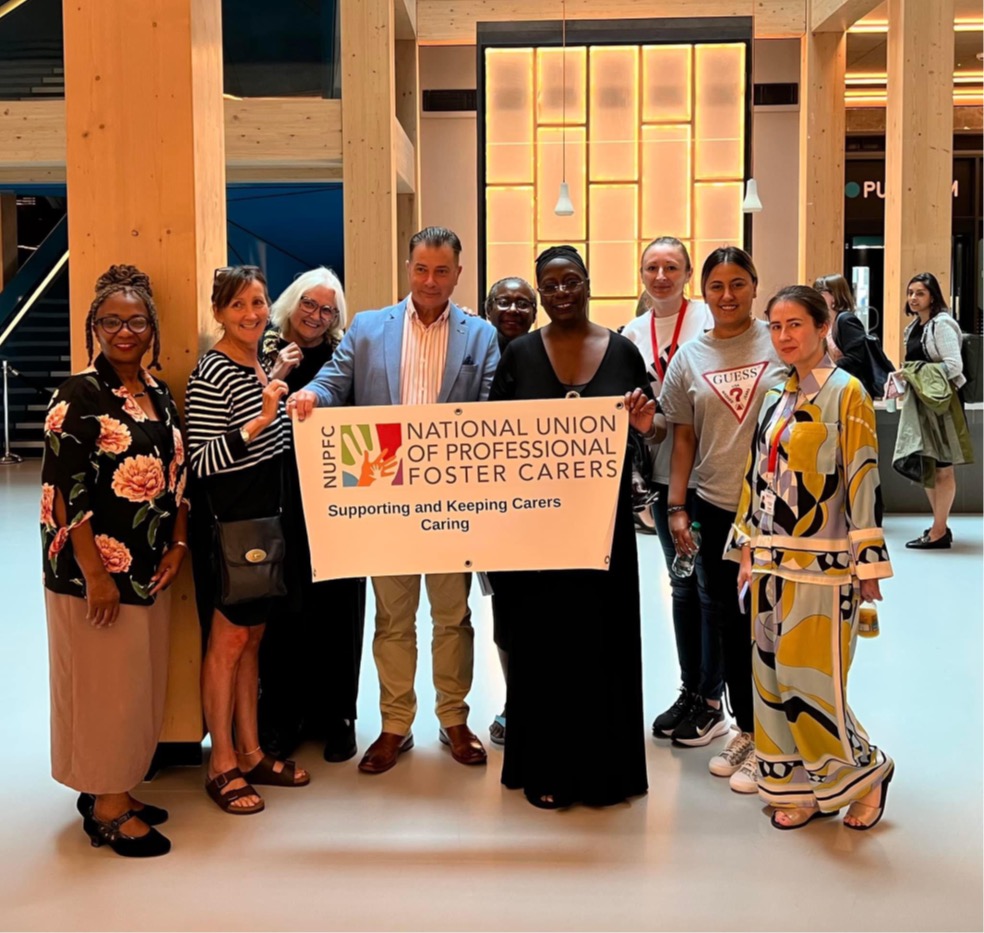
2Shades is delighted to announce the National Union of Professional Foster Carers (NUPFC) as a sponsor of this year’s Autism Hero Awards, supporting the Parent / Carer of the Year category.
The NUPFC is the only government-certified trade union in the UK dedicated exclusively to supporting foster carers, kinship carers, special guardians, and adopters. Its mission is clear: to ensure carers are informed, protected, and properly supported as they provide care for some of the most vulnerable children in society.
What sets the NUPFC apart is its depth of lived experience. Its specialist caseworkers — available 365 days a year — include current and former foster carers alongside retired social workers. This hands-on understanding allows the organisation to offer practical, empathetic guidance rooted in real-world challenges. A strong legal team further ensures members are never left navigating complex systems alone.
Caring for children who have experienced emotional harm or additional challenges can be demanding and emotionally complex. The NUPFC works closely with professionals around each child, helping to ensure carers — and in turn, the children themselves — receive the support, advocacy, and understanding they deserve.
Many children within the care system are autistic, while many others remain undiagnosed. The NUPFC actively promotes early diagnosis, recognising that timely understanding can make a profound difference to a child’s wellbeing, access to support, and long-term outcomes.
By sponsoring the Parent / Carer of the Year category at the Autism Hero Awards, the NUPFC is shining a light on the resilience, commitment, and quiet heroism of carers. This partnership not only celebrates individual achievement but also raises wider awareness of autism and caring within professional circles and among key decision-makers.
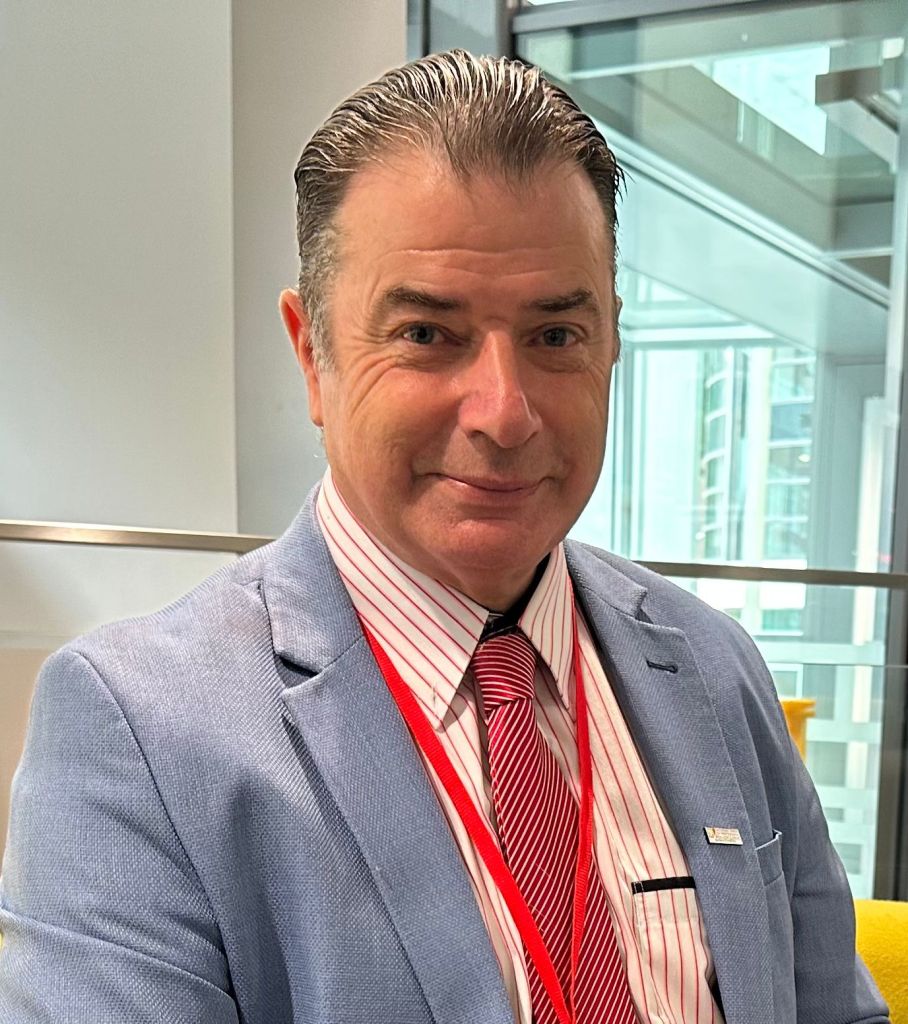
Robin Findlay, Founder and General Secretary of the National Union of Professional Foster Carers, said:
“Anna Kennedy’s tireless campaigning continues to raise awareness of the many strengths, talents, and contributions that autistic people bring to our communities. We are proud to support the Autism Hero Awards and to stand alongside Anna Kennedy Online in encouraging autistic people, and their parents and carers, to seek support when needed, build confidence, and achieve great things.”
Anna Kennedy OBE added:
“We are absolutely delighted to welcome the National Union of Professional Foster Carers as sponsors of the Autism Hero Awards. Their commitment to carers and families aligns closely with our values, and we look forward to working together to celebrate autistic individuals and recognise the dedication of those who support them every day.”
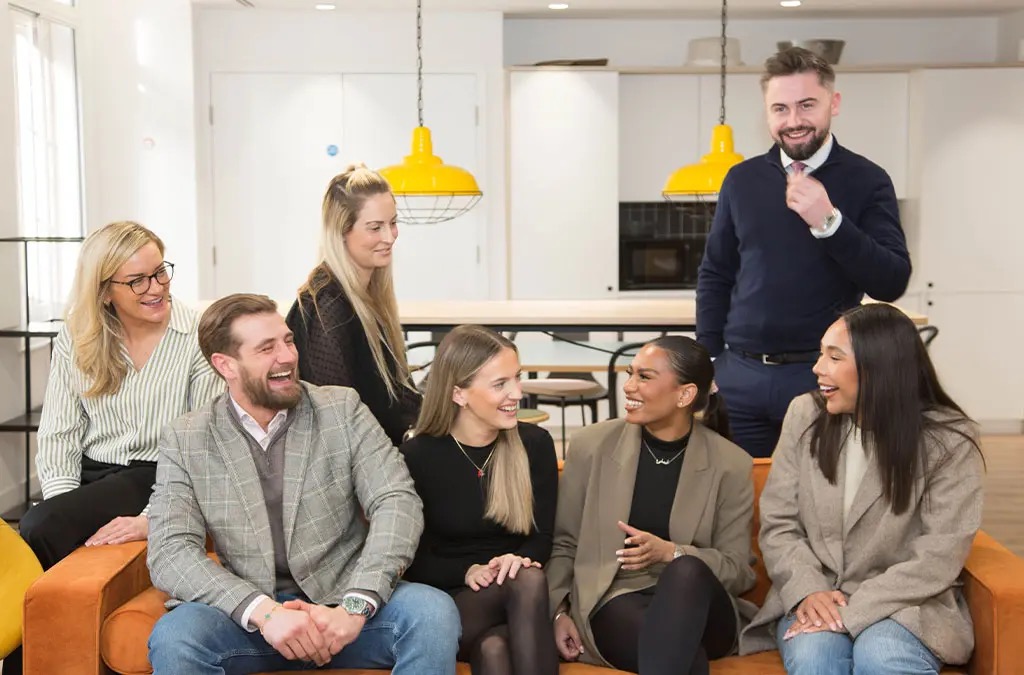
The Eleventh Hour Group is proud to sponsor the Young Person of the Year category at the Autism Hero Awards.
Known for its people-first approach, the Eleventh Hour Group is built on professionalism, integrity, and long-term partnerships within healthcare. Working closely with NHS Trusts, private providers, and local authorities, the organisation supports vital services by ensuring the right people are in the right place at the right time — always with care and respect at the heart of what they do.
That ethos extends beyond healthcare delivery into meaningful community engagement. This year, the Eleventh Hour Group is honoured to sponsor the Young Person of the Year category at the Autism Hero Awards, an event that celebrates achievement, advocacy, and lived experience across the autism community.
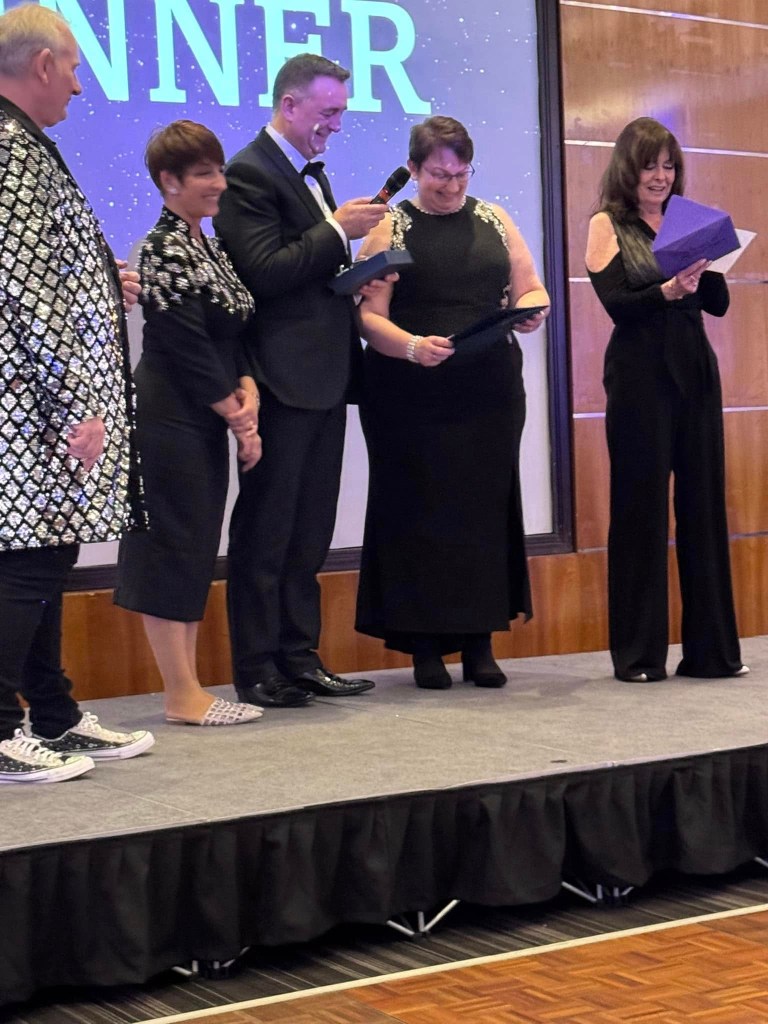
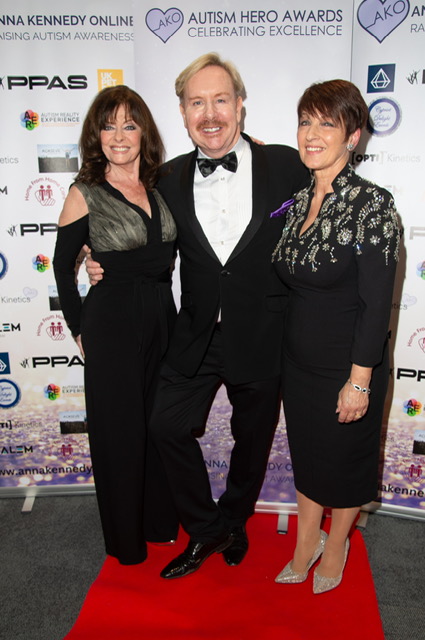
Anna Kennedy on line patron Vicki Michelle presents an award along with Dr Anna Kennedy OBE at the Autism Hero Awards .
Speaking about the sponsorship, Aaliyah McGuire, Director of Complex Care at the Eleventh Hour Group, said:
“EHG is proud to be supporting the Autism Hero Awards and sponsoring the Young Person of the Year category. Anna Kennedy Online’s work has a profound impact on the lives of autistic individuals, and their values align closely with ours. It’s a privilege to support such an important celebration of young people and their achievements.”
Hosted by Anna Kennedy Online, the Autism Hero Awards recognise individuals and organisations making a genuine difference. The Young Person of the Year category is a particularly powerful moment of the evening, shining a spotlight on young autistic individuals whose resilience, creativity, and voices deserve national recognition.
The awards ceremony will take place on 9 May at the Holiday Inn, Regent’s Park, bringing together families, professionals, advocates, and supporters to celebrate progress, inclusion, and positive change.
Dr Anna Kennedy OBE has long been a leading voice in autism advocacy. Through her tireless work with Anna Kennedy Online, and events such as the Autism Hero Awards, she continues to champion understanding, inclusion, and opportunity for autistic individuals and their families.
Dr Anna Kennedy OBE said:
“I am absolutely thrilled to have a company like the Eleventh Hour Group join us. With their strong background in healthcare, it is incredibly exciting to welcome them into the Anna Kennedy Online family. Their support truly reflects a shared commitment to people, care, and inclusion.”
By supporting the Young Person of the Year category, the Eleventh Hour Group reinforces its belief that true impact comes from valuing people, recognising potential, and investing in the next generation.
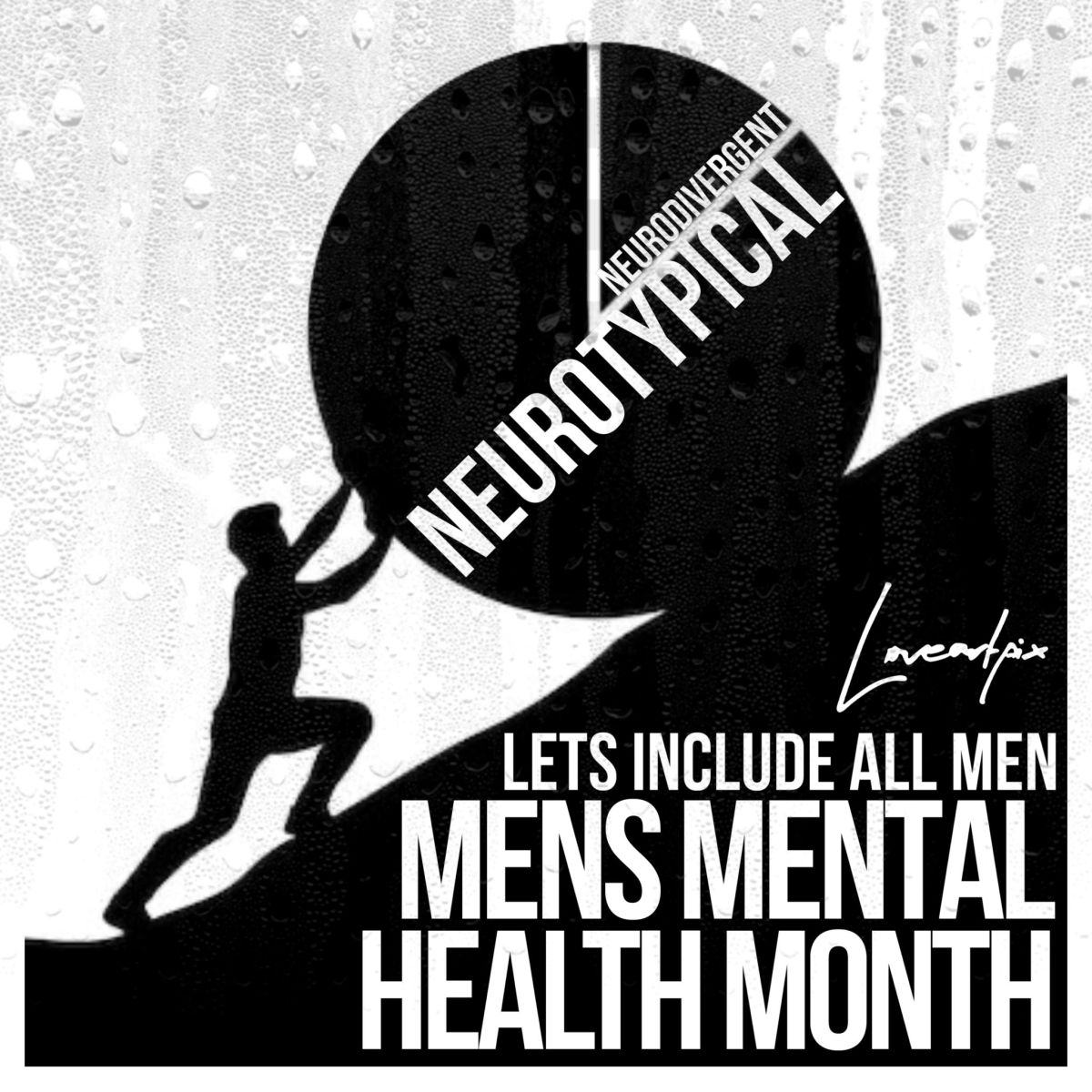
By Guest Writer Manchester based award winning artist and my friend Loveartpix.
November is Men’s Mental Health Month, and as usual, I want to move beyond the usual catchphrases like ‘Talking Helps‘ as it’s far more complex than that. The question I keep returning to (because it’s personal) is this: does our generic, neurotypical framing of “men’s mental health “leave too many men like me behind?
Campaigns, days, and months do matter – they reduce stigma by getting the much needed conversations going and remind us to check in on friends. But what is their impact if suicide rates are still just as high, and some of the men at greatest risk (neurodivergent men) are largely left out of the conversation?
We rarely say this plainly: autistic people face a much higher risk of suicide than non‑autistic people. A large Swedish population study found that autistic adults, especially those without intellectual disability, were around nine times more likely to die by suicide than their non‑autistic peers (Hirvikoski et al., 2016).
Autistic adults without intellectual disabilities are, on average, more likely than non‑autistic peers to experience mental health conditions such as anxiety and depression. Factors that contribute include chronic camouflaging/masking, sensory overload, social mismatch and stigma, late or missed diagnosis, and barriers to tailored support.
In clinical samples, the picture is even starker: two‑thirds of autistic adults report lifetime suicidal ideation, and about one‑third report suicide plans or attempts (Cassidy et al., 2014). If the risk is this high, why isn’t this part of the headline of our November conversations?
And what about the many who are undiagnosed – men whose autistic traits are missed or misread due to lack of awareness? How many die by suicide after years of the wrong treatment, the wrong framework, or a string of mental‑health labels that never addressed neurodivergent needs in the first place? We don’t track this well enough to know – this, for me, is very worrying.
I’m not speaking in theory. For more than two decades, I repeated the same words over and over, and the responses I received didn’t fit their box – so it was a continuous battle creating more mental health issues.
“Look Dez, you’ve taken every combination of medication we can offer you. What else do you want us to do?” – words you don’t want to hear from the psychiatrist in charge of your mental health and well being!
Even after my diagnosis, I’m basically begging for support in any way possible, but they still don’t have an answer. Right now, no services are willing to accept my case. That isn’t a lack of “talking.”It’s a system that doesn’t understand or accommodate neurodivergent needs.
“Talk to someone.” “Pick up the phone.” “Open up.” These messages are well‑meant—and sometimes they help. But they assume a neurotypical nervous system. When distress is driven by sensory overload, alexithymia (difficulty identifying and describing feelings), shutdown, or the aftermath of masking, being asked to “speak up” on a phone call, or in fluorescent‑lit rooms, with vague questions, can be not only ineffective but also actively dysregulating and even traumatic.
Personally, I often communicate better in text when I go into meltdown (and after), I need time to process, and rely on concrete, direct language and clear communication. Standard CBT delivered at a pace, full of metaphors and homework that assumes neurotypical cognition, doesn’t work unless it’s really adapted. Yet adapted therapy is patchy across the UK, and post‑diagnostic support for adults remains weak at best – if it exists at all! I’ve learned this the hard way: I’ve been “talking” for years. What’s missing isn’t the willingness to speak – it’s services that listen but don’t know how to respond to neurodivergent communication without pathologising it.
Diagnostic waiting lists have exploded. There are now well over one hundred thousand people in England awaiting autism assessments, with many waiting far longer than the 13‑week standard – often 12–24 months or more. Adult ADHD pathways are similarly overloaded. Late diagnosis isn’t just an administrative delay; it can mean decades of inappropriate treatment plans, missed adjustments at school and work, and a build‑up of trauma from being told to “try harder” in systems not built for your brain. Each missed or delayed diagnosis is a missed opportunity for prevention – especially when we know suicidality is elevated in autistic populations.
89% of autistic adults in the UK aged 40-59 are undiagnosed – Kings College London (2025)
This is why the generic approach to “men’s mental health” feels inadequate to me. Awareness months aren’t wrong – they are just incomplete. We can’t keep telling men to “open up” while offering only neurotypical doorways.
Here’s a truth I wish we’d say out loud: it’s a huge barrier when men are already “talking,” but the system still can’t understand what they’re saying. I’ve used the same words for more than twenty years. The approaches offered back haven’t matched my needs – and I am not a unique case! Even after my diagnosis, when I articulate my needs clearly, services have no adapted pathway, no training, or no remit that fits. At this moment, I’m not being accepted by any service. That isn’t impartial; it’s exclusion by design.
Neurodiversity, complex trauma, and racialised stress each demand deep, specific knowledge. Very few clinicians are experts across all three. That’s not a criticism of individuals; it’s a system‑design problem. Our pathways remain separated: autism/adhd/dyslexia over here, trauma/cptsd over there, “men’s mental health” somewhere in a campaign toolkit. Meanwhile, men sit on waiting lists, collecting labels, and learn to mask harder. Many still struggle to speak openly – especially when their experiences don’t match neat, neurotypical scripts of sadness, worry, and recovery.
Campaigns must reflect the facts: men are not all the same, and neither are their minds – neurotypical and neurodivergent.Put neurodivergent men on the list and on the panels. Highlight that autistic burnout is not laziness; that ADHD‑related rejection sensitivity can look like despair; that shutdowns and meltdowns are not misbehaviour. And tell men this clearly: if standard tools haven’t worked, maybe it’s the tool and not you!
And let’s make the suicide data visible, not buried in academic journals. If autistic men face a dramatically higher risk, surely that belongs on the first slide, the first poster, and the first funding line?
We should admit where the evidence base is thin and choose humility. Research is (hopefully) accelerating, but we’re years from fully understanding these intersections. Until then, ‘specialists’ need to listen more to lived experience – with an open mind, and not through the generalised, stereotypical lens that turns nuance into “non‑compliance.” Ask what helps. Believe the answers. Adapt!
None of this diminishes the value of awareness months; it actually refocuses them. If we want November’s messages to be more than posters and hashtags, we have to build services that fit all men, not the imaginary neurotypical everyman. The stakes are life and death. A system designed around the most complex needs will serve everyone better.
‘I have personally reached out to some well-known men’s mental health services and asked how they handle neurodivergent individuals, and I have been met with half-hearted replies and almost snubbed to my face’ – an all too common response in my experience.
Acceptance has been central to how I navigate life now – there isn’t any help out there at the moment, as the research simply isn’t there. Acceptance hasn’t removed the struggle, but it has reframed it for me. I have been ‘speaking up’ for years. I don’t need another generic neurotypical catchphrase. I need services that recognise what I’m saying – and are ready and able to respond with understanding, compassion and a willingness to make reasonable adjustments.
Sources for the statistics mentioned:
– Hirvikoski, T. et al. (2016). Premature mortality in autism spectrum disorder. A population‑based study in Sweden. Findings include markedly elevated suicide mortality, especially among autistic adults without intellectual disability.
– Cassidy, S. et al. (2014). Suicidal ideation and suicide plans or attempts in adults with Asperger’s syndrome attending a specialist clinic. Reports 66% lifetime suicidal ideation and 35% plans/attempts.
Hi it is Anna here founder of the autism charity Anna Kennedy Online. Since starting the charity in 2009, my passion has always been to raise awareness, acceptance, and understanding of autistic individuals and their families. Over the years, through our events like Autism’s Got Talent and The Autism Hero Awards, I’ve had the privilege of meeting so many incredible people who continue to inspire me every day.
This Pride Month, I want to take a moment to celebrate our autistic LGBTQ+ community members—many of whom still don’t feel fully seen or supported. Inclusion isn’t just a buzzword; it means accepting and embracing every part of who someone is. I’ve spoken to young people and families who are navigating this intersection, and I know how important it is to feel heard, respected, and safe to be your true self.
This column is a reminder that you are not alone. You matter. You belong. And we see you and your welcome at AKO Love Anna xxxx
Why do you think it’s important to recognise and celebrate Pride Month within the autism community? Recognising and celebrating Pride Month within the autism community is important because it fosters a sense of belonging, validates the experiences of LGBTQ+ autistic individuals, and promotes greater understanding and acceptance. This recognition challenges the misconception that autism is solely a deficit and instead highlights the unique strengths and contributions of autistic people. We’ve seen this time and time again through our events such as Autism’s Got Talentand The Autism Hero Awards.
What are some of the unique challenges that autistic individuals who are also LGBTQ+ face? Autistic individuals who are also LGBTQ+ often face the challenge of navigating two distinct communities. This can lead to increased isolation and mental health struggles. Some people I’ve spoken to find it difficult to feel fully understood and accepted, as they may not feel they completely fit within either the autistic or LGBTQ+ communities.
How does your organisation support autistic people who identify as part of the LGBTQ+ community throughout the year—not just during Pride Month? Since launching our charity in 2009, we’ve always been supportive of the LGBTQ+ community. We’ve offered advice and support to individuals and families who’ve reached out, and we’ve proudly included many LGBTQ+ performers in Autism’s Got Talent, as well as nominees for the Autism Hero Awards. Our team includes a wonderfully diverse group of ambassadors, charity patrons, and volunteers who reflect our inclusive values.
Autisms Got Talent
Have you noticed an increase in autistic people feeling confident to express diverse gender or sexual identities in recent years? In my opinion, yes—there is growing awareness, acceptance, and confidence among autistic individuals when it comes to expressing diverse gender and sexual identities. Research supports this trend, and organisations like Reframing Autism are playing an important role in empowering autistic people to explore and embrace who they are.
How can parents, carers, or educators better support young autistic people who are exploring their gender or sexual identity? The most effective way to support young autistic individuals exploring their gender or sexual identity is through active listening, affirmation, and creating safe, respectful environments. This includes using preferred names and pronouns, sharing reliable resources, and helping them access both peer and professional support networks.
How can Pride events become more sensory-friendly or accessible to autistic attendees? Have you worked with any organisers to help with this? To make Pride events more sensory-friendly, organisers should consider providing quiet zones, visual guides, clear schedules, and accessible information. It’s also vital to ensure authentic and diverse representation within the planning teams. While we haven’t yet partnered with organisers on this specifically, it’s something we’d be very open to in the future.
Do you see any stereotypes or misconceptions that still need to be challenged when it comes to autism and LGBTQ+ identities? Yes, there are several. One persistent misconception is that being both autistic and LGBTQ+ is rare, when in fact, research shows a significantly higher prevalence of LGBTQ+ identities among autistic individuals. Another issue is the lack of visible role models and media representation. Although awareness is growing, we still need more positive stories and accurate portrayals of autistic LGBTQ+ people in the media and beyond.
What message would you like to share during Pride Month on behalf of the autistic community—especially those who often feel invisible in both autism and LGBTQ+ spaces? My message is: “You are seen. You are valid. You are loved. Don’t be afraid to embrace your authentic self. Find your space, take your time, and know that there is a community ready to welcome and support you.”
“For people on the autism spectrum, art is a powerful medium that encourages self-expression.”
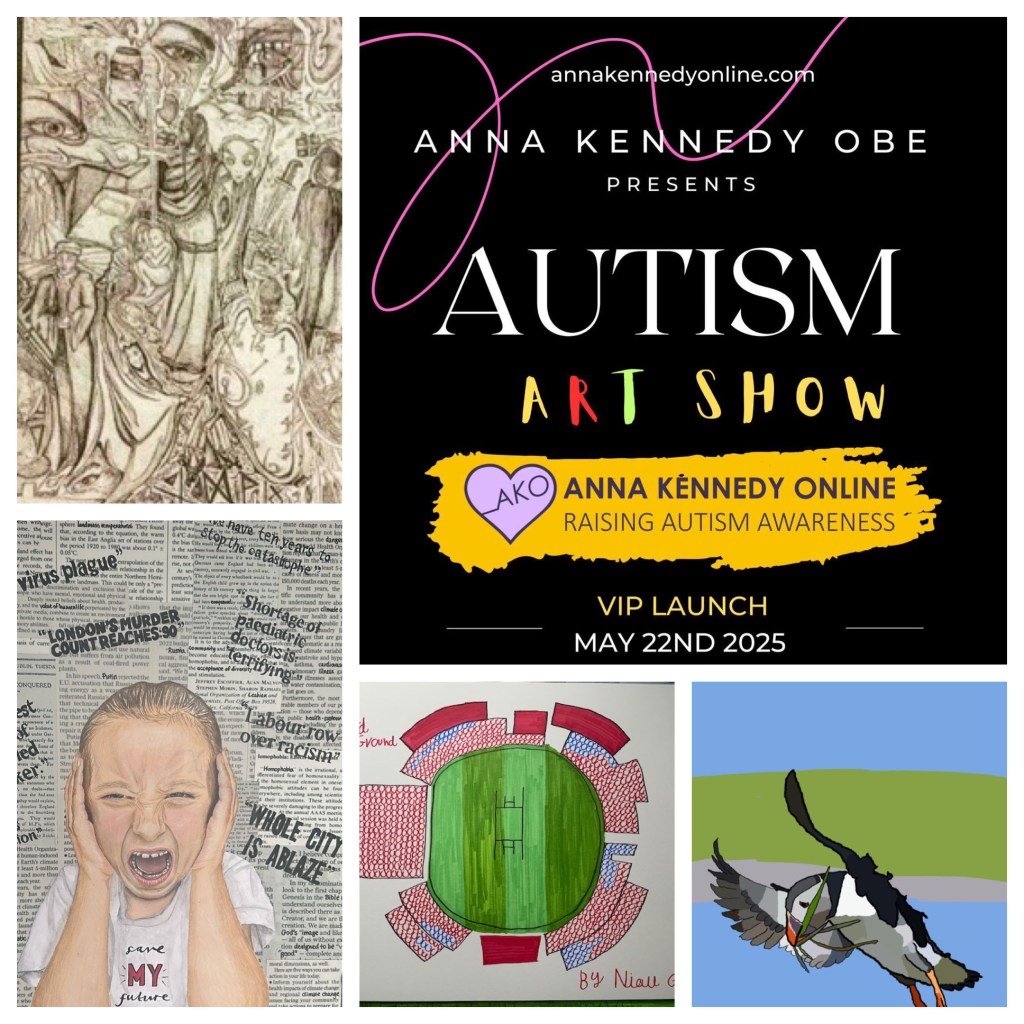
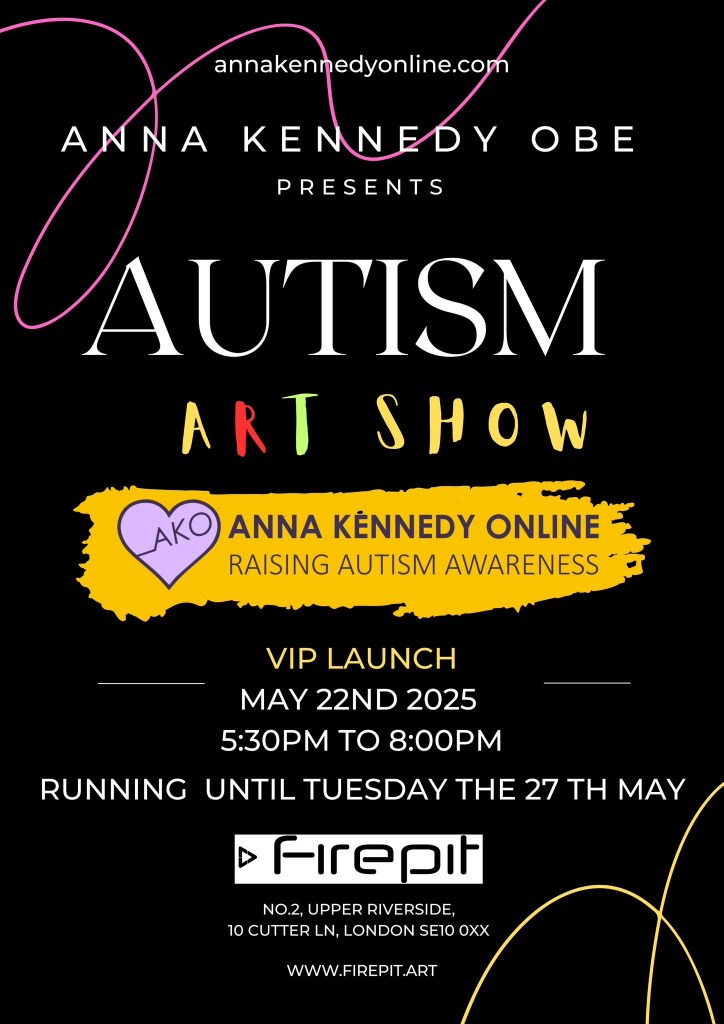
Anna Kennedy Online, in collaboration with the Firepit Art Gallery , is proud to present the first-ever “Autism & Art Show. “This exciting event showcases incredible artwork from autistic artists and their allies, with all profits supporting the charity Anna Kennedy Online. Art is more than just a passion—it serves as a therapeutic outlet, offering solace and joy to many individuals on the autism spectrum. With great enthusiasm, Anna Kennedy OBE, charity patron Steven Smith, and Firepit Art Gallery founder Markus Jake invite you to celebrate and support these talented artists. Ar) Event Location: Firepit Art Gallery CIC Firepit Gallery No.2, Upper Riverside, 10 Cutter Ln, Ground Floor Unit, Greenwich Peninsula London SE10 0XX Learn More & Support the Charity
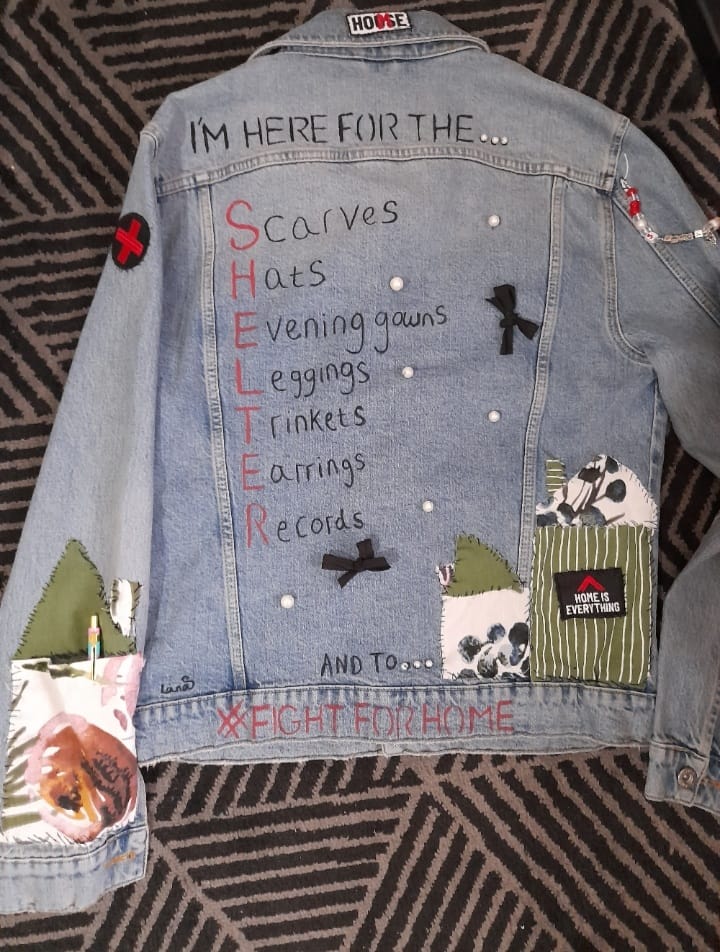
jacket not for sale Aladdin Sane £200.
The Autism & Art Show — 22nd May 2025
Join us for a celebration of creativity, resilience, and neurodiverse voices at The Autism & Art Show, showcasing a rich tapestry of work by autistic artists from across the UK. Each participant brings a unique story and style, making this event a powerful tribute to the talents of individuals on the spectrum.
Featured Artists
Angelo Kennedy
Angelo, 32, is autistic and lives with significant sensory processing disorder. On display is a vibrant painting of sunflowers he created at just 10 years old. Angelo enjoys cooking, bowling, and continues to work hard on his independent living skills. His brother, Patrick, is also on the spectrum and works at Pinewood Studios.
£500 pounds by Angelo Kennedy for offers contact spman@btinternet 07969016222
Lana Mitchell
Lana, who lives with autism, once feared unfamiliar environments. In 2024, she began volunteering at Shelter Crystal Palace, where her uniqueness was embraced and her creativity blossomed. She now designs themed window displays and, to celebrate her one-year anniversary, created a striking punk-style denim jacket.
sold
Collette Sherriffs
Collette, 47, from Kincardine, Scotland, has loved art since childhood. Despite working hard to earn a place at art school, her dreams were crushed when her mother told her she was “too stupid” to succeed. Heartbroken, she gave up art—until recently. One of the pieces on display is from her original portfolio, which her mother once threw away but was fortunately saved. Now a devoted mum of two, Collette champions her children’s creativity with pride and encouragement.
Offers over £250 inbox spman@btinternet.com
Niall Guite
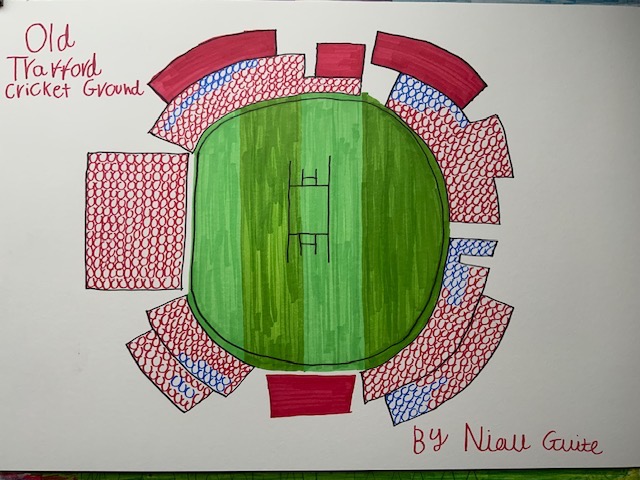
Niall, 30, is an artist with autism, an intellectual disability, dyspraxia, and dyslexia. He gained international acclaim after raising funds for Special Olympics GB by selling his iconic stadium drawings. Niall has exhibited at the Royal Academy Summer Exhibition, delivered a TED Talk, and received an Honorary Doctorate from Sheffield Hallam University for his work promoting inclusion through art.
A collector piece offers over £250 inbox spman@btinternet.com
Piluca Artist
Piluca: Artist. Muralist. Fashion Visionary. Street Art Queen. Born in Madrid and ignited by Brixton’s wild heart, Piluca is a published illustrator, muralist, fashion designer, and founder of I Am Here 2 Play, launching this May at Hypezeus, London. Her vibrant murals and street art light up London’s iconic venues, turning the city into an open-air gallery. A WinTrade Awards finalist, she moves effortlessly across fine art, fashion, and branding with fearless, raw style. Piluca’s creative impact extends deep into communities—leading workshops, festivals, and campaigns with purpose. From fashion to neuroscience illustration, her work defies boundaries—and London proudly wears her name.
Offers above £350
Chris Wild
Chris is an author, artist, actor, care home consultant, government advisor, youth advocate, and charity patron. A passionate voice for young people in care, Chris’s first book, Damaged, shares his personal story. His second, The State of It, challenges the systemic failures affecting vulnerable youth. Through art and writing, he continues to inspire change and awareness.
Chris Wild painting offers over £500
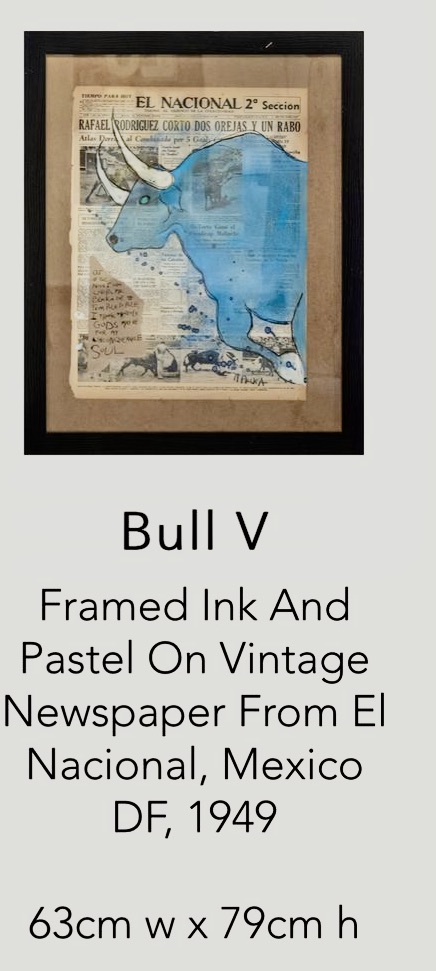
Artism by Jake
Jake, 20, finds joy in painting. As a young man on the autism spectrum, his artwork offers a distinct and captivating perspective. All profits from his prints are donated to charitable causes.
Offers over £150
Heidi Simm
At 17, Heidi is the creative mind behind Disco City, a fusion of Disney characters and her own original creations. With a strong, determined spirit, she uses her art to express herself, manage her mental health, and explore new techniques. Her inquisitive nature and unique imagination make her work stand out.
Fabulous fun £250 please inbox me at spman@btinternet.com
Dr. Ian Hale
Based in Bristol, Dr. Ian Hale is an author, poet, autism specialist, and certified Master of Photography. His book, Asperger’s, Autism and You: Is the Epidemic Real and Are Vaccines the Cause?, blends personal insight with clinical research. Ian, who is autistic himself, shares his journey through media, public speaking, and art. His photography — praised by brands like Chanel and Vogue — offers a profound glimpse into his neurodiverse worldview.
Offers over £200 please .
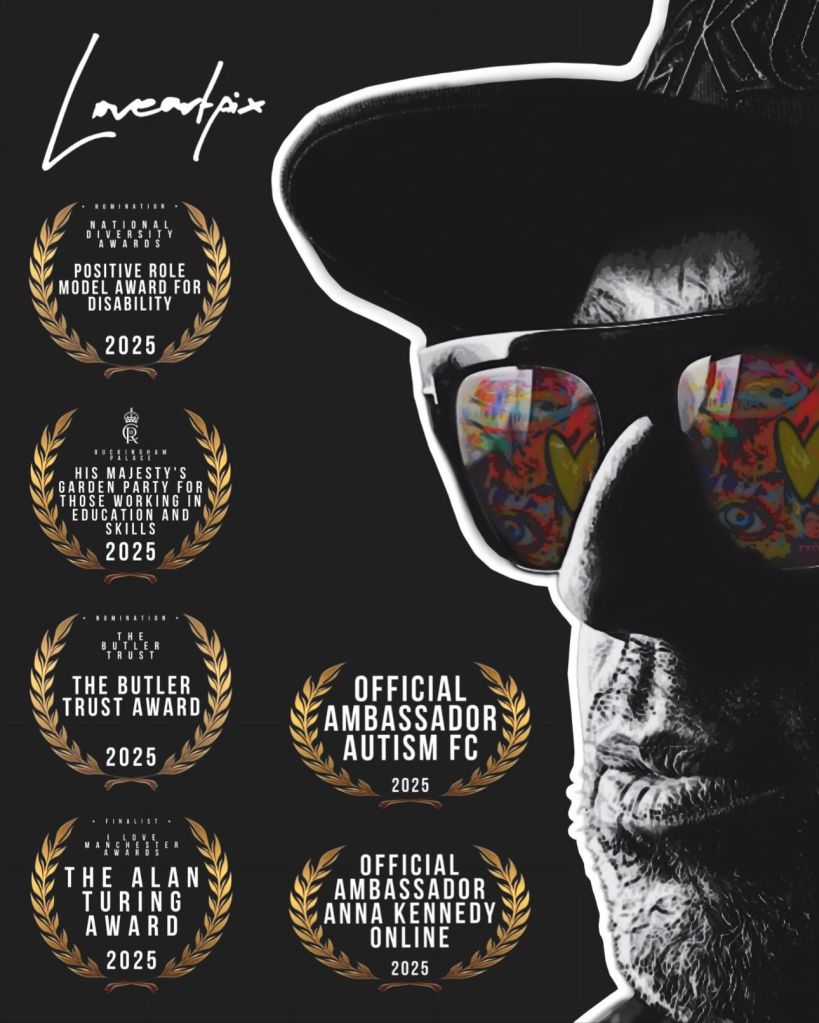
Loveartpix (Dez)
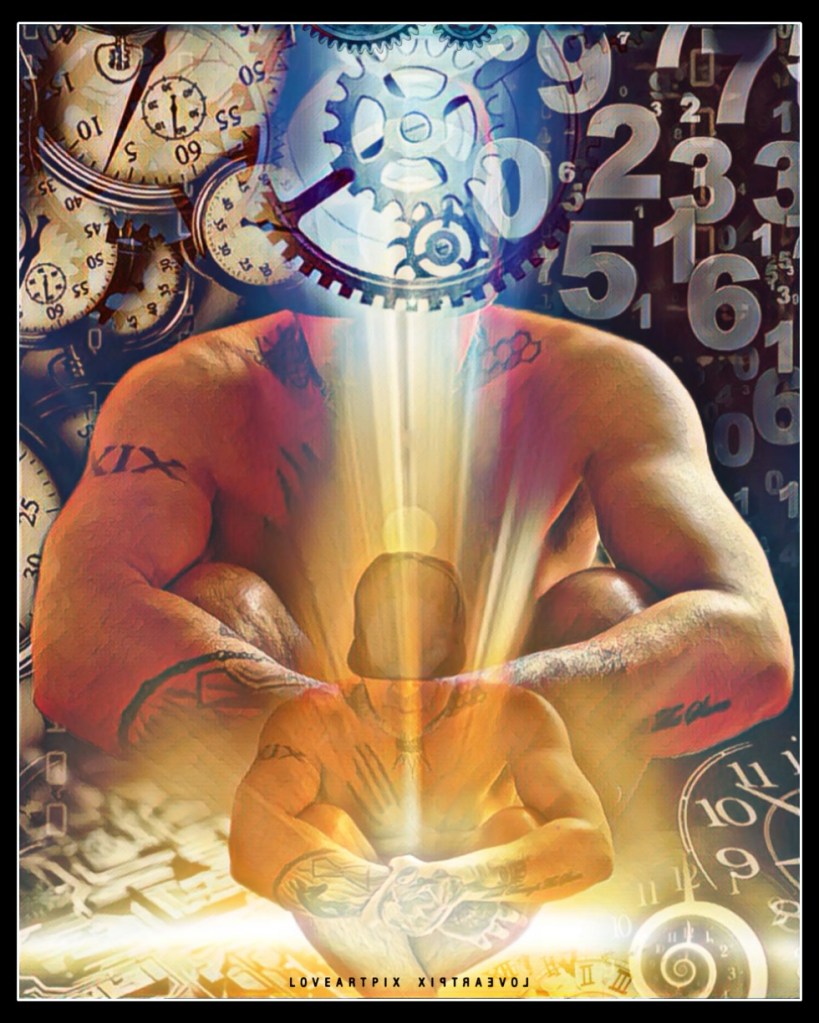
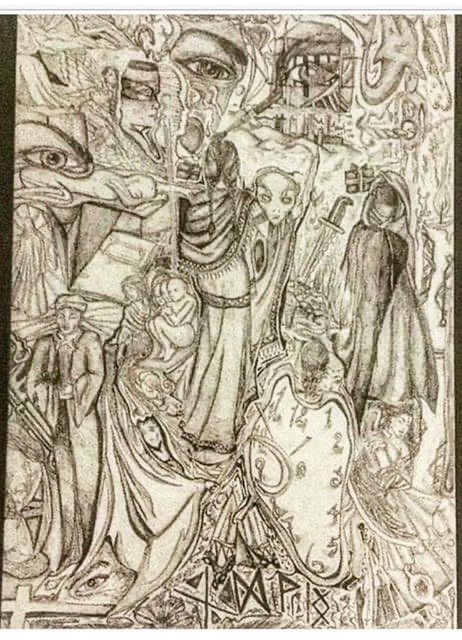
Loveartpix , a self-taught AudHD (Autism + ADHD) artist from Manchester, uses creativity as a vital outlet for mental health and self-expression. Diagnosed with Bipolar Disorder, Autism, and ADHD, he began his art journey in 2018 as therapy. His vibrant work often reflects the spirit of Manchester and the experiences of neurodivergence.
Loveartpix with the wonderful art he will be showing offers over £1000 please .
Annemarie Bickerton
With over 30 years in photography and art, Annemarie specializes in editorial portraiture. As digital photography evolved, she pivoted toward headshot work, applying her skills to editorial, corporate, and artistic projects. Annemarie is also a proud mum to Sam, who lives with autism, and continues to champion neurodiverse creativity in all its forms.
£500 by Annemarie Bickerton
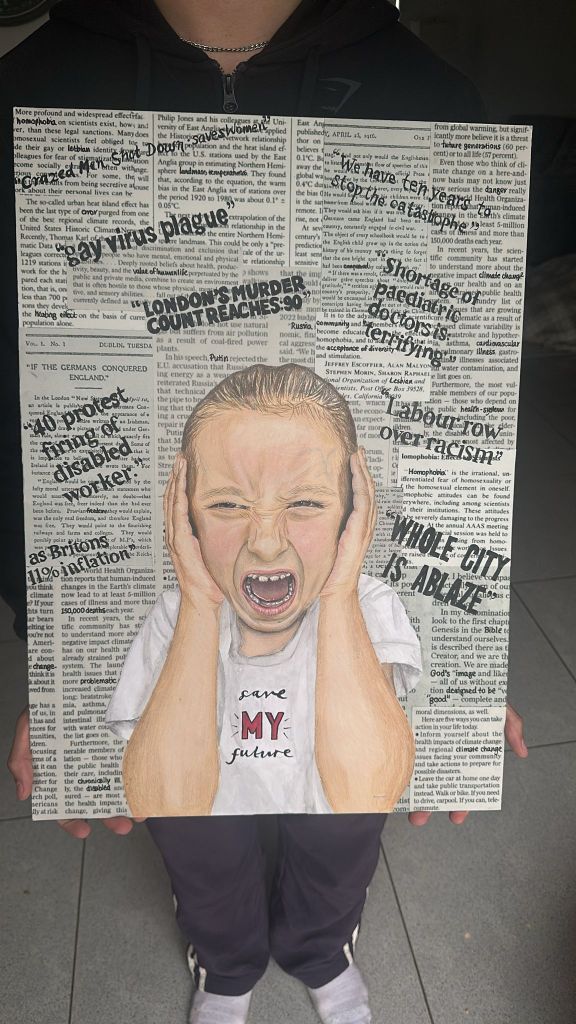
Sam Bickerton
Sam, diagnosed with ASD and dyslexia, demonstrates resilience in the face of social and emotional challenges. From early Lego builds to his love for origami, mask-making, and boxing, Sam’s creativity offers a safe space for self-expression and calm. His journey is one of strength and self-discovery through art.
an example of Sam work the will be. bigger one on the night offers from £150 message me spman@btinternet.com
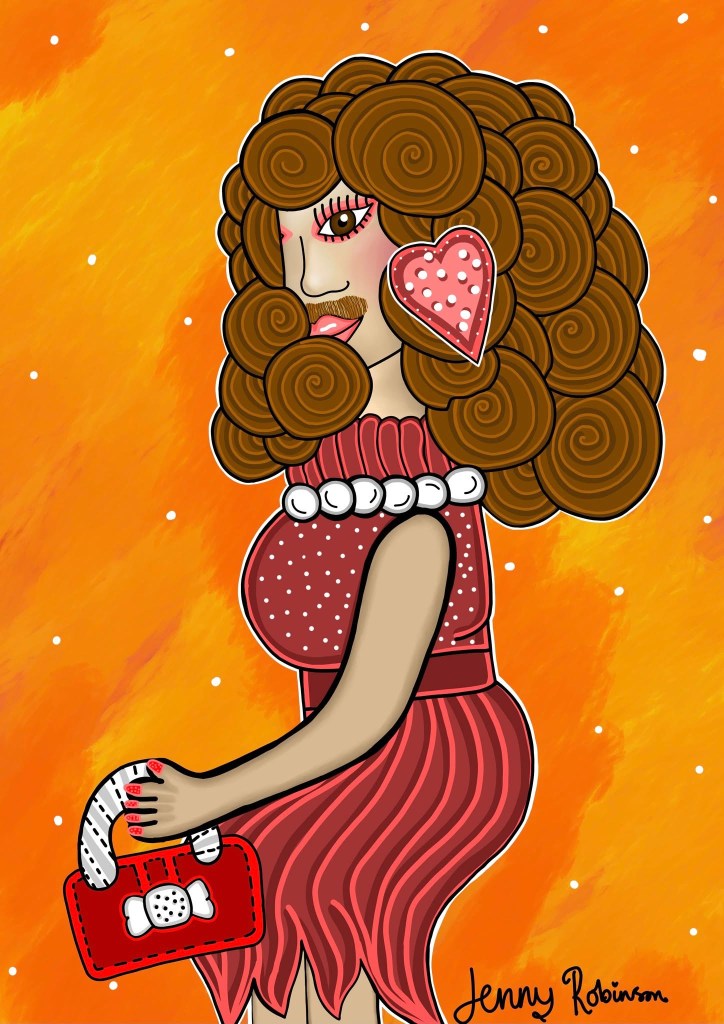
Jenny Robinson
Jenny is a self-taught digital artist and graphic designer with a love for Freddie Mercury. Her standout piece is a digital portrait of Freddie in a custom outfit inspired by the I Want to Break Free video. Although not included in her solo exhibition, Jenny has pledged to donate 100% of the sale proceeds to the Anna Kennedy charity. Diagnosed with autism a year ago, she now explores digital art as a core part of her creative identity.
Jenny Robinson £250 inbox spman@btinternet.com
Marcus Mason-Williams
Marcus is a multi-talented autistic artist and entrepreneur. As a founding member of The Lilac Review — a government-backed campaign spotlighting disabled-led businesses — Marcus uses his business, CoolArt2021, to share wildlife-inspired storytelling and merchandise. “Art and performing set me free,” he says. “Through my stories and performances, I connect with others and the world around me.”
Offers over £250 message Steven Smith 079069106222
AlastairBlasterArtz
Alastair McEwen, also known as BlasterArtz, is a full-time carer for both his disabled parent and autistic son. Through art, he finds a way to manage emotions, connect with loved ones, and reflect on mental health. His heartfelt piece Blanky, created with friend and writer Steven Smith, has moved many and embodies the power of art as a lifeline.
BLANKY offers over £200
Eddie Wells
Eddie grew up in East London, navigating life with undiagnosed ADHD and dyslexia. Creativity was his refuge. Following his father’s death in 2013, he realized that art wasn’t just an outlet — it was his salvation. His work reflects the inner world of someone living on the spectrum and overcoming silent battles through creative expression.
Offers over £2000. e-mail spman@btinternet.com
Shayla Curtis
At just 18, Shayla is already a passionate advocate for children with autism and complex needs. Diagnosed with autism herself, she struggled in most subjects at school — except for art. Encouraged by a supportive GCSE teacher, Shayla flourished creatively and now uses her skills to design activities that help young people express themselves, build confidence, and develop life skills.
SOLD
Tally Nothey
This piece is deeply personal. As the mother of an autistic child, Tally has faced days that felt overwhelmingly heavy—marked by worry, exhaustion, and the deep ache of feeling misunderstood. Yet, through every challenge, it has been the support of close friends that has carried her forward. Each woman represented in this work symbolizes someone who has stood beside her, held space for her fears, celebrated the smallest victories, and reminded her of her own strength when she struggled to find it.
This image reflects that journey. It acknowledges that while friendship may not solve everything, it makes the burdens easier to bear. Together, they have cried, laughed, and lifted one another—and because of them, she never walks alone.
work in progress £500 .
Darren Chapman – Actor & Artist
Darren Charman – Visual Artist & Storyteller
Darren Charman is a British visual artist and actor, originally from Hastings in Sussex. His creative journey began in the world of performance, training in the Meisner technique at The Actors Temple in London, where he developed a deep sensitivity to emotion, narrative, and human expression—qualities that now echo powerfully through his artwork.
Drawing on his background in character-driven storytelling, Darren’s art is bold, imaginative, and often laced with wit. Each piece invites viewers into a world that balances humour with poignancy, reflecting the layered perspectives of someone equally at home on a stage or behind a canvas.
Darren has received recognition for his work in comedy film, winning two DAFTA awards for The Fetishman (The Irishman Parody) and Living Dead (Living Parody). These accolades underscore his instinctive grasp of character, timing, and satire—all of which now inform his artistic practice.
Stunning bracelets by Darren £100 or above .
Gemma Lees is a Romany Gypsy, disabled and autistic fine art installationist, performance poet, comedian, facilitator and journalist from Bury. Her practise focuses on protest, advocacy, inclusion and telling the stories that no one else is.
Last year she worked with: Arts and Homelessness International, Traveller’s Times, Headteacher Update, SEN Magazine, ACERT, Queer Britain, Turnpike, Cartwheel Arts, BBC Radio Manchester, Triple C, Warwickshire Libraries, CultureDale, WOW Fest, Factory International, CIJ and CRIPtic.
A qualified post-compulsory teacher, she is a passionate advocate for GTRSB and neurodiverse inclusion in schools and wider education.
Sadie King is a 16-year-old student currently studying for her GCSEs. She has a strong passion for character design and storytelling. Sadie hopes to build a career in creating her own animated series. Her work often explores original concepts and imaginative worlds. She is eager to share more of her art and ideas with others. Sadie welcomes feedback and is open to showing additional work
Offers over £200
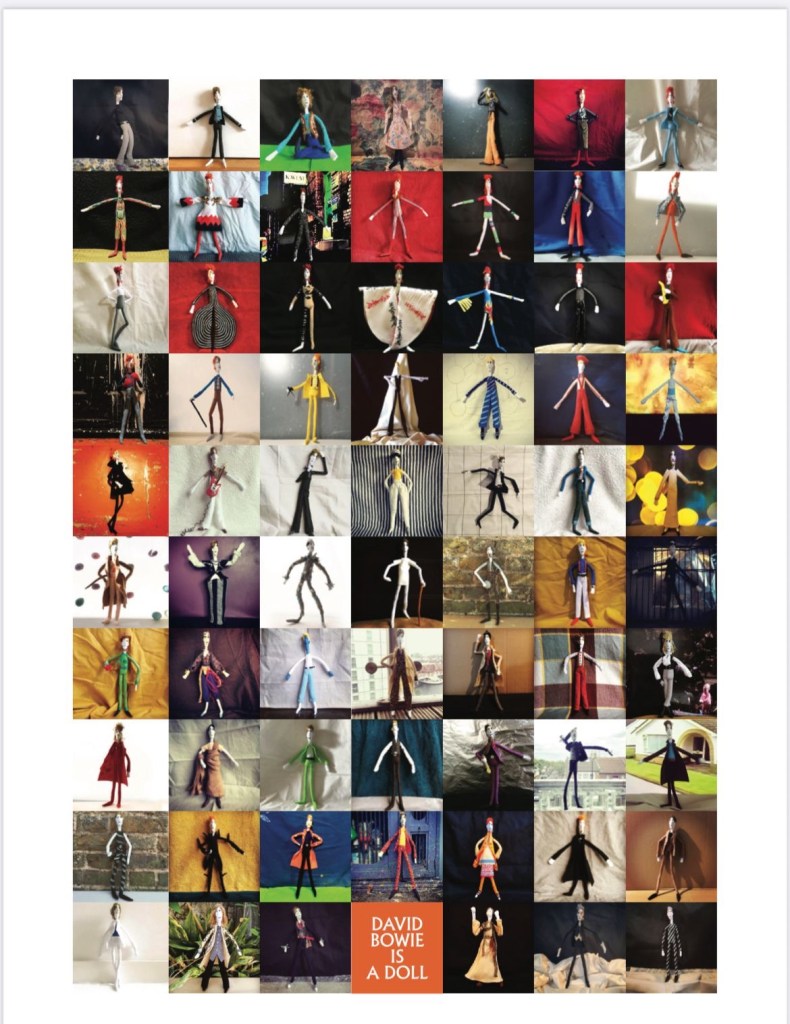
John Lee Bird is a multi-disciplinary artist known for his global exhibitions of paintings, collages, and sculptural work. His DOLLS project features over 2,000 hand-sewn textile sculptures celebrating idols, friends, and queer culture. Inspired by film, drag, cult TV, and music, each 13-inch doll is crafted from felt, beads, buttons, and embellishments. The project began during lockdown as a therapeutic return to textiles, starting with 69 David Bowie dolls. It has since grown into a rich portrait series spanning pop culture icons and personal heroes. John’s work is driven by obsession, emotion, and a deep love of music and storytelling. He also creates sound and film, collaborating with artists such as Simon Fisher Turner and Xiu Xiu. John co-runs the queer club night KNICKERS with musician Jemma Freeman.
Posters £25
PATRICK STEELE-BODGER Patrick calls himself a “Media Wikipedia” and “the Sheldon of Media” – a nod to his incredible recall of screen and sound. From a young age, he’s expressed himself through TV, film, books and comics. He recreates the tiniest details, from split-second sound effects to hidden cameos. Patrick loves drawing characters, writing fan fiction, and exploring music from Louis Armstrong to Daft Punk. As the in-house artist for Meet The Pods, now becoming a toy range, his creativity shines. He also designs bespoke greeting cards – and if you ask his favourite word? It’s “EXCELSIOR!”
£100 each
The Autism & Art Show isn’t just an exhibition — it’s a statement. It’s about the strength of neurodivergent minds, the healing power of creativity, and the joy of self-expression. Come and be inspired by these extraordinary artists.
The story of BLANKY .
SOLD OUT.
Blanky
Art Alastair Blaster words Steven Smith
“We are all born as blank canvases; hate, racism, and a lack of understanding are learned.” How you choose to see the world and create the tapestry of your life is up to you. Blanky is here to “Make Earth Safe Again.”
In another universe, under a different sun, there was a planet much like Earth called Alacritas. It was a world of lush tropical forests, crystal-clear lakes, and unpolluted seas. The people of Alacritas lived in harmony, where kindness and tolerance were deeply ingrained in their way of life. Their homes were built to exist in perfect balance with nature, and even in their cities, the air remained clean and pure.
Advertisement
Privacy Settings
The Alacritans were far more advanced than humans. Meditation and self-healing were essential practices, and their very beings were composed of energy molecules, allowing many to heal themselves from illness. Some possessed extraordinary abilities, such as telepathy and body transformations, harnessing the sun’s rays to bring goodness to their planet and others. While there were occasional exceptions, as the saying goes, “one bad apple”—but that is another story.
You could say it was a utopia—until they arrived.
The people of Olethros came claiming peace, seeking to live in harmony with the Alacritans. But the sun did not welcome them. Almost immediately, it burned their skin a bright orange, making them stand out. Rumours spread that their own planet had been devastated by pollution, war, and slavery.
It soon became clear that the orange ones had not come as friends but as conquerors. They sought to strip Alacritas of its rich minerals, enslave its people, and channel their energy into restoring their own dying world.
The peaceful Alacritans were unprepared for battle. Their civilization, built on unity and respect, was nearly wiped out. Only a few survived—those who could transform or scatter their molecules to avoid detection.
The Olethrans ravaged the planet like ants devouring sugar. Within a year, there was nothing left. In desperation, one Alacritan, Blanky, used his powers to escape. Transforming into pure energy, he fled into the cosmos in search of help. But as he left, Alacritas could take no more. The planet exploded, sending Blanky hurtling off course.
100 Years Later
Planet Earth
London, Waterloo
Patrick was fourteen, tall for his age, and loved playing basketball. From the window of his small ground floor apartment, he watched the other kids on the court, longing to join them. He knew he had the talent to be a star player. But his mother, protective as ever, rarely let him out alone. She feared he would be bullied or misunderstood because of his autism.
One Saturday afternoon, his mother had a friend over and asked them to watch Patrick while she ran errands in Stratford. With their eyes glued to The Real Housewives, they barely noticed Patrick, assuming he was immersed in his video game as usual.
But today was different. Quietly, Patrick put down the controller and crept toward the door. His apartment, on the ground floor, was only 200 yards from the basketball court. As he stepped outside, excitement surged through him. The sun’s rays warmed his face as he gently closed the door behind him and ran toward the court.
But then—he tripped.
As he hit the ground, something surrounded him, unlike anything he had ever seen. A strange, shifting cloud engulfed his body, sending tingles through his skin. As the mist dispersed, a small figure emerged.
Patrick couldn’t believe his eyes.
Before him stood a tiny being—completely blank, as if made of smooth, featureless clay. It pointed a stubby finger at Patrick’s baseball cap. Amused, Patrick handed it over. The moment the creature touched the fabric, the hat transformed into the same clay-like substance as its body.
Advertisement
Privacy Settings
Then, to Patrick’s shock, the small figure spoke.
“I am Blanky. Your planet needs me, or it may suffer the same fate as mine.”
Patrick stared, wide-eyed.
“I need sunlight to regain my strength,” Blanky continued. “With your help, I can transform and protect those who are hated and discriminated against. I have chosen you, Patrick, because you are special. For now, my body is just a canvas. Put me in your pocket, and let’s go play ball.”
Patrick didn’t hesitate. He gently scooped up Blanky and tucked him into the pocket of his jacket.
“I’ll tell you more soon,” Blanky assured him.
Patrick knew he had just made a special friend—one he would have to keep secret for now.
What neither of them realised was that Blanky had maybe arrived years too late.
Apologies for the delay in sharing my column—my head has been spinning! It’s been such a busy time, with so many exciting things on the horizon that I can’t wait to tell you about.
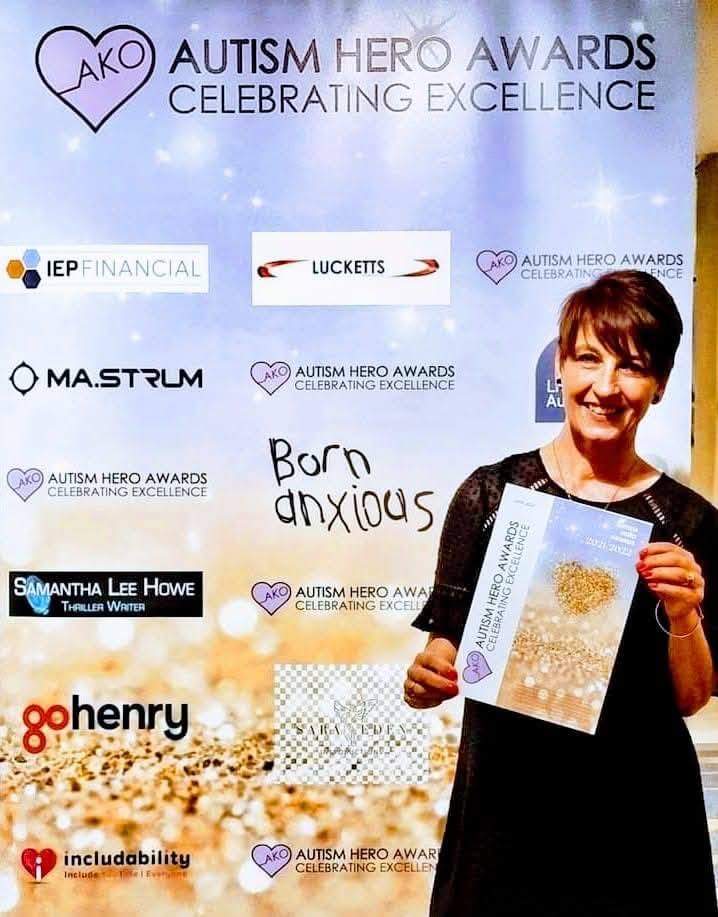
First and foremost, a heartfelt thank you to everyone involved in last month’s Autism Hero Awards.
We had an unforgettable evening at the 6th Annual AnnaKennedyOnline Charity Autism Hero Awards. ✨ A huge congratulations to all our winners and finalists! ✨
Thank you to everyone who attended and supported the event—our incredible judges, VIP guests, fabulous performersEve Devenney and Angus Baskerville, and all our amazing charity supporters.
A HUGE thank you and much love to all of my AnnaKennedyOnline volunteers. Your time, dedication, and support made this night a tremendous success. I couldn’t do what I do without you!
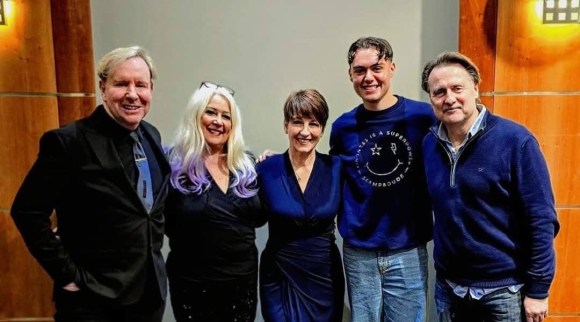
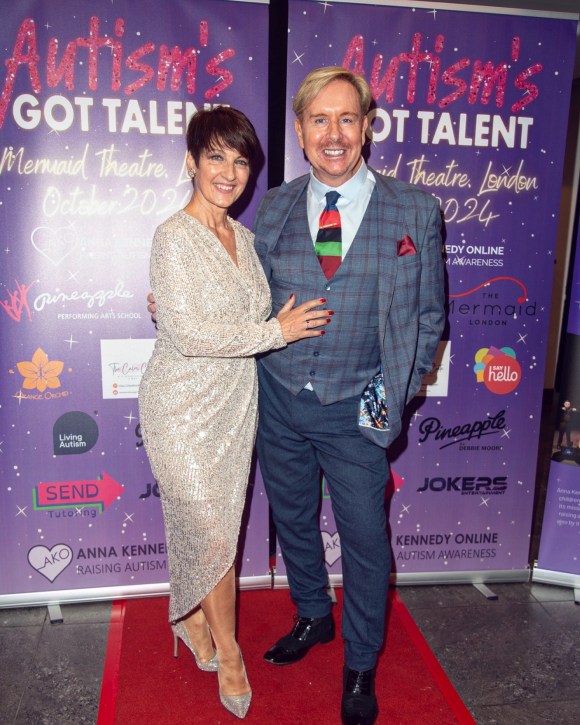
Vicki Michelle and Steven Smith with Dr Anna Kennedy OBE
Special Thanks:
💫 Aston Avery and Phil Barnett , our brilliant MCs for the evening – the AKO dynamic duo!
💫 Lisa Robins, my PA and friend, who has stood by my side and worked tirelessly for nearly 15 years.
💫 Tally Nothey, for creating our amazing programmes and marketing materials.
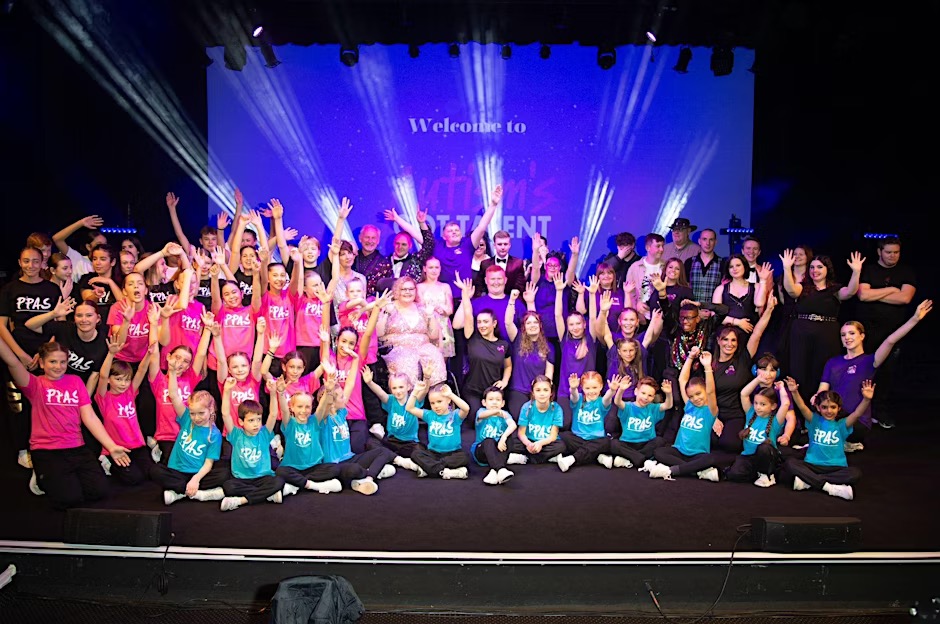
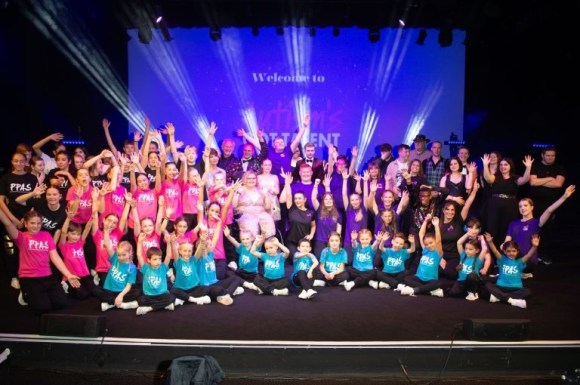
💫 Maggie Paterson and her team of dancers from PPAS, who have supported our events for the past 14 years.
💫 Steven Smith, one of our charity Patrons and a dear friend, for your unwavering support over the last 9 years. Your presence means the world to us.
📣 Check out the full list of our 2024/2025 Winners and Finalists: 👉 Click here to view
Lisa and I recently travelled up north to Whitley Bay to prepare for the next Autism’s Got Talent showcase. If you’re interested in participating in the London event, entries close on May 31st! You can find all the details here: https://annakennedyonline.com/autisms-got-talent/.
We’re also thrilled to announce our first-ever Autism and Art Show, taking place at the FirePit Gallery in London. If you’d like to have your artwork featured, please email: spman@btinternet.com. One of the incredible artists whose work will be featured is
I live with autism, anxiety, and depression, which severely affect my ability to work in a mainstream job. I would love to work and have tried setting up various home-based businesses, but unfortunately, none have been successful.
Being in my 40s, my main source of income is Universal Credit, but they are now trying to take it away and force me into employment. I have explained that my day-to-day life is unpredictable, and committing to a job would be impossible, but they are not listening and say If I can go out and about I can go to work ,
What can I do?
Elizabeth, Brighton
Hello Elizabeth,
Thank you for your message. We have received many messages since the announcement of welfare cuts by the government recently.
Universal Credit, a UK benefit system, can pose challenges for autistic individuals, potentially leading to pressure to work despite the difficulties you have mentioned. It would appear that some autistic people may face having benefits reduced or stopped if they don’t meet certain work related requirements. In my opinion the Universal Credit system may lack the flexibility needed to accommodate the needs of autistic individuals like yourself.
A good organisation to contact to ask for advice is Disability Rights UK or DAWN of which I am an Ambassador. www.dawnsupport.co.uk
Sending you best wishes
Anna
Dear Anna,
My son is autistic, very active, and an absolute joy. He’s now 24, and my husband and I feel it’s time for him to gain independence by moving into his own studio or flat. However, he is completely against the idea and has a meltdown every time we bring it up.
Is there an advice board or resource that can help young autistic adults transition to independent living? What should we do?
Joe, Bradford
Hello Joe,
Thank you for your message and yes this can be a tough for all, the transition of moving home into independent living.
Planning and Preparation is key and to engage your son in the planning process. Start my talking and allowing them to express their preferences and needs. This will be a gradual process , a sudden shift can cause great anxiety. Research different housing options, including independent living, shared housing maybe an option or specialist housing to fit his needs.You will need patience and understanding , this is challenging all round.
My son Patrick has been living in his flat for almost 4 years now. Small steps but we got there in the end.
Good Luck!
Dear Anna,
I am a huge fan and would love to see you have your own show!
I’m 16 and living with a variety of challenges. One thing that really depresses me is the thought that I may never get to meet someone special. It feels like the prospect of romance is zero for me.
Are there ways for autistic people to meet and build relationships?
A good programme to watch on Netflix where my Overseas Ambassador Dani Bowman is taking part in is ‘Love on the Spectrum. ‘
There is also useful information on the Ambitious about Autism website. They offer a UK wide platform for autistic young people aged between 13 and 25 providing a safe online space to connect and understand your autistic identity. It also features ‘Relationships and Intimacy My way’ plus lots of resources.
Happy New Year! Let’s hope 2025 is a great year for us all. I’m busy with my team, as always. Among the many things we have lined up is The Autism Hero Awards, being held at the Holiday Inn, Regent’s Park, London on the 15th of March. You can find information on how to get tickets and sponsorship details at the bottom of this column.
As always, we also have the amazing Autism’s Got Talent later this year—audition tapes are welcome now!
In other news, our autism ambassador, Kieron Lee, is launching a neurodiverse musical education platform as his final major project for his BA (Hons) degree in Popular Music.
We’re also thrilled to announce that our patron, Steven Smith, along with the incredible Annemarie Bickerton, will be hosting the first-ever Autism Art Show, featuring artists on the autism spectrum and supporters of the charity. Money raised will go directly to the charity. This event will be held at the sensational gallery, The Fire Pit (https://www.firepit.art), from May 22 to May 25, 2025.
Dr Anna Kennedy OBE with one of her patrons Steven Smith ,
Please keep your questions coming into 2Shades magazine. I’ve been thrilled to join such a diverse and exciting publication!
Dear Anna, Trust you’re well. My family loves your column. We were wondering: What do you think are the most common myths about people living with autism?
Dawn, Essex.
Thank you, Dawn, for your kind comments. Sadly, there are still a lot of autism myths out there.
Here is five common ones
5 Myths and Facts About Autism
Myth 1: Autism is caused by vaccines.
Fact: There is no scientific evidence linking vaccines to autism. Numerous studies have thoroughly debunked this myth. Autism is believed to be influenced by a combination of genetic and environmental factors, but vaccines are not one of them.
Myth 2: People with autism lack empathy.
Fact: Many individuals with autism experience empathy deeply, but they may express it differently. Some may have difficulty recognizing social cues, but this does not mean they lack feelings or care for others.
Myth 3: Autism only affects children.
Fact: Autism is a lifelong condition. While symptoms might present differently as people age, autistic adults continue to experience challenges and strengths associated with autism throughout their lives.
Myth 4: Everyone with autism has the same abilities and challenges.
Fact: Autism is a spectrum, meaning it affects individuals differently. Some may have significant support needs, while others may live independently and excel in various fields. No two autistic people are alike.
Myth 5: Autism can be cured.
Fact: Autism is not a disease and does not need to be “cured.” The focus is on acceptance, support, and enabling autistic individuals to thrive by embracing their unique perspectives and abilities.
Would you like to dive deeper into any of these points?
Dear Anna, My daughter is being labelled disruptive at school. She’s been diagnosed with autism and severe learning difficulties. Despite discussing this with the headteacher, she’s suggested that Mary, my daughter, not return this term and instead find a school more suited to her needs. Anna, I feel lost—what can I do, or who can I turn to for help?
Diana, Essex
Dear Diana, I feel your frustration.
Please do contact our charity website using our contact form at http://www.annakennedyonline.com. We can discuss the possible way forward. In the meantime, do some research on schools that may meet your daughter’s needs within an hour’s drive of where you live.
You will then be in a more informed position on what is available in your area. You could visit a few schools to get a feel for the services and resources they offer.
Dear Anna, How does someone become part of Autism’s Got Talent? My son is super talented at playing guitar. He’s a little shy and unsure about auditioning. He’s also worried about encountering a harsh judge.
David, Edinburgh
Hello David, Autism’s Got Talent is now in its 14th year and one of the highlights of our charity year.
This is a showcase of talented individuals performing at The Mermaid Theatre, London. Autism’s Got Talent is not a competition.
Please do watch our highlight videos on our charity YouTube channel.
You could also come along to the show in October to experience the magic. Share the experience with the audience made up of parents, friends of the performers, and members of the public who are regular supporters. Feel the magic and be inspired. Then send a tape in of your son performing . love Anna
Autism’s Got Talent.
Dear Anna, My son is 19 and wants to start dating. He’s a lovely young man but has a stammer and lives with autism. I’m worried about how he’ll handle rejection. Is there a webpage or group where he can meet like-minded people?
Brenda, Norwich
Hello Brenda, There are many dating sites now for autistic individuals.
A popular Netflix docuseries, Love on the Spectrum, showcases autistic individuals navigating the world of dating. One of our charity’s overseas ambassadors is featured in series one and two.
In this romantic docuseries, people on the autism spectrum look for love and navigate the world of dating and relationships. https://www.netflix.com/gb/title/81338328
Good luck!
Dear Anna, I love your dancing! I’m 17 and want to learn to dance seriously. Living with autism has always made it feel challenging, but I’d like to get more involved. How did you learn?
Love, Melanie, Brighton
Hello Melanie, Dance is a great way to stay fit and boost your mood and well-being. I started tap dancing at age 6 and fell in love with dance then. It definitely keeps you feeling young.
Join a local dance class and discover which dance style suits you best. There are also many dance classes online if this makes you feel more comfortable at first, then gradually progress to a dance studio.
Good luck and enjoy!
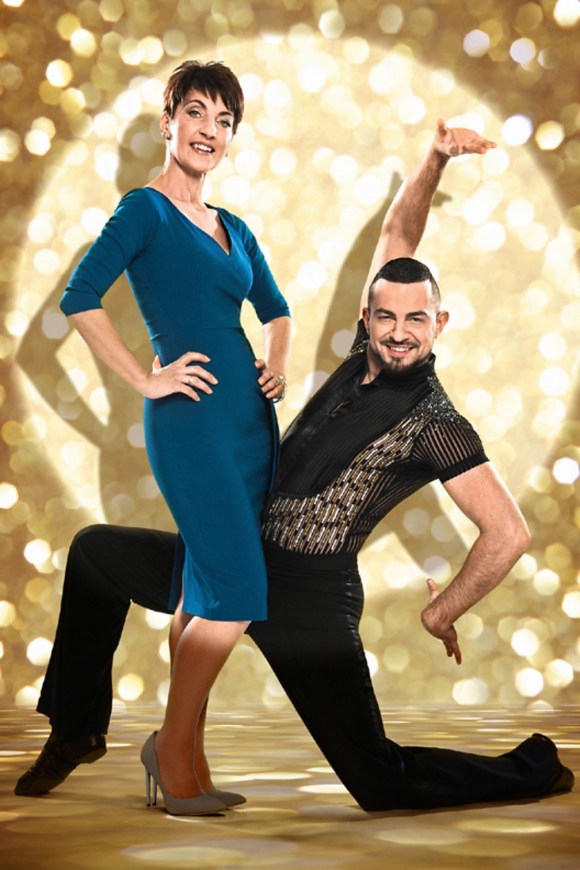
Anna Kennedy with her former Dance Partner Robin Windsor
Sam Grierson said, “After my best friend took her own life, I stopped writing. I couldn’t write anymore. I met Michelle and she told me to give myself a nudge. And I went on holiday a few weeks later, and I sat on a beach in Croatia. And I hear her in my head, give yourself a nudge. And I thought to myself, you know, I’m autistic.
We’re not supposed to have big emotions. But I was having massive emotions for Jenny taking her own life. And I missed her. She’d been my best friend since I was four. And I completely missed her. And I’m thinking, I am having colossal emotions here. How is it possible that autistic people don’t feel?”
I’ve had the honour of watching Sam’s short film The Programme which is set to release in November. Her writing and direction of this enterprise made me feel a thousand emotions at once.
It’s about a non-binary and autistic character called ‘Drum’ played by Granite Harbour actress, Michelle Jeram who is interviewed by an AI robot. The purpose of this film is for the AI robot to gather information on a neurodivergent individual’s feelings and emotions to navigate how to treat them in the future.
The conversation between the AI robot (played by Sherise Blackman) and Drum was a painful watch and in many ways, made me feel seen and a huge reminder of the empathy we lack as human beings. The urgency to separate what’s normal and abnormal in people through labels, assumptions and ignorance is the root of all the divide.
People often forget that the spectrum of neurodiversity is far too varied to be generalised. There’s a reason why people say “they’re on a spectrum” after being diagnosed or familiarising themselves with certain traits. With this context in mind, Sam’s work deeply reflects how feelings and emotions also lie on an infinite spectrum that cannot be classified.
Sam explains, “Autistic people are shut down and shut up so often. I just wanted them to be able to express themselves and just talk. So I wrote the film to talk about grief and loneliness because they’re big feelings we don’t talk about. And again, as a neurodivergent person, what does that look like for us? And Drum’s not trying to be every neurodivergent person, it’s just a story by a person. But by letting them articulate their feelings, big, deep feelings, I just wanted to let people sit without uncomfortableness”
The essence of discomfort Sam speaks of while watching any of her creative explorations is an attempt to free the mind and elevate us to all forms of acceptance.
How often, as human beings, do we come across a story, feel a rush of emotions based on our own life experiences and settle on an opinion? Or, in some cases, feel so unsettled that the world becomes a projection of our emotions?
However, that’s exactly what Sam tries to portray through her work, we’re all human and equally messed up, neurodivergent or not. We’re all invited to feel the emotions that we do in our own ways. The keyword being feel and to be courageous to sit with ourselves, allow the voices to speak to us and initiate transformation through self-acceptance.
Sam mentioned, “Liz and I run workshops, we start all the workshops on the left hand side of the room, we put flip charts up and we say, right, what does autism look like? What does grief look like? And then can you express your emotions, for example, right? So we’ll put these on flip charts. And then Liz will interview me a little bit about why I wrote the film and then we’ll watch the film. Then we purposefully take a break. We let people go to the loo or whatever and just sit with it for a minute. We bring them back in the room and we say, right, talk about the film for a bit. And before they go, we do the flip charts again but on the other side of the room. We say, right, what does autism look like? What does grief look like? And can you express your emotions?
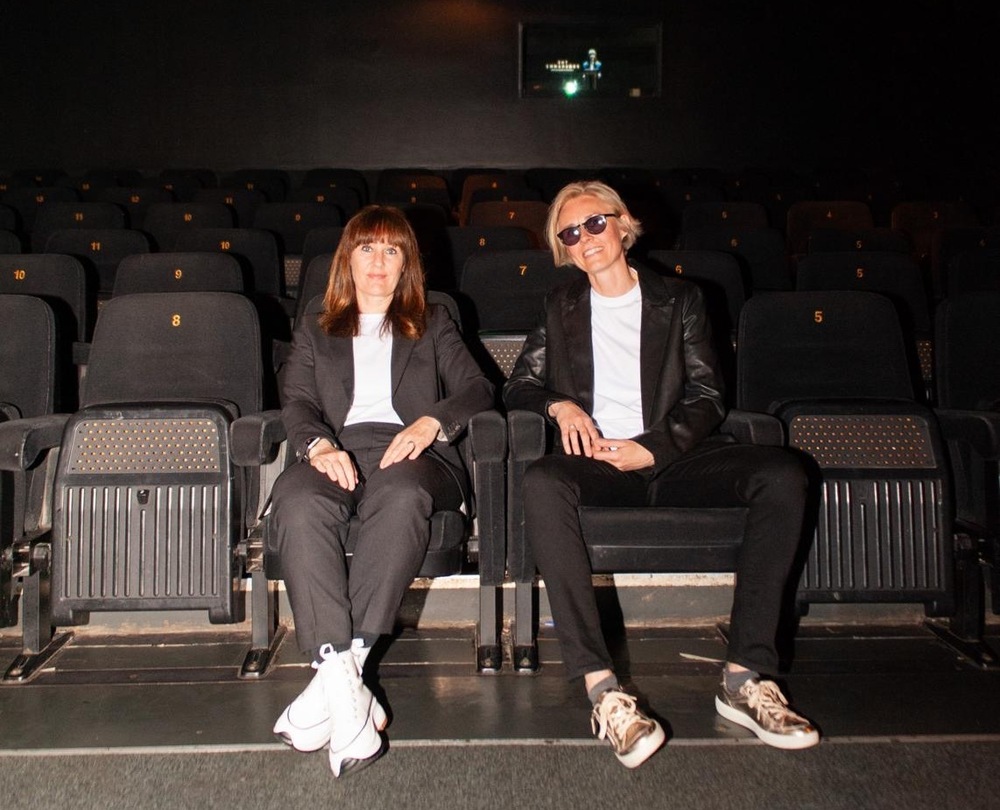
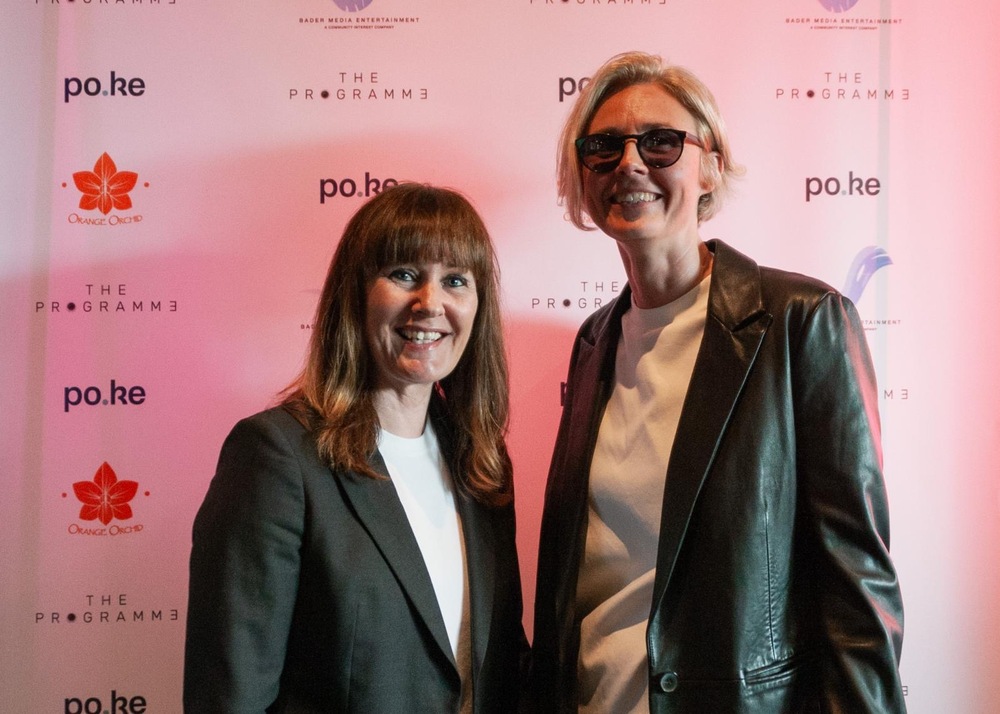
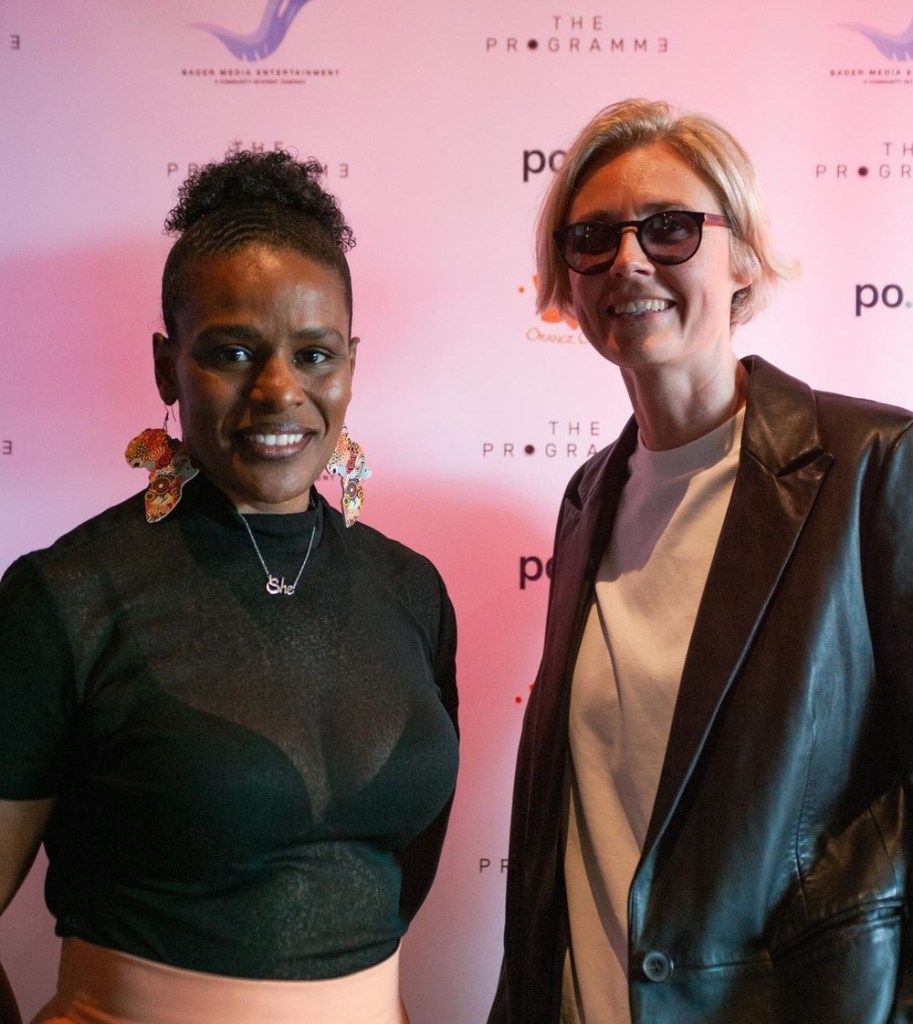
Sponsor and Film Producer, Liz Crutchley with Sam Grierson now working on a new feature film, ‘Station’
Every single person who’s ever been to our workshops has transformed in that two hour period from what they wrote and thought when they came in, to what they wrote and thought when they left, because we have challenged people, we have moved people’s perception. And the reason that we were able to do that is because we’re telling the story. And we’re able to draw people into Drum’s world and see it through Drums’ eyes in a really personal way. And so for me, what do I want to achieve? It’s that. It’s taking people’s perception beforehand and coming out the other side and transforming it. I think most people who’ve seen the film said they needed to watch it again.”
I had to watch it two or three times myself, not to make sense of the character, but mainly to make sense of my own emotions. I went through a spectrum of thoughts watching The Programme because at times I felt the writing was peeling into my heart like a stranger breaking into my house but I allowed it to happen?
At times I felt a wave of sympathy for Drum’s character for being dehumanised by the AI robot when they not only answered the questions, but also bravely articulated every ounce of their misery. Only to be shot down for digressing or being “vague”.
Sam has evolved to a state of living where she challenges herself to do things and think differently but also does everything her creative soul tells her to do. She has a wonderful community of people who share her vision to allow people to go beyond themselves and into themselves.
Executive Producer, Claire Brown with Sam Grierson
Soundtrack writer and artist, Megan Black with Sam Grierson
She continues to represent the neurodivergent community through her storytelling but also wishes to create a space for everyone to feel safe to express themselves. She works selflessly to include all voices to have a platform through her projects to spread an important message.
Sam said, “I’d like you to think differently, the other side of it. And I really want to hear from people. We’re going to put it out in November, free, because all my content is free. I really want to talk about neurodiversity. So I don’t charge for anything. It’s all self-funded. I just do it because I want to do it. I want to tell these stories. I’m going to put it out.
I really, really want people to get in touch with me and tell me what it did. What did it do? How did it make you feel? If you don’t like it, fine. Tell me why you didn’t like it. I don’t need you to like it. I don’t need you to love my film. But did it make you have some kind of emotional reaction? Yeah, that’s what I want to do. That’s what I want to do with all my audio plays, all my stories. I want to provoke an emotional reaction in people.”
And just like her audacious podcast, “Daring to be Different” Sam holds no grudge with criticism and opinions. When someone like herself enters a space of inspiration through service to the world and a community, it doesn’t matter what people think, it only matters what they feel and what they desire to share.
She is in the works of another project set in Glasgow called ‘Station’ about a man in a train station having conversations with fellow travellers to explore a multicultural perspective to life.
Director of Photography, James Peakman with Samantha Grierson
What I will say about Sam’s work before you experience it for yourself is that she always ends it with a twist. A stomach-curling, pillow-grabbing and mind-bending twist that leaves you hungry for more.
Her purpose towards people is to provide an outlet for limitless perception that without intention, without bias or any kind of expectation or outcome, re-programmes us to lead with our hearts.
Watch the trailer of ‘The Programme’ by Sam Grierson
Michelle said, “You know as a police officer, you always have this sort of authoritative nature about you. Every job you go to, you have to be a different person. Delivering a death message, or making an arrest, my voice will have to change, it’s a different persona.
A lot of it is listening and communication. The listening part is also in acting because you’re reacting to what is being said to you. It’s kind of transferable skills that way”
After facing a tragic incident whilst making an arrest resulting in 5 knee surgeries, Michelle was forced to end her career as a copper.
She continued as a consultant with the police after her recovery but she had an inkling that she had more to life than this.
Michelle decided to relive her childhood dream of becoming an actress. Urging her to train herself through acting classes online during the pandemic.
After a year and a half, she secured the role of DS Simone ‘Monty’ Montrose on BBC’s Granite Harbour as an investigator in the series.
While this was a breakthrough moment for her acting career, she enlightened us on the conditions faced in the acting industry.
Michelle said, “As an actor, we audition for way more than we ever get. It’s just ridiculous the amount of no’s and or the amount of you don’t hear anythings. You can audition for 20 roles and just get one and I think coming into the industry later in life, I can handle that.
If I was 18 or in my 20s, I’d probably find the constant rejection really difficult. It’s very competitive, not everyone can afford a ticket to London for an audition, put a day aside just for that. I do this full time now but there are so many people who have other jobs and have to take time off for this.”
I could feel the amount of empathy she holds for people. Having been a police officer and now an actress, she wishes to do her job with conviction and not for any kind of recognition.
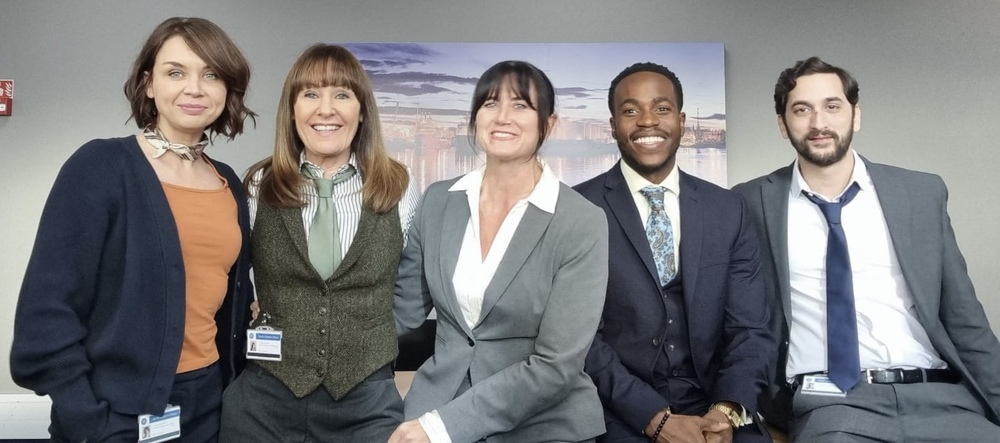
Michelle Jeram the set of Granite Harbour
I imagine being a police officer is far from easy and the unpredictability requires a lot of courage to deal with every day.
I sensed a grimness as she said the words, “There are some things you should never see.”
It transported me briefly to the times she might’ve had to go back home and process the horror she witnessed.
The mental health of police officers is frequently overshadowed by the government’s control over them. There are a handful who seem to exploit their powers to fulfil a demonic agenda.
But for the good ones who are human beings just like the rest of us, they have to play a role that provides a thankless service to others and hardly for themselves.
Michelle said, “When I joined in 1991, there wasn’t any counselling support. You’d sort of have this dark humour, not demeaning but to sort of cope with it yourself. There is counselling and things like that now but I think it’s the numbers in policing that are so few that they’re being single-crewed it shouldn’t be like that.
It’s a sorry state of affairs unfortunately but, I loved my 23 years and I’m very proud of it.”
Her enthusiasm as a police officer reflects greatly on screen as she now takes on detective roles to structure her brand as a newbie in the industry.
She dives into research and curates a background story for each of her characters to bring them to life.
She draws inspiration from her experience as a copper to understand the depth of her character. Which helps her react to her coworkers cues and mediate the necessary emotion.
Her personal experience also helped with roles where she was required to improvise and be as authentic as she could be.
She said, “Granite Harbour allowed us to do that for example, and I’m like, I don’t think Monty would actually say it like that so I might change it slightly. Similarly with Queen At Sea, the director wanted me to be as authentic as possible. He didn’t care if the person had acting experience, he preferred someone who knew the procedure.
For instance a rape incident, if you’ve never dealt with that, you don’t know the process and what’s being said, it would be quite difficult.”
We both agreed that it’s not to say that actors don’t have the capability to tap into those raw emotions required for a scene, but a past experience could definitely provide an edge.
As we continue to speak, I was curious to know how being autistic blended with such contrasting careers.
However, Michelle is a doer and for her the process of creation and the contribution of each soul towards the art mesmerised her.
Michelle explained, “You know that’s what fascinates me I think, the whole process of how a show is really put together. The set design, sound, electricians, the runners, everything. I remember on my first week in Granite Harbour in series one, when it was appropriate, I went around to everyone and asked them what they did. To tell me exactly what they did.
I remember watching Charlie and the Chocolate Factory and Bugsy Malone, you know the original one with Jodie Foster. I was fascinated, it stayed with me. And I think what it is about acting for me is the whole creative process. And you see the finished product, you’re like, cool!”
The creation of art can sometimes be viewed from a superficial lens, I personally forget that it takes a collective of talent to put together a refined piece of work.
The creative choices, the artistic direction, the lines, the emotions everyone face through the day in the process of making it.
Michelle said it perfectly when she said to me that a good crew can always help make the process easier. She added, “You have better chances if you’re nice to the people you work with and it helps if you’re not a d*ck.”
She adores the cast of Granite Harbour and whoever she has worked with so far. Sharing a bond beyond the set aided in finding a flow for a seamless production and on screen chemistry.
We delved a little deeper into the networking and socialising aspect of being a neurodivergent actor and former police officer.
She said, “As a police officer, I realised after a while that nothing really bothered me. I’d see horrific things and go okay, then on to the next job. I felt quite unfazed by things. I’m still unfazed, I don’t particularly get emotional. I don’t remember the last time I cried, I’m quite a black and white person. There are no grey areas with me and that obviously served me well as a police officer.”
Neurodiverse individuals are often misunderstood as emotionless or apathetic. Or that they’re rude and unappreciative of the world around them.
It’s quite an unfair assumption that seems to be getting a lot more attention now, to reeducate people on their innate ability to feel.
As someone who struggled with social anxiety, I did feel like I played a role to feel accepted. Social gatherings can be overwhelming, you either love it, learn how to love it or hate it.
I’ve felt disconnected on multiple occasions whilst trying to build meaningful connections spontaneously. It takes time for me to truly connect but it can often be misunderstood as aloofness.
Michelle said, “When it comes to social gatherings, I never really love it. I’m quite a solitary person, I find the social side of it quite difficult but I understand the necessity of it because we need to work together and when we hang out, we learn a lot more about each other and that shows on screen. There’s a shorthand when it comes to who you’re acting with because they’re your friend.”
It makes me wonder if we’ve followed a society that depends on instant gratification and phrases to fit in. And how it’s often a recycle and reuse behaviour that keeps us afloat.
It’s hard to find connections that sustain in the world we live in where the walls within us are higher than a tower.
Attempting to narrow an infinite spectrum of neurodiverse people and urging them to be ‘normal’ only pushes them further away from their truth.
Michelle said, “A friend of mine called Sam Grieson wrote and directed a short film called “The Programme” to smash down barriers to say that it’s actually just a different way of processing. It’s a film about Drum, my character being interviewed by this robot in order to train the future AI on how to respond to human emotions. It’s about identity grief and how one deals with an autistic mind because we’re always told that we don’t feel, which is not true.”
I’ve had the opportunity to watch The Programme before it’s launch in October and it worries me for the future.
Emotions are such an individual and private journey- it’s not shaped to be predictable, it’s meant to be unique.
The AI robot in the film in many ways reflects the mentality of some people who box neurodivergent individuals as “odd”.
But have we as human beings wondered if the system of normalcy provided to us has perhaps limited the expansive view of our species?
Pushing us towards judgement of the other for their inability to match up to the standards of what is expected?
Michelle Jeram at the premiere night of The Programme
We arrived at an intriguing discussion soon after that reaffirmed my spirituality. We talked about how spiritual language can help us cope and focus on our vision towards our dreams.
In the age of spirituality where everyone seems to be talking about growth, we find ourselves using manifestations to align us to a vision. Michelle confidently said, “The weird think about Granite Harbour was, I knew I was going to get it. I read a lot about manifestations and it’s not just about visualising it, I also put it into action.”
Awareness of ones presence and potential can help structure a foundation to start with but there’s a certain amount of hard work and determination that needs to support it.
Michelle agreed and added, “I do hear people give advice to actors, they say ‘Stick with it! Your time will come!’ But I don’t think that’s entirely true. You have to know how to act as well, And there are a lot of people that I’ve done acting classes with or seen. And you know, it’s almost like I’m sure that they can act with the right guidance.
Telling somebody, keep going, keep going. Well, if nothing changes, nothing changes. You know, there’s got to be a change if you’re not getting anywhere.”
We do require a system upgrade even as human beings. Adding new skills, renewing a resume, whatever it may be, it gives us an opportunity to present ourselves as proactive and seeking growth in our reality.
Michelle continued, “They might be new headshots. Do you still look like your headshots? It might be a new show. It might be creating your own work. It might be getting some acting coaching. And a lot of these things cost money. But you know, one job will pay for that.You can reinvest and then go, right, I’m going to get some more acting coaching and get a job, reinvest.
And I think that just telling somebody to keep going on the same line that they’re on, if they’re getting anywhere, I’m not entirely sure that that’s the best advice to give. It’s no good your nan telling you she thinks you’re fantastic. Because my mum loves everything that I’ve done. And I’m like, mum, it was rubbish. Mums and dads, they just see you as this beautiful child. And they’ll say everything is amazing. But it’s not always helpful. It’s not constructive.”
At the end of the day, everyone deals with life in a way that makes sense to them. We are habituated to function from a place of safety and protection of our energy to identify the roles we play in our lives that feels most fullfilling.
The reality is that change is constant, the methods of achieving it are endless and the inspiration is subjective. Resistance to change breeds contempt and embracing all kinds of change can open pathways that achievers like Michelle have openly invited into their existence.
Great to be back and this month I would like to address a question people keep asking me: how do people get diagnosed when they are sure they are on the spectrum or are living with autism?
Be prepared for a long wait depending on where you live. You can also go for a private diagnosis which can cost between 1k to 2k.
“It’s becoming trendy to say you’re on the spectrum.”
Is it becoming trendy? I think it is more a case that autism awareness is now much more widespread, especially with celebrities now sharing their diagnosis to the public. People are recognising that they may be on the autism spectrum due to past struggles in their day-to-day life.
Dear Anna,
My daughter is nearly 24 and living with autism. I raised her by myself with help from my parents who passed on over the last year. The Government stops helping with her at 25 and my health is not great. What can I do to secure her a future?
Penny, Edinburgh.
Hello Penny,
Thank you for sharing your story. Once autistic adults reach 25 it can be difficult to find suitable services for our loved ones. I am in the process of looking for a day service my son Angelo since his college is closing July 19th and we were only given 28 days’ notice.
A good organisation to ask for help – and it’s a free service – is Living Autism. They can help you search for a suitable provision for your daughter. Their website link is www.livingautism.com
They have supported our charity in the past and also share useful resources that may help you. Wishing you lots of luck!
Anna and husband Sean at number 10 .
Anna, How can people help sponsor Autism’s Got Talent?
We are in our 13th year of Autism’s got Talent and it’s the highlight of our charity year!
Our small charity with devoted volunteers relies on support from the community, companies and the public. To find out more about sponsoring Autism’s got Talent please contact Steven Smith our Charity Patron or my PA Lisa.robins@annakennedyonline.com
Part Sponsorship is £500 where you receive 2 VIP tickets, your logo appears on our red-carpet brand board, programme, and shared across my social media made up of over a 100k followers.
A show not to be missed on October 12th at Mermaid Theatre Blackfriars. Door opens at 6pm and show starts at 7pm.
Dear Anna,
My son is very talented and was diagnosed with a Autism several years ago. He is 14 and wants to go to theatre school.
My worry is he is deeply sensitive and has a lot of issues. Is it really wise to guide him into a world that may hurt him?
Dorothy, Southend.
Hello Dorothy,
Thank you for your message about your talented son. There are many amazing performing arts schools across the country. Only yesterday I attended such a fantastic show in Leighton Buzzard. So many wonderful performances and happy families.
A good idea if you’re on social media is to share a post asking for recommendations of performing arts schools in your area. Facebook can be a useful place for recommendations by other parents.
Dear Anna,
I am convinced my son is being bullied at school. He is autistic but goes to a mainstream school.
He has become more introverted and does not want to do other school activities. He says I should not talk to the school
David, Brighton.
Hello David,
Sorry to hear about your son being bullied as I know this is both stressful for your son and the family. Yes, do speak to the school It is best to nip it in the bud asap for your son’s own wellbeing. Speak to his teacher or the headteacher. Schools take bullying extremely seriously.
Sending you best wishes and hope this is dealt with quickly.
Anna, thank you for everything you do. When is The Autism Hero Awards?
The Autism Hero Awards will take place in March 2025 at The Holiday Inn Regents Park. You can still nominate your Hero at www.autismheroawards.com . It’s such a wonderful event where 36 finalists travel to London for a 3 course meal. There is dance and entertainment from a few of our Autism’s got Talent performers. Winners are announced on the night.







 Event Location:
 Learn More & Support the Charity


















 2Shades Magazine