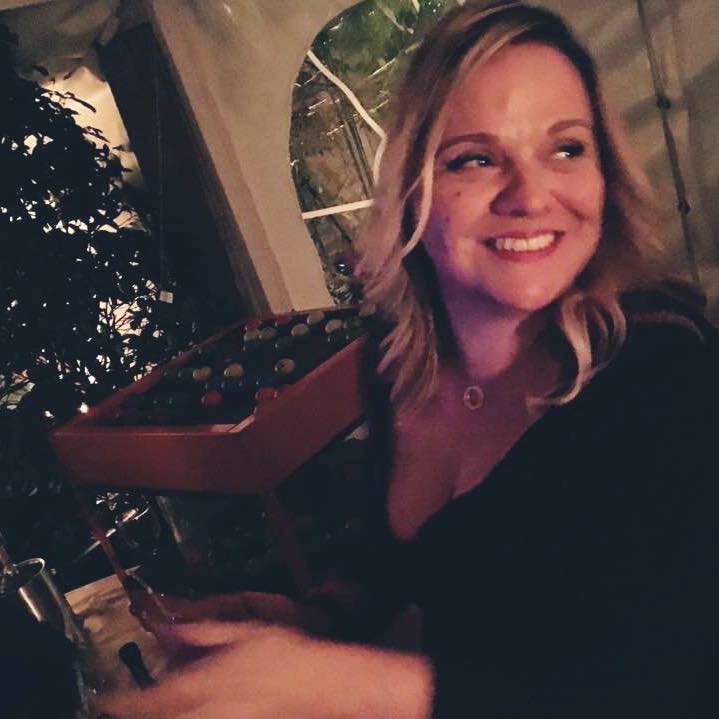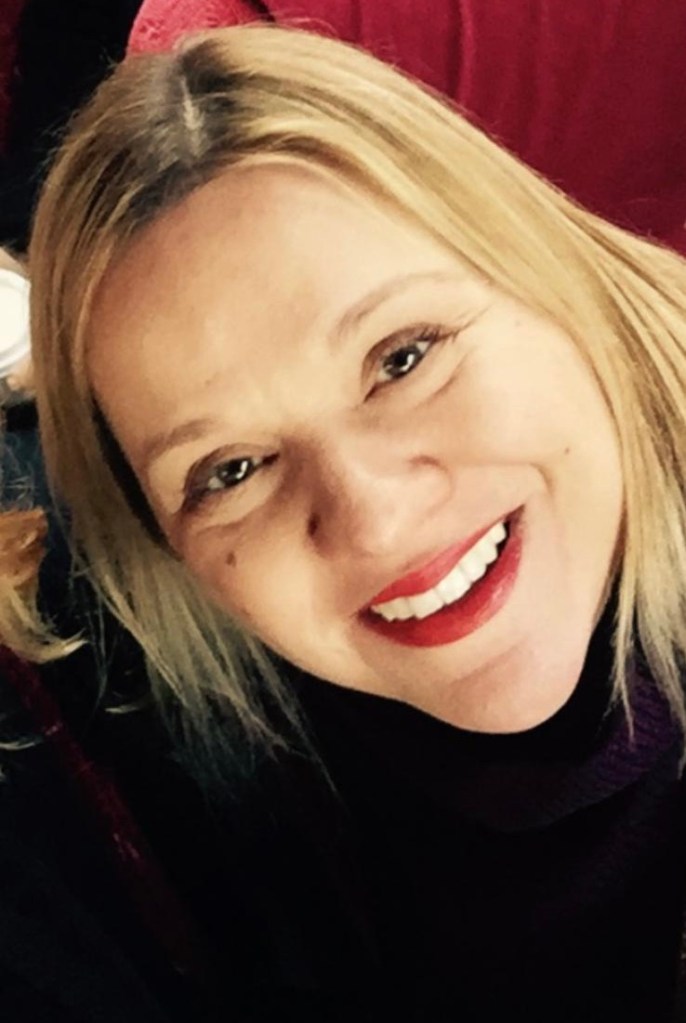
Heidi is back, and she’s here to help you get through and enjoy the holiday period.Hear her on Gateway Radio on the Aston Avery Show and on YouTube.Please write to her at 2Shades: spman@btinternet.com if you have a problem.Heidi can only answer so many, but she will try her best. Heidi is back, and she’s here to help you get through and enjoy the holiday period.spman@btinternet.com if you have a problem.Heidi can only answer so many, but she will try her best.
Dear Heidi Hope you are well. My son is coming with his girlfriend for Christmas. She is a lovely girl, but she’s not really my kind of person — though she makes my son happy. Lunch is going to be a problem: she is vegan and we are all meat eaters. Making it worse, she talks about animal cruelty while we’re eating. Now my son has decided he’s vegan too. I will make a nut roast and vegetables for them, but is it acceptable to tell them I don’t want to hear about animals and cruelty while we eat? Diana, Uxbridge
Heidi replies: You’re being considerate by preparing vegan options, and it’s perfectly reasonable to set boundaries at the table. Explain kindly that you respect their choices, but mealtimes need to stay pleasant for everyone. A gentle, “Let’s save the debate for later,” is enough. Mutual respect works both ways. Maybe try having a coffee with her before Christmas, go over the menu, and then explain your boundaries so it doesn’t become a big issue on the day.
Dear Heidi My boyfriend and I like to party and occasionally take drugs. I feel it’s under control on my end — high days and low days, that kind of thing — but I am a traditionalist when it comes to Christmas. He wants to invite two friends over and seems more interested in getting drugs in for after lunch than the food or the day itself. What can I do? I want a white Christmas — not that kind of white one. Mike, Bournemouth
Heidi replies: You deserve a Christmas that feels safe and joyful. Tell your boyfriend clearly that you want a drug-free day and that you aren’t comfortable hosting a gathering that revolves around substances. If he can’t respect that boundary, it’s a sign something needs addressing in the relationship — and perhaps in your habits as a couple. A peaceful Christmas requires mutual respect. Any regular drug use is not only illegal but a sign of addiction; once it’s in your life, it has a habit of resurfacing.
Dear Heidi Can you please help me? My mother is a total control freak and she runs Christmas like a military operation. This year I want to go to my friends’ in Cornwall. I am 19, at college, and have a part-time job. How do I break the news? I hinted at the idea and she brushed it off. How do I tell her? Malcolm, Newcastle
Heidi replies: You’re an adult now, and part of growing up is making your own plans. Be direct, calm and kind: “Mum, I love Christmas here, but this year I’m spending it with friends.” She may protest, but stick to your decision. Set the boundary with respect, not guilt, and give her time to adjust. The sooner you tell her, the better — and be aware she may not stop being controlling, so learning to stand firm now will help.
Dear Heidi Please help. We are going to my fiancé’s for Christmas. His mum is nice, but his dad is awful — he constantly makes crude comments and flirts with me when no one is looking. What can I do? Do I tell my fiancé or just put up with it since we don’t go that often? Tiffany, Leeds
Heidi replies: You should not put up with inappropriate behaviour, no matter how infrequent the visits. Tell your fiancé privately and calmly what has been happening. He needs to know, and the two of you can decide together how to handle it — whether that’s him speaking to his father or setting clearer boundaries. You deserve to feel safe and respected.
Dear Heidi I am going home for Christmas. This summer I came out at university. My parents are religious and it is going to be a shock to them. Should I go down sooner to tell them? I don’t want to ruin Christmas. Paul, Cardiff
Heidi replies: If you feel emotionally ready, telling them before Christmas may ease some of the pressure on the day itself. It gives them time to process without the intensity and expectations of the holiday. Choose a calm moment, be honest, and remember: their reaction is about their adjustment, not your worth. You deserve to be loved and accepted as you are.
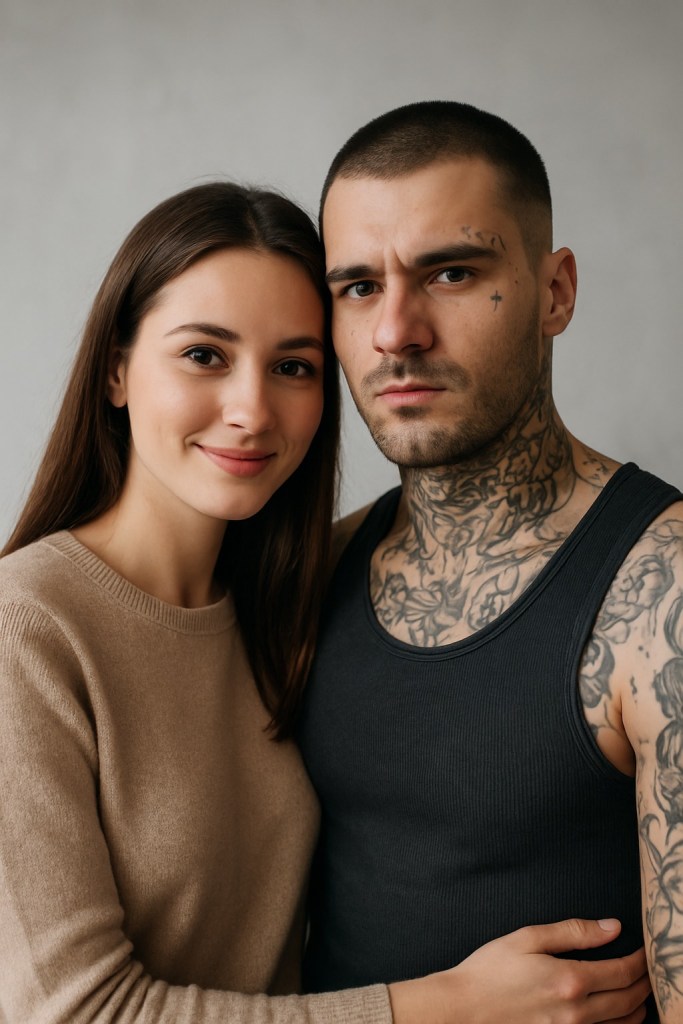
Dear Heidi How are you? Please can I beg for your help? My best friend is driving me mad. She goes from one bad relationship to another. She loves the bad boy look — covered in tattoos and looking like they got out of prison last week. It’s always a car crash, and to be honest, my empathy is running low. It’s my birthday soon, and honestly, her whining on about her love life is not my idea of fun. Would it be wrong not to invite her? — Nadine, Essex
Dear Nadine, Oh, the endless bad-boy drama — I think we’ve all had a friend like this! It’s exhausting watching someone you care about drive straight into the same brick wall again and again, isn’t it? Here’s the thing: you can’t fix her, and it’s not your job to. If she chooses chaos, that’s her story to live — but you’re allowed to protect your own peace. For your birthday, surround yourself with people who bring joy, not stress. If inviting her will spoil your day, then don’t. You can see her another time when you have the energy to listen. Being a good friend doesn’t mean being a doormat — sometimes it means stepping back with love. Or be brave and tell her how you feel, that it’s draining you. Love, Heidi
Dear Heidi Really love the show. My husband has always been a bit homophobic. Six months ago, he liked my hair so much he wanted a few highlights. Knowing he’s not great about the gay thing, I suggested he shouldn’t go to my beautiful stylist — who is also a friend — but he insisted. His hair looked amazing, but a few weeks later I was shocked to find he’d been out for drinks with my hairdresser, and now they’ve become friends. He says it’s rubbish that he’s homophobic and that he enjoys the laughs they have together. There’s a lads’ weekend to Ibiza coming up — no ladies allowed, which is fine — but can you imagine my hairdresser going too? I asked him why, and he said he’s going anyway and will get them into a few clubs. What’s going on? — Marieanne, Southend
Dear Marieanne, Well, this is a twist! It sounds like your husband has discovered that friendship doesn’t have to come with labels — and that’s actually a good thing. Maybe getting to know your hairdresser has opened his eyes a little and softened his old prejudices. As for the Ibiza trip — I can see why your eyebrows are raised! But before your imagination books a one-way ticket to Jealousville, take a breath. This might simply be two people enjoying new company and shared humour. If your instincts tell you there’s something deeper going on, have an honest, calm chat. But don’t jump to conclusions — this could be the best thing to happen to your husband’s attitude. Who knows? He might come home with a tan, a hangover, and a new respect for your fabulous friend. Love, Heidi
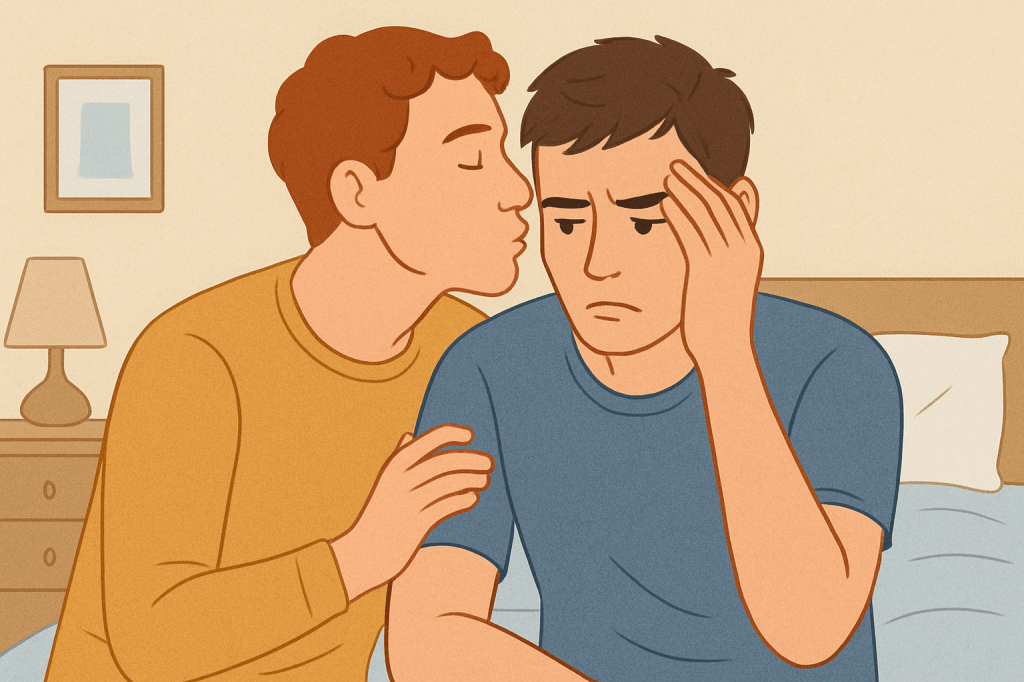
Dear Heidi I am madly in love with this lad, and he’s only gone and asked my friend to the dance! Honestly, Heidi, I am fuming — and she knew I liked him. I’m fifteen, and she dresses like she’s a dancer, while my mum says no to lashes and short skirts. It’s not fair. I’ll probably never speak to her again. What can I do? — Mandy, Basildon
Dear Mandy, Oh sweetheart, teenage love can feel like the end of the world — but I promise, it isn’t. You’re fifteen, and your heart is still learning who deserves it. This boy clearly doesn’t, and your friend’s choices say more about her than they ever could about you. You don’t need lashes or short skirts to shine — confidence is far more magnetic than mascara. Let her have her dance; you focus on being you. One day soon, someone will see the real you and won’t want to dance with anyone else. For now, dry your tears, hold your head high, and remember — nothing burns brighter than self-respect. Love, Heidi
Dear Heidi I’m feeling really down. I’m so fat, my budget won’t stretch to fat injections, and the gym just leaves me flat. No girls like me, and I’m nineteen and not going out anymore. What can I do? — Peter, Brighton
Dear Peter, First, let me tell you this — you are not alone. So many young people feel exactly the way you do, especially with all the “perfect” bodies plastered across social media. But real attraction doesn’t come from injections or six-packs — it comes from self-worth, kindness, and confidence. Start small: walk, move, cook decent food, talk to people. Find one thing every day that makes you feel good — music, a hobby, helping someone, anything that builds you up instead of tearing you down. The more you value yourself, the more others will see your worth. Confidence isn’t something you buy — it’s something you grow, and it lasts far longer than any gym membership. Love, Heidi
Dear Heidi My husband has announced that his mother is coming for Christmas. She’s horrible — the most passive-aggressive, rude woman you could meet. We’ve never got on; she has a way of finding a cloud in every silver lining. She’s on her own, and honestly, that’s what she deserves. My husband says she’s not that bad. Should I tell him it’s me and the children or her — and leave home for Christmas? — Sandra
Dear Sandra, Ah, the mother-in-law Christmas horror — a timeless festive classic! I can hear the carols already: “Silent night? Not likely.” You clearly feel hurt and unseen by your husband, but issuing ultimatums rarely ends well. Instead, set clear boundaries. Tell him you’ll welcome his mother — but only if everyone treats each other respectfully. If she can’t manage that, then maybe she stays elsewhere next year. Remember, Christmas is one day. Don’t let her steal your sparkle — pour a glass of something festive, smile sweetly, and rise above her barbed comments. Nothing annoys a passive-aggressive person more than calm happiness. Love, Heidi
Hi Heidi Not really a problem, but how do you get to be a counsellor or agony aunt? — Simon
Dear Simon, What a lovely question! Becoming a counsellor or agony aunt starts with empathy — and you clearly have that. Training in counselling, psychology, or journalism helps, but life experience and genuine curiosity about people matter just as much. Start small: volunteer with support organisations, write advice pieces online, or train in active listening. The best agony aunts aren’t perfect — they’re just honest, compassionate, and willing to help others make sense of their messiest moments. And who knows, Simon — you might be writing your own “Dear Simon” column one day! Love, Heidi
Heidi Gammon is BACK — and school’s in session! Sharpen those pencils, unpack the lunchbox, and brace yourself — because whether you’re heading to high school, moving into halls, or just trying to survive term-time drama, I’ve got the answers you need. From messy roommates to holiday hook-ups, from bullies to big life changes — let’s crack open the advice book and dive right in.
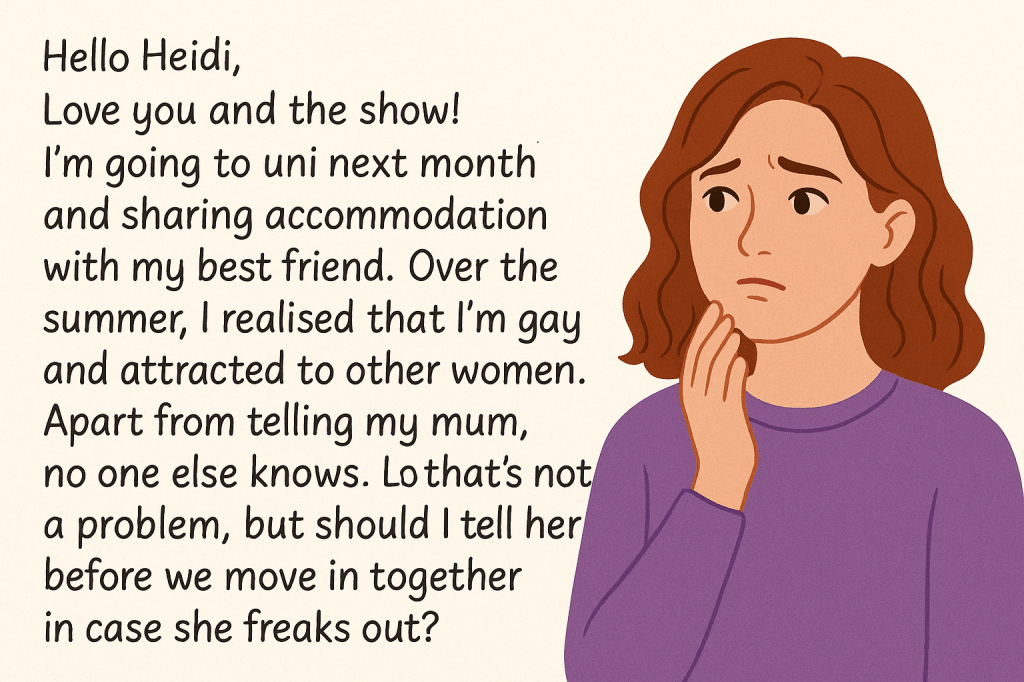
Hello Heidi, Love you and the show! I’m going to uni next month and sharing accommodation with my best friend. Over the summer, I realised that I’m gay and attracted to other women. Apart from telling my mum, no one else knows. I don’t fancy my best friend, so that’s not a problem, but should I tell her before we move in together in case she freaks out? Amber, Southend
Heidi says: Amber, the only “freak out” here would be if your friend suddenly forgot you’re still the same person you were last term. Your sexuality isn’t a warning label you have to stick on before move-in day. If you want to tell her, do it because you trust her, not because you’re scared of her reaction. And if she’s a real friend, she’ll be more interested in who’s nicking her milk from the fridge than who you fancy.
Dear Heidi, This is awful. I’m not gay, but I’m friends with a guy who is what you might call “fluid.” We got very drunk on holiday, and I remember him performing an oral sex act on me. There’s no way it would have happened sober, and now it’s made it difficult to be friends. I tried to talk to him about it, but he just said, “What happens in Ibiza stays in Ibiza.” I have a girlfriend, and I’m terrified she’ll find out. What do I do? Colin, Billericay
Heidi says
Colin, Ibiza clearly needs a new slogan: “What happens in Ibiza… tends to follow you home.” You’ve got a friendship issue and a relationship issue — and both need honesty. Tell your mate the boundaries from now on. As for your girlfriend, decide whether you’re confessing to ease your guilt or because it’s something she genuinely needs to know. Either way, learn your lesson: too much booze and fuzzy boundaries are a recipe for regret.
Hi Heidi, How are you? Last year I shared uni accommodation with a great guy — honestly, we were like brothers — but sadly he’s moved to the States. A new guy is moving in, but I bumped into his old roommate who warned me: he doesn’t mind him personally, but apparently he walks around naked, smokes weed, and puts porn on openly. Plus, he’s messy and leaves everything for others to clean up. That’s my idea of hell! It’s too late to back out — what can I do? Hunter, Basildon
Heidi says: Hunter, sounds like you’ve been dealt the ultimate “uni flatmate bingo” card. On day one, set the house rules in plain English: no nakedness in shared spaces, no weed inside, and mess gets cleaned. If he ignores that, fortress your room — lock, headphones, maybe even a mini-fridge. And remember: it’s one academic year, not a life sentence. What’s up Heidi, I’m still at high school and I hate it. There’s a girl who bullies me so badly that my life is a misery, and I don’t want to go back. What can I do? Stella, Brentwood
Heidi says: Stella, no one should dread school because of one cruel person. Tell a teacher, a school counsellor, or your parents — and keep a record of everything she says or does. If it’s online, screenshot it. Schools are legally obliged to act on bullying. I promise you this: she is not as powerful as she seems. One day you’ll be out in the world living your best life, and she’ll still be stuck in her small one.
Heidi, My girlfriend and I have been together for five years and we want to adopt a child — maybe two. How do we go about it? My mum says it’s a terrible idea and refuses to help. Mandy, Brighton
Heidi says: Mandy, if love, stability, and commitment are in place, you’re already halfway there. Start with your local council or an approved adoption agency — they’ll guide you through assessments, training, and matching with a child. It’s a long process, but worth it. most local authorities and agencies like pact do information evenings for people thinking about adoption these are great and informative and well worth going to
As for your mum, her approval would be lovely, but it’s not a requirement on the application form. Build your family your way.
2Shades writer Steven Smith grows. a beard picture by Graham Martin
As the singer Kelis would say, “Her milkshake brings all the boys to the yard”. One thing that will always bring me howling to the yard is a man with facial hair or, at the very least, that five o’clock shadow.
In the late 70’s, the clones with their check shirts and ’taches emulated what many gay men saw as the ultimate heterosexual man with Tom Selleck and Burt Reynolds the undisputed poster boys. And let’s not forget the fantasy images of Tom of Finland.
Image: Tom of Finland foundation
In my experience, much as the clones looked “hot”, what was on the lid was often not what was in the can. Many were hiding their dislike of their own sexuality by playing it pseudo straight, something that was compounded when, in New York in the 80s, I was outside the Munster Bar and a friend advised me, “Babe: if you get into any trouble scream for the drag queens. They will come running. The clones will just go hollering back into the bar.”
Freddie Mercury brought the clone ’tache look back to life for Queen’s third studio album, “The Game” – a trend many said was inspired by the San Francisco gay clubs. The look was prevalent in London at Heaven, the Coleherne and the Earl’s Court Catacombs. Freddie is actually quoted as saying that when he looked back on all that black nail varnish, chiffon and satin, he thought, “God, what was I doing?”
The much-missed Freddie Mercury.
I recall having lunch with the late, amazing Kenny Everett and the Daily Mail journalist Lester Middlehurst in early 90s Los Angeles, when I couldn’t help but notice that both men had moustaches. Kenny was delightful and so very sweet. Still, he commented that I should really grow a ’tache. Men without them simply looked like women to him.
My partner of 18 years had a sexy ’tache, and his hair was standing up on the crown where someone had cut it too short, when I first spotted him. Devilishly handsome, I loved his ’tache. Although I’ve always remained smooth faced, I guess I always went with the theory that opposites attract. It just did not feel right to me if I missed even one day with the razor.
Movember, the well-known charity, was behind my only attempt to grow a ’tache. One week in and friends kept asking if I had not washed. Two weeks on and it was starting to show, and though not impressive, it was there. A beautician friend of mine offered to get rid of a few nose hairs.
During the action she waxed half my newly sprouted moustache off. I let out a little shriek of horror. “WHERE’S MY MOUSTACHE GONE?”
“Is that what that was?” came the reply.
It seems that 2020 saw an explosion of male facial hair adorning our screens. My favourite actor, Colin Farrell, makes me go weak at the knees with his Irish accent and ’tache. Eurovision, though cancelled, gave us the Russian band “Little Big”. Joining them from the gypsy Russian band “The Hatters” was Yuriy Muzychenko.
Yuriy – “Little Big”.
Yuriy, with his many stages of facial hair, is sex on legs, as well as being uber-talented. Since “Little Big” seem to embrace the ’tache so easily, it’s a pity their stance on LGBTQ issues seems a little questionable. Tom Hardy and Jake Gyllenhaal are wearing the beard this season and it looks (as Americans would say) totally awesome on them.
Colin Farrell. Phwoarrr.
Graham Martin, one of London’s premier LGBTQ photographers, has seen an explosion of his clients sporting facial hair. Graham, who himself wears a distinguished silver-fox goatee, tells me that half his male clientele have some sort of ’tache or beard, compared to around one in ten just five years ago. Designer stubble started sneaking in, and the odd ’tache. The demand for the more rough-and-rugged look started pushing ahead of the usually popular twink or surfer look.
Your correspondent with Graham Martin.
It could be that the gay scene is evolving. When I first came out in the late 70s, I was told at the tender age of 16 to have fun as “you’re washed up by 25”. Nasty lies fed to me by the chicken-hawks, as they were called back then.
At one point during the groundbreaking (and sure to win every award going) “It’s a Sin”, written by Russell T Davies, two of the characters are chatting. Curtis tells Richie he slept with a man who was 36; both express their disgust. Arguably the gay scene has always been youth obsessed, with a tendency towards the Dorian Gray complex.
Still, change certainly has come upon us. The Daddies, Silver Fox and The Bear, Wolf and Well-Over-40 seem to be the new in. One Silver-Haired Daddy who is in his sixties, wearing a ’tache and beard, says he is inundated with young men wanting to meet, as well as guys his own age. All seem to love the beard.
Michael Edde is a popular barber in London’s Earl’s Court with a large gay clientele. He has seen a huge increase in beards and ’taches.
Legendary barber Michael Deeds.
“The best way to get your beard looking good is to grow it for ten to fifteen days and have it professionally shaped”, says Michael. “Obviously during lockdown this is impossible. My recommendation is to use conditioner or beard oil, and you might try using Buddha clippers. Start with the highest gauge and work down till you get the shape you’re happy with. Many of my male clients love a beard.”
Picture Graham Martin
Being on my own during lockdown, I gave up shaving for a day or two and decided I quite liked the look. The second time around I had better luck, and my ’tache seemed to come through strongly this time. I had a little help from Watermans’ “GROWME” shampoo.
By week four, I had a beard and a ’tache for the first time in my 59 years.
Reactions were, erm, varied. Some people burst out laughing. Two girlfriends thought I looked like a Joe Swash tribute act. But for the most part, it went down very well. Graham Martin thought it was an attribute. My ex loved it, and even my sister thought it was cool. One thing that did stand out is the fact I am ginger, and much as I have hidden this since I was 18 by dyeing my hair blond, there was no way of hiding it with the beard. Maybe in my sixth decade, embracing my red-headed Scots heritage might not be a bad thing. It has certainly been fun trying it, and it may be here to stay.
Certainly now, I can say with conviction, “Who’s your Daddy?”
Hi Oscar, We at 2Shades think you are art. We love your openness about living with addiction, and we would love to know more.
Thank you so much—that’s a wonderful thing to say. And thank you for having me. It was lovely meeting you at the Routine exhibition recently.
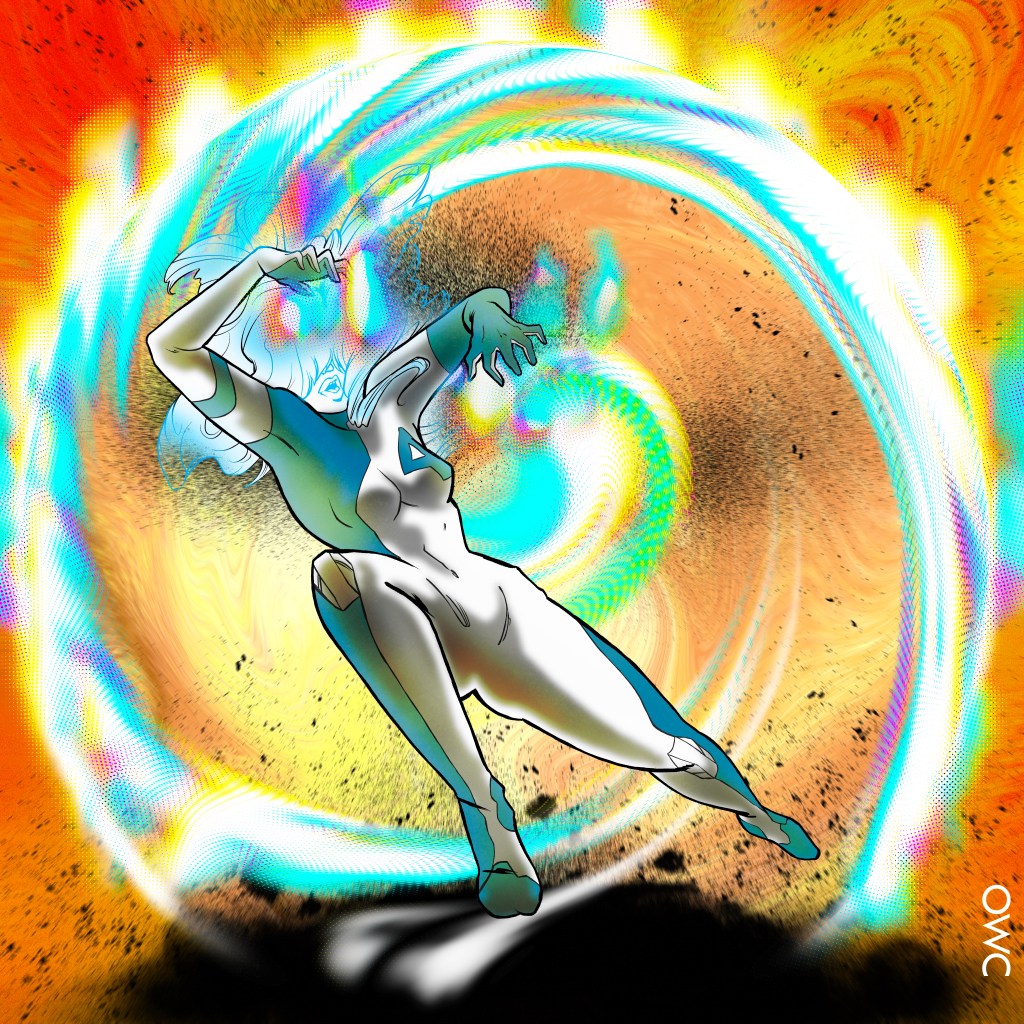
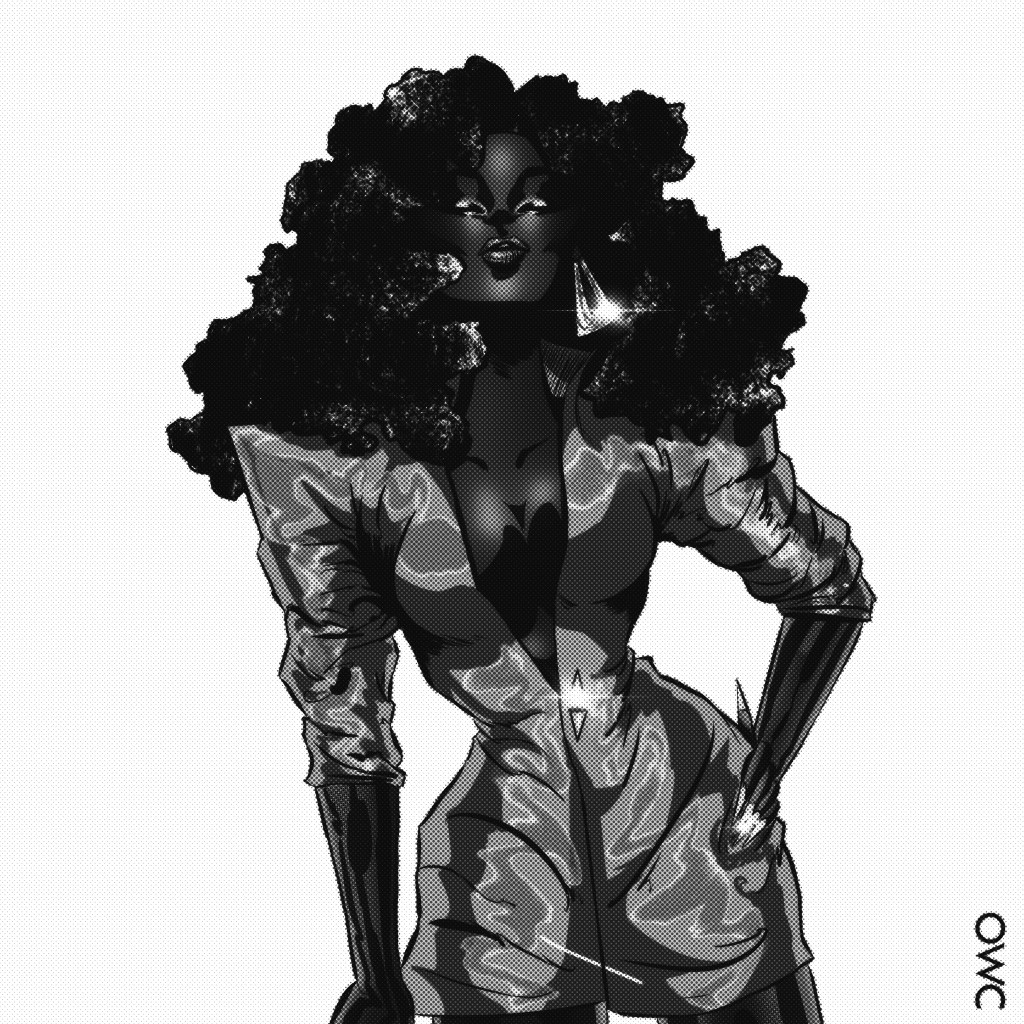
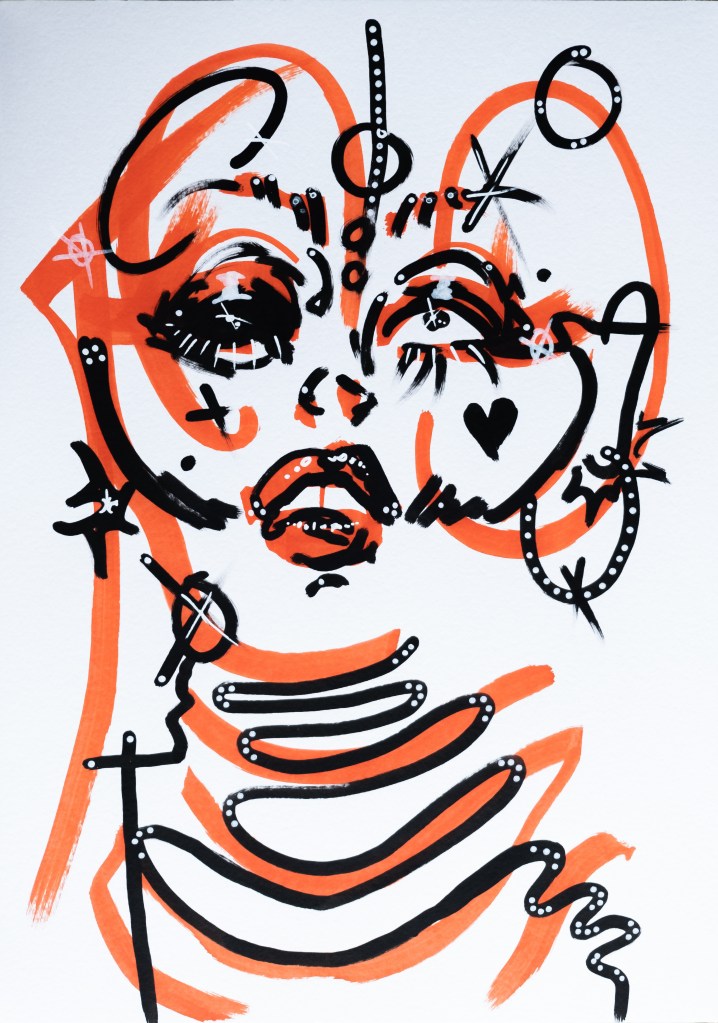
I’m Oscar, an artist based in London. I make a lot of different things, but mostly graphic illustrations that revolve around fashion, comic books, or BDSM. I’m a recovering alcoholic and addict. I’ve been sober for a while now, and I’ve been working on both my creative career and rebuilding my life—I’m even back at university. I love bold colours, especially red (my absolute favourite), which features heavily in my work. But sometimes, just simple black-and-white linework can be really rewarding too. You’ll usually find me watching horror movies, rocking out to the Sugababes, drawing some femme fatale in a fabulous outfit—or playing video games, of course.
I’ve been drawing for as long as I can remember. It’s been a way for me to express so much—my sexuality, my adoration of femininity, my experience as a queer person, or just the thrill of an incredible superhero fight scene. Now I’ve had the chance to exhibit and work as an illustrator, which has been amazing. I’m only getting better, so I’m excited to see what the future holds.
What does it feel like to create, for you?
For me, creating is perfect concentration and calm. My head is usually full of thoughts—non-stop—except when I’m drawing or designing. That’s when everything quiets down. I get totally absorbed in the world of the piece, in the details of the colours—or I just disappear into the flow of (deafening) music and let the pen take me somewhere new.
I’ve grown a lot as an artist since getting sober. I had to figure out how to be creative again, because my addiction robbed me of that desire—and the ability. I worried it wouldn’t come back. Part of me thought art was lost to me, or at least the passion for it was.
Thankfully, it came back—but it feels different now. These days, I create with less intention and let my emotions and the pen guide me. Trusting my skills is a big part of that. I’m the best I’ve ever been, and there’s a sense of security in that, because it allows me to just let go. That freedom is why creativity is such a safe space for me.
When you’re an addict, so much of your life is micromanaged. I avoid certain places when I’m too tired or upset because the pull of alcohol or drugs can be dangerous when I’m not stable. I have to constantly protect myself in a world where addiction is everywhere. Being around alcohol and drugs is exhausting—so I make sure I recharge, or I crash.
Creation is free of all the mental admin I have to do every day around addiction. That’s why it’s such a solace. I get to be somewhere else, someone else—feeling, seeing, and doing something else. It’s incredibly freeing.
Can you remember the earliest thing you created artistically?
Absolutely. I’ve always loved comic books and still collect them—I’ve got hundreds in my room. They were my gateway into art. I used to print out images of my favourite characters at primary school and try to redraw them as best I could.
Around that time, I also became obsessed with the brides of Dracula—after seeing Van Helsing with Kate Beckinsale. Those brides were everything to a young gay boy from South London. Flowing sleeves that turned into wings? Iconic.
I also drew Storm, Elektra, Catwoman, and Raven from Teen Titans because I grew up watching all those shows, not even realising there were decades of comics about these amazing women I could be reading. I started copying comic pages and poses from books I bought or found online. Comic artists are incredibly underrated—the technical and artistic skill needed is mind-blowing.
Redrawing other artists’ work was how I learned. It’s a great skill to develop early on. Even now, I love watching artists create on YouTube. That’s how I pick up new techniques—watching how someone shades or sketches anatomy, then figuring out how I’d do it. I tell every new artist I meet: understand the process. See how other people use the medium. It’ll change your practice.
What correlation does addiction and art have for you?
Addiction seeps into parts of who I am and, by extension, my art. My obsessive focus on one subject or style until I burn out feels very much like addiction. My love of recurring colours or patterns feels repetitive—like addiction did.
But, honestly, addiction was the opposite of being an artist for me. Toward the end of my using, I just stopped creating. There was nothing left inside to work with—no soul to put into art. Addiction stole that from me. Even though it was my own doing, it still feels like a theft.
That whole “depressed addict artist” stereotype? It wasn’t me. There was no creating going on. I don’t know how people stay functional in addiction. I couldn’t. Everything outside of using and, occasionally, working just faded away.
That said, art can be just as self-indulgent as addiction—just without the destruction. And it can pay! Which is the opposite of addiction, where I only ever lost money. So in that way, it’s gratifying.
Do you have any stand-out influences in your creative journey?
Yes! René Gruau is my favourite fashion illustrator. The first time I saw his work, I was blown away by his minimalism—but also by the drama and flair. His use of red (swoon) and sheer elegance… phenomenal.
Simone Bianchi is a comic book artist I’ve loved for over a decade. He paints many of his pieces, which makes them feel unique—especially in comics. His grasp of anatomy and colour is chef’s kiss. He drew Storm better than anyone at Marvel. Big hair, boots, cape—flawless.
Tim Sale is another one. Famous for Batman: The Long Halloween and one of my favourites, Catwoman: When in Rome. His work feels like a fashion illustrator started doing comics. Perfect intersection of the things I love. He passed recently, which devastated me. The industry lost a legend.
Music is also a huge influence. I have a very visual connection to it—like a movie trailer in my head. I never draw without music. It’s the emotional gateway to my creative brain. I often play the same song on repeat for hours when I’m trying to stay in a feeling.
Nowadays, my inspiration is more internal. I rarely use references unless I’m doing commissioned work. But I still like life drawing sometimes—to keep my skills sharp.
How did you control the battle with addiction?
I wouldn’t call it “control,” because there’s not much you can control. For me, it all comes down to one non-negotiable truth: Sobriety or death. If I use again, I know I’ll die. That’s not melodramatic—it’s just the reality. So there is no choice. I’ve worked too hard to rebuild my life and relationships. I’m not throwing that away.
I take my peace seriously. Work is work, but my life means more. If I don’t want to go out, I don’t. If I need a day to myself, I take it. I fought for my happiness. I’m not sacrificing it for anyone.
AA helped me massively—especially early on. Those people saved my life. But as it’s anonymous and not about promotion, I’ll leave it at that.
Do you remember your darkest moment dealing with addiction?
Yes. Any time I tried to end my life. It happened a few times during my addiction. Thankfully, I wasn’t successful—but I remember that feeling of walking around not wanting to be here. I truly believed the world would be better off without me.
That feeling consumed me for years. The only relief came through explosive, manic episodes that never ended well. I felt hollow, like I had nothing left to offer.
These days, I still have hard moments—days or even weeks of depression—but now I know it’s not forever. That helps. Therapy helps too. Lots of it.
What’s next in your journey?
I just graduated with a first in Graphic Design! So right now, I’m job hunting and creating more art. I’ve been lucky to exhibit a few times and would love to do more of that. I’ve also got some creative projects in the works I can’t talk about yet—but I want to do everything. I didn’t think I’d live past 21, so the fact that I have time now? That feels powerful.
I’d love to put my work on clothing. That would be amazing. But for now, it’s more art, more exhibitions—and staying open to new projects. Commission work has always surprised me in the best ways.
Do you feel people are quick to judge you?
Probably. But it doesn’t bother me.
I’m gay. I live in a world where my community is still criminalised in many countries. Judgment comes with the territory. I have a small circle of people whose opinions matter. Everyone else? Irrelevant.
I love heels, claws, and makeup sometimes. Any queer person will tell you: being visibly queer means being hyper-aware of how you’re perceived. But I’m not hiding any part of myself to appease someone else’s discomfort. That’s a terrible deal.
I’m also quite introverted now. I enjoy my own company. And if someone doesn’t like me? Not my problem. I’m not for everyone—and I don’t want to be. That sounds exhausting.
I’m not unkind. I’ll apologise if I’m wrong. I work hard in therapy so my issues don’t hurt my people. But I also stand by myself. If I’m not sorry, I don’t say it. There’s great power in saying, “I’m not sorry.”
And hey—I draw men being sexually tied up. I expect judgment. But art is made to be disliked as much as it is to be loved. If someone hates my work, great. That’s their job as the audience: to respond. Love or hate—it means it made them feel something. That’s all that matters.
Quick Fire Sushi or Chinese – Neither Kiss or Slap – Both Bowie or Madonna – Madonna Favourite Place in London – My house First thing you’d change as mayor for a day – Free dental / Legal protections for trans people that can’t be undone by a moron
Ah… the Passive Aggressives. We’ve all met them. They open their mouths and what comes out sounds like a compliment—but it’s actually a veiled put-down. Before you can respond, they’ve already moved on to a new subject. Like silent assassins, they strike, then dare you to recover from the blow.
If you say, “Hey, would you like that said to you?”, they recoil in horror and reply, “Why are you so sensitive, darling? It was a compliment,” shaking their heads like they’re the victim of #PassiveAggression.
From: “I do admire how you keep going when others would have thrown in the towel ages ago—so brave,” to: “You know that outfit suits you—don’t let others put you off, whatever they say.”
Favourite?
My personal favourite came from a friend who’d actually introduced me to my now-best male pal. She told me: “So glad it’s going well with you two… you shouldn’t care what others are saying about you both.”
Let’s not forget the classic: “You can’t tell anyone I told you this, but so-and-so said XYZ about you.” My reply? Always: “Why were they so comfortable telling you?”
Now, much passive aggression comes from strangers, but the deepest cuts usually come from people we love, see regularly—or worse—family members.
Madeleine, a dear friend of mine, simply can’t help herself.
We All Know a Few Wicked Queens
The trouble is, I love her, and I tend to overlook her barbed remarks. Picture this: dinner with a group of friends as she regales the table with a story— “Oh darling, we were sitting up in premium class while Steven was way back in economy, squashed between two people.”
Everyone chuckles and looks at me sympathetically. In reality, she was also in economy. A bit further from me, yes—but the same class. Why make me the fall guy in her tale?
I don’t correct her. Honestly, I’m speechless. And who wants to play #PassiveAggressiveTennis? I know she loves me—really.
Spelling Lessons
Another agent friend, Antonia, has a wicked sense of humour, and her loyalty redeems a lot. I was so looking forward to lunch with her. She’d just returned from New York, promoting her girlfriend’s record, and we planned to pop into a gallery event where one of her friends was exhibiting.
But it didn’t take long for the first blow: “Darling Donna [her girlfriend] and I were just saying—you forget what a great writer you are—pause—as you’re just such an appalling speller.” Then, after another pause: “Does someone help you?” she asked, casually munching a root vegetable like we were discussing the weather.
It’s true—I’m dyslexic. Spelling is not my strong suit. But after over 20 years writing for publications around the world, and two published books, I’ve earned my place. If it weren’t for journalist and presenter Jane Moore encouraging me— “You have the voice. The rest will come—just do it.”
With technology, hard work, and mentors like Jane, I carved out a writing career. These days, people actually rate my work—and that means a lot. So I just smile and explain that yes, I have editors and tech, and the tools are better now.
Before I finish, the topic shifts—to Donna hitting the charts in the U.S.
Still Not Done
Later, at the packed gallery event, Madeleine introduces me to a group of people: “Everyone, this is Steven. He’s a great writer—but can’t spell.”
They look bemused. Madeleine has struck—and vanished—leaving me standing there hoping no one starts a crowdfund for my spelling lessons.
Arlena & Real Life
Life isn’t like the movies when the passive-aggressive gang comes for you. Most of us feel like rabbits in headlights—unlike the deliciously sharp Dames Diana Rigg and Maggie Smith in Evil Under the Sun.
Maggie, as Daphne Castle, greets Diana Rigg’s character Arlena Marshall: “Arlena and I were in the chorus of a show together—not that I could compete. Even in those days, she could always throw her legs in the air higher than any of us—and wider!”
Arlena retorts, “Kenneth, what a surprise. When you told me the island was run by a quaint little landlady, I had no idea it was Daphne Castle.”
There’s a fine line between bitchy and passive-aggressive.
Mother-in-Law Moments
A friend’s mother-in-law, taken backstage after a show, hugged the leading man and gushed about how amazing he was. The leading lady popped in to say hello. She turned to her and said, “I thought you were great… don’t listen to those reviews.”
Silence. The actress smiled, made her excuses, and left. When we later pointed out it was a line from The Feud (Joan Crawford vs. Bette Davis), the poor woman was mortified—she hadn’t meant it to cut. In hindsight? Hysterically funny.
The day before, she’d overheard me chatting to a famous pop star: “Who was that?” she asked. I should’ve said, “Mind your own business,” like my mum would. But I answered. Her reply? “Why would they want to talk to you?”
Gobsmacked. And somehow, older people get away with more. She really is lovely, though.
LGBTQ and the Passive Blow
As a member of the LGBTQ+ community, we often face passive aggression. It’s exhausting.
At a wedding in Guernsey, where the bride was 20 years older than the groom (so you’d think a liberal crowd, right?), a woman rushed up: “Oh, you two must be Mandy’s gay friends from London!”
She beamed like she expected us to burst into I Am What I Am. I tried some small talk. She wasn’t done: “David is gay—from EastEnders!” I replied, “Really? Amazing. I’ll look him up in the book.” Her eyes widened, “There’s a book?” “Yes, we’re all registered. I’ll bring you a copy next time I visit Mandy.”
Okay, that may have been me being passive-aggressive.
From: “I don’t mind the gays. My hairdresser’s one.” to: “I’m all for it—but don’t you mind not being able to have children?” We’ve all heard those.
Let’s not get started on the “bitchy queen” lines: “Don’t mind me, it’s all in jest. I’m just a bitch.” You’re waiting for them to hand you the poisoned apple. “Go on, bite, dear.”
What the Experts Say
Dr Pam
Experts say the best way to handle passive-aggressive people is not to react.
Self-help psychologist Dr Pam Spurr (@DrPamSpurr) says:
“People can be passive-aggressive for many reasons, but usually it’s because they have a manipulative streak.
If they want to put you down, the easiest way is with a backhanded compliment. It wrong-foots you and leaves you wondering what they really meant. That’s emotional manipulation.
She adds:
“Passive aggression often comes from resentment, envy, or jealousy—sometimes without them even realising it.
Some people, however, do know exactly what they’re doing. They enjoy the power of the subtle jab.”
Her advice?
Call it out calmly—especially if you see the person often.
If it’s someone you barely know—ignore it, put it in perspective.
Realise: it’s more about them than it is about you.
According to LearningMind.com, passive aggression also includes chronic lateness (to gain attention), controlling events, undermining others behind their backs, playing the victim, or pretending there’s no issue when there clearly is.
Psychology Today agrees:
Recognise the behaviour.
Stay calm.
Don’t take it personally.
Confront it if needed.
Blackmail and Backlash
These all sound simple on paper. But for people like me—who hate confrontation—even a kind challenge results in tears and emotional blackmail. I’ll do anything to stop someone crying.
Growing up, pointing out when someone was wrong led to a meltdown. Still today, if I gently mention something upsetting, I get: “I can’t say anything right,” soon followed by, “I had a terrible childhood.”
Let’s be honest—in the UK, from the 60s to the 80s (and sometimes now), talking about feelings can feel like a deadly sin.
Teach Them Young
Signe Whitson, LSW, writing for Psychology Today, notes:
“Without directly addressing passive-aggressive behaviour, the pattern will play out again and again. For real change, benign confrontation is necessary.”
She argues being assertive isn’t something to fear.
I agree. Imagine if we taught kids that if someone they love says something hurtful, it’s okay to speak up and share how it made them feel.
As Dr Pam says,
“Sometimes they don’t even realise what they’re doing.”
Happy Pride, everyone! just reflecting on Pride I thought Id share some background about me .
Becoming a counsellor wasn’t my first career choice. From a young age, my true passion was doing people’s hair. But strangely enough, hairdressing and counselling are closely linked. You know what they say: if you can’t afford a therapist, see your hairdresser!
In my case, it actually worked the other way around. My hairdressing career took off—I specialised in colour and built a hugely successful business. My CV includes working with celebrities and the rich and famous, and my colouring talent brought me into collaboration with some of the biggest names in the hair world.
But I always had a burning desire to really listen to my clients. No matter who they were—a rock star, a socialite, or a fashion icon—it became clear early on that we all face similar challenges: heartbreak, divorce, bereavement, anxiety, depression… the list goes on. People might argue that wealthy clients don’t have the same worries, but I’ve seen both ends of the spectrum. Money doesn’t always bring happiness.
That 16-year-old girl living in a Chelsea townhouse who wants to come out to her family isn’t so different from the one growing up in a council flat. Their circumstances may differ, but they’re both human and both deserving of support.
My fascination with people and their stories led me to retrain as a therapist. But it wasn’t just my clients who inspired me—it was also my own life.
I’m a gay woman and I came out in the 1990s. It was a brave move at the time—it certainly wasn’t trendy or widely accepted. We had very few role models: K.D. Lang, Melissa Etheridge, and Ellen DeGeneres were among the few out and proud. And let’s face it, lesbian characters in TV and film were usually portrayed as mad, bad, or dead. For many of us, The Killing of Sister George was the only reference point. Though it’s a classic with sensational performances, it doesn’t exactly paint a rosy picture of lesbian life.
(That’s why I’m so looking forward to the upcoming documentary on The Gate Club—the legendary lesbian venue on the King’s Road where parts of Sister George were filmed.)
When I came out, it raised a few eyebrows—even at the very trendy Vidal Sassoon salon in central London, where I was working at the time. Once word got out, some of my regular clients switched to other colourists.
While I had amazing support from some colleagues, moving on to other salons often meant facing homophobia—surprisingly, sometimes even from gay men. It’s not something we talk about often, but it’s real. Although my inner circle included fabulous gay men, there were definitely some who didn’t welcome us lesbians with open arms.
And believe it or not, I was refused entry to some gay clubs for looking “too straight”! Apparently, I was too femme.
Thankfully, times are changing. But we mustn’t take that progress for granted. Homophobia still exists in many forms, and we need positive role models, education, and continued activism to keep moving forward.
When I started studying to become a therapist, going back to college felt surreal. One classmate broke the ice by saying, “So proud to be your first lesbian!”—we’re still great friends to this day. But not everyone was welcoming. One peer was consistently rude and passive-aggressive. It was never openly discussed, but I strongly sensed a kind of veiled homophobia. Thankfully, the rest of the class were amazing, inclusive, and my tutor was truly sensational.
Back in the day, it would have been unthinkable to be openly gay in one successful career, let alone two.
Happy Pride, everyone! Let’s celebrate how far we’ve come. There’s still plenty of work to do, but I’m proud to be waving the rainbow flag—and I can’t wait to answer your emails.
Love, Heidi
Dear Heidi,
My girlfriend dumped me before the pandemic because she enjoys clubbing and going to bars. That’s just not my scene. I’m looking for something more meaningful—I want to meet someone and settle down. But dating apps and websites scare me, and the bar scene isn’t for me. Alex, Bethnal Green
Hi Alex, Thank you for writing in. You’re not alone—plenty of people feel intimidated by the modern dating world. The key is to find spaces that align with your values. Consider LGBTQ+ book clubs, walking groups, art classes, or volunteering for a cause you care about. These are great ways to meet like-minded people in a low-pressure environment. And if you ever decide to try dating apps, choose ones with detailed profiles—look for people who are also looking for something serious. Take small steps—you’ve got this! Love, Heidi
Dear Heidi,
My girlfriend and I have been together for two years and plan to marry next year. Recently, she’s expressed a desire to try threesomes, saying it’ll “spice things up.” I don’t want to lose her, but honestly, it’s not for me. What should I do? Madeline, Manchester
Hi Madeline, Your feelings are completely valid. Relationships should be based on mutual respect and clear boundaries. If something doesn’t feel right to you, you shouldn’t feel pressured to agree. Talk to your partner openly and honestly—express your feelings without judgement. A strong relationship can withstand differences, as long as there’s communication and compromise. The right partner will respect your comfort zone. Take care, Heidi
Dear Heidi,
I’m 19 and come from what you’d call a “rough” family. My two brothers and I are all amateur boxers. My dad is a real “man’s man” and uses words like “queer” as an insult. I’ve been dating girls to hide who I really am, but one of them suspected something when I didn’t want to go all the way—she called me a “poof.” I love my family, but what can I do, Heidi? Should I risk coming out? Mike, Blackpool
Dear Mike, Thank you for your honesty. Coming out is deeply personal, and only you can decide when the time is right. It’s okay to take your time. You don’t have to come out until you feel safe and ready. Remember, there’s no shame in protecting yourself emotionally and physically. If you ever feel unsafe at home, reach out to LGBTQ+ support groups—there is a community out there that will support and celebrate you for who you are. You’re not alone. With warmth and strength, Heidi.
I couldn’t agree more with the divine Joan Collins—who, as a fellow Gemini, always knows how to speak her mind. Just last month she said, “It is rude to ask a lady her age.” And I say, absolutely right. While we’re at it, let’s extend that rule to men, too. Age should never be the first thing people bring up at the dinner table—or anywhere, really. Yet, for some strange reason, some people still haven’t got the memo.
Even the legendary Ms Collins never misses a moment to bring up age on her own terms, and good on her. The problem is when others decide it’s their business to discuss or dissect your age as if it’s a defining feature of who you are.
Trust me, being asked, “Guess how old I am?” is the social equivalent of stepping on a rake. It’s awkward, unnecessary, and usually driven by vanity or insecurity. Worse still, when someone asks you how old you are in front of a group—what exactly are they hoping to achieve? Shock? Admiration? Or a bit of good old-fashioned one-upmanship?
Pictures by Graham Martin
Personally, I’m incredibly proud of the age I’ve reached. I’m in great company—hello, Tom Cruise and Boy George! To be able to say I’ve lived a full and colourful life, packed with lessons, laughter, a few bruises and many blessings, is something I treasure. But that doesn’t mean I want to be constantly labelled by it.
is 60 the new 40 well George and I hit 64 and still partying
Still, I must admit, the age hang-up isn’t mine—it’s other people’s. I’ve been at parties where someone makes an entrance like a movie star arriving late on the red carpet. You know the type—deliberate delays, dramatic flair, sunglasses indoors, and a whole production just to let everyone marvel at how good they still look. And yes, they do look amazing, but does everything have to revolve around how young or “well-preserved” someone is?
I’ve even been in situations where my own friends—who happen to look much younger than their age—draw the same “oohs” and “aahs.” I once attended a dinner with a long-time friend who, despite being in his twenties, has the soul and intellect of someone in his seventies. We were seated with a man I didn’t know, and from the moment he sat down, the conversation steered toward age. He asked if we still went clubbing, commented on siestas as “old man naps,” and suggested that we must prefer quiet evenings now. I stopped him mid-flow and said, “Darling, I don’t do the age thing or put labels on people.”
That’s when it hit me: his obsession with age wasn’t about us—it was about him. My young friend whispered to me later, “He’s projecting his own fears onto you.” And he was right. So many people are battling their own discomfort with growing older, and instead of embracing it, they try to deflect that discomfort onto others. Sad, really.
But here’s the truth: age isn’t a limit or a barrier unless you make it one. I’ve always envisioned myself living with a bit of swagger—relaxed, charming, and totally unbothered. I’ve seen people in their 70s, 80s, and 90s absolutely raving—living their best lives, dancing under disco lights, refusing to be boxed in by the number on their birth certificate. And I say: why not?
Of course, your priorities change. These days, I enjoy good dinners, meaningful conversations, and yes, a nap if needed. But that doesn’t make me any less fun, adventurous, or alive. I just don’t have the patience for drama or superficiality anymore—and I count that as progress.
Teenager to now .. living life to the full
One thing I wish people would do more is just be. Enjoy where you are, who you’re with, and the life you’re living. Stop measuring your worth—or anyone else’s—by youth, appearance, or how “on trend” you are. Confidence, kindness, and curiosity will outlast collagen and hair dye any day
So yes, age is just a number, and we should all be proud of the years we’ve lived and the experiences they’ve brought us. But really—can we stop bringing it up every five minutes?
No matter how good David Beckham looks in his BOSS underpants, there is absolutely no way I am paying £45 or more for a pack of three. Even if he personally delivered them to my door, it would still be a firm no from me.
It’s not that I’m being tight with money — far from it. I live a very busy and active life, constantly working out, dashing from place to place, and keeping on top of everything. For me, my underpants need to be practical above all else. They must offer strength, durability, and a feel-good factor against my skin. In short, they have to work hard and feel great at the same time.
From my personal experience, even some of the big-name designer brands don’t always deliver. In fact, some of them don’t last much longer than cheaper alternatives, and when you’re paying prices that rival the cost of a good pair of jeans, it’s hard not to feel resentful. I still want to look and feel good in my underwear, of course, especially with summer fast approaching. Warmer weather means I’ll be out and about a lot more, and let’s be honest — I’ll probably need to change my underpants at least twice a day.
Now, here’s the great news. Listen up, boys, girls, and everyone in between who loves staying up to date with the latest must-have fashion in men’s underwear. I have found the very best option out there — and it won’t break the bank!
Not only does it look fantastic on, but it feels absolutely incredible. Your body can breathe, the fit is spot-on, and you won’t believe the comfort. The brand you need to know about is FM London. Trust me, this is going to be the most talked-about brand very soon.
FM London started back in 2015 with three brothers who were completely fed up with paying ridiculous prices for basic clothing. They decided to do something about it and created a no-fuss brand that delivers real quality without the hefty price tag.
When it comes to men’s socks and underpants, these guys are truly onto a winner. Their underwear offers everything you could possibly want:
A stretchy, ergonomic fit
A cotton-rich blend that feels soft and breathable
Anti-chafing design for all-day comfort
Odour-fighting technology to keep you feeling fresh
This is my top recommendation for the summer — affordable, comfortable, and practical. Plus, they still look great enough to wear on a date night (whatever that is these days!) and bring a little bit of sexy back into your wardrobe.
So if you want to feel good, look good, and not spend a fortune, check them out. Trust me, your underwear drawer will thank you.
Cinzi Lavin, an award-winning musical dramatist and writer
Cinzi Lavin, an award-winning artist from the States reached out to 2Shades to tell her story
When I read about her, I was shocked to find out how she isn’t better known for her contributions. But that wasn’t the point, Cinzi’s calm yet captivating approach to life is a distinct voice that 2Shades is honoured to provide a platform for.
Here’s how Cinzi’s journey with life has taught her a great deal about the unexpected turns it might take, and how you can make it easier for yourself, in her own words.
“Everyone’s success story is different. As an award-winning musical dramatist and writer, my work involves telling stories, so I’ll gladly share mine in hopes of inspiring others.
I’ve seen life from many angles: as a child growing up in a wealthy Manhattan suburb and as a young woman eking out a living as an impoverished musician. I’ve been a New Yorker and a Texan. I’ve been an actress, playwright, educator, and lifelong student (and may I never graduate!).
My career path, if it were printed out like an EKG reading, would look like someone having a coronary seizure. Far from straight and uneventful, it included forays into multiple fields in every direction. However, all the paths I followed—from journalism to teaching to performing (and more)—played a crucial role in developing the skill-set I use today.
Early on, I wanted to do amazing things, and I was good at writing and had an ear for music. I took piano lessons for a few years with a neighbor-woman, and I was her worst student. A few decades later, I’d created and produced three full-length original musical dramas and performed by invitation at the White House.
The short answer to the question of how I achieved this is that I made bread out of straw—I created something out of nothing. Circumstances dictated that if I wanted to enjoy success, it would take more than hard work, luck, ambition, or even talent: it would require my humanity, my creativity, and my ability to recognize that obstacles are only illusions.
Here are my three crucial components for success:
1.) Helping Others – There is much to gain by the intentional, systematic, unselfish, and abundant donation of your time and talents. Imagine someone putting a teaspoon of vegetable seeds in a hole in the ground and returning to discover a football-field size crop has grown from it.
I’m a huge proponent of volunteering, because it represents an opportunity to learn valuable skills in a supportive atmosphere, boosts confidence and self-esteem, and encourages networking which may lead to furthering your goals. Additional ways of helping others include always striving for a win-win scenario and mentoring others in your field.
2.) Thinking Creatively – Particularly when you start with nothing, creativity is a powerful way to optimize your talent. Always do things the way you think they should be done, even if it’s not how everyone else does it. In addition, don’t be afraid to utilize unique or unusual ways of promoting your work, such as lecturing in local clubs or libraries.
3.) Ignoring Obstacles – My artist’s statement is as follows: “As an artist, my two most valuable tools are my index fingers; when someone tries to point out obstacles to my dreams, I place them firmly in my ears and say, ‘La la la! I can’t hear you!’ It works every time.”
One of my favorite stories involves a young man who took a job selling encyclopedias door to door many years ago. On his first morning at work, his employer provided him with six sets of the heavy books; he put them into his car, and set forth. Around noon, he returned, saying “I’m ready for the next six sets to sell this afternoon.” His boss and his fellow salesmen were shocked. Nobody had told him that the six sets he’d received that morning were intended for him to sell during the upcoming month. Thinking the six encyclopedias were his morning’s quota, he didn’t suffer any preconceived failure.
As for success itself, I recommend that anyone aspiring to greatness not only define what they want but why they want it. For example, if you want to make a lot of money, it’s not the pieces of paper or the multi-digit numbers on your bank statement that you actually want—you want something the money represents, whether that be financial security, power, or the freedom to do whatever you wish with your time.
I highly recommend practicing economy in your career—not necessarily of money, but of everything good that comes your way. Envision a pathway to success where not a scrap is wasted. During America’s Great Depression in the 1930s, when money and resources were scarce, there was a popular saying: “Use it up, wear it out; make it do, or do without.” People did what they could to make the most of whatever they had. They even created a recipe for a delicious dessert called “Water Pie”!
One of my favorite films is Apollo 13. It recounts the true story of America’s 1970 mission to the moon, during which things went terribly wrong. An oxygen tank ruptured two days into the flight, endangering the crew members, whose life-support system was disabled. The film shows how the three astronauts, with help from NASA’s ground control workers, improvised a means of reestablishing the carbon dioxide filter system using various materials foraged in the tiny spacecraft.
The first time I saw the film, I was spellbound, watching the men in outer space—whose only hope for survival depended upon whatever they had with them that could be used to make the necessary repair. Suddenly, inconsequential bits of plastic tubing or similarly unremarkable items literally meant the difference between life and death. It impressed upon me the importance of taking nothing for granted, and of utilizing everything at one’s disposal even when survival isn’t at stake. Put another way, if those astronauts could save their own lives more than 200,000 miles from our planet with a few bits and bobs they collected in their space capsule, what more could I do here on earth with a wealth of resources available to me? (Not least of which is oxygen!)
In pursuit of your dream, waste nothing; treasure every networking connection, every professional invitation, and every promotional opportunity. I rejoice for those for whom success is within easy reach, but those who are starting with nothing are the ones whom I congratulate, because the world of possibilities opens before them.”