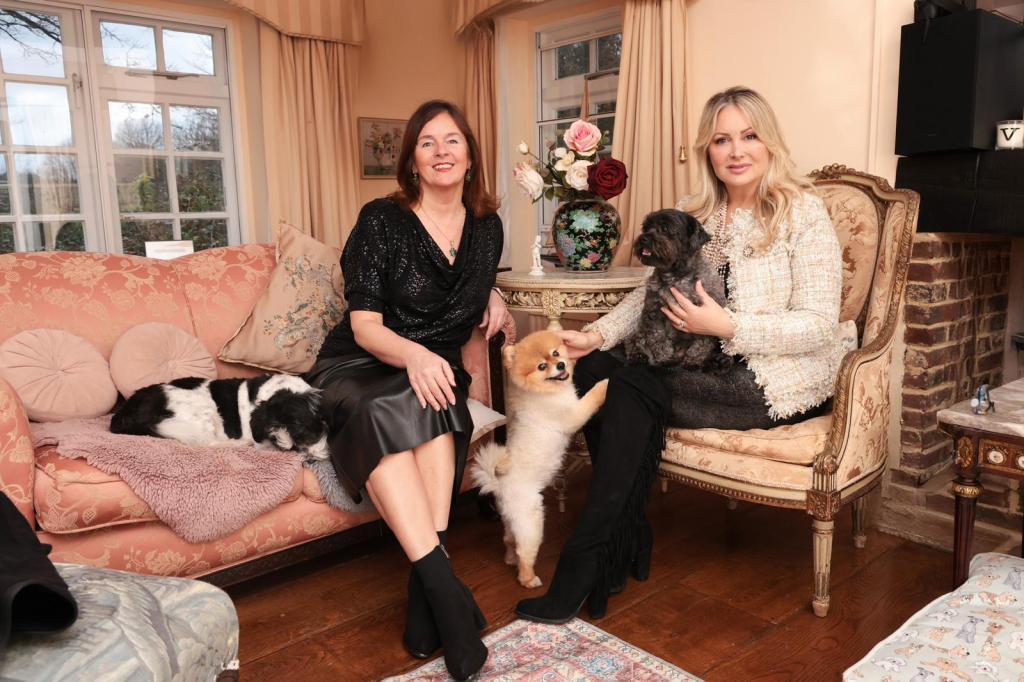
Clare McSweeney is back, sharing her latest expert tips and answering your questions on all things aesthetics.
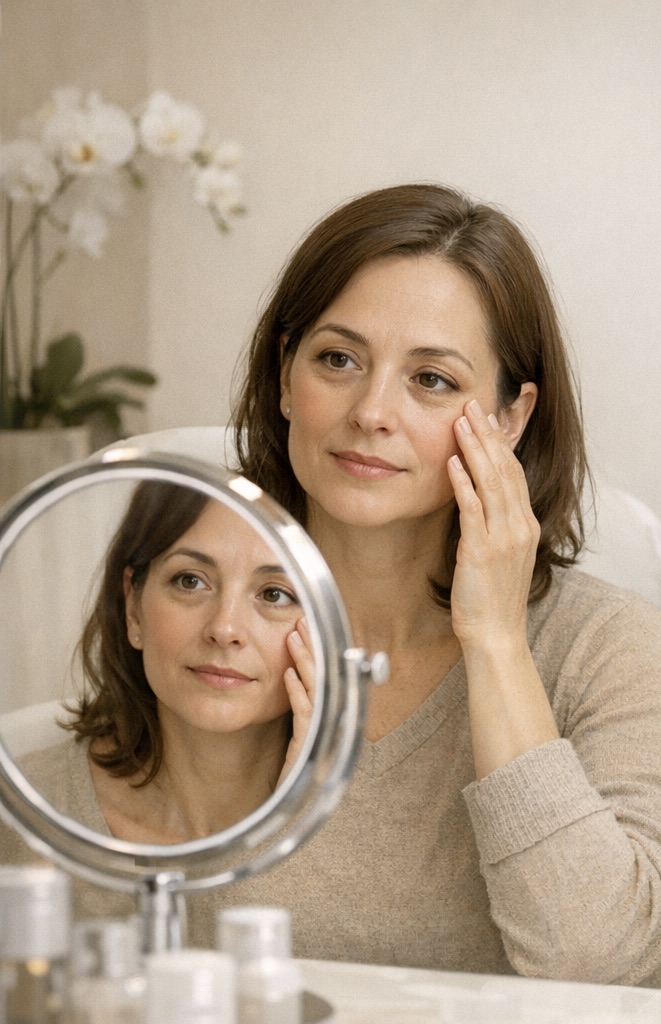
As we begin to shake off winter, many of us are left with skin that looks tired, dull, and in need of a little TLC. Seasonal changes can play havoc with hydration, texture, and glow — but the good news is there are plenty of ways to refresh your skin without going straight for injectables.
Clare’s Top Five Tips for Beating Tired Winter Skin
Hydration is everything – Drink plenty of water and use a good-quality hyaluronic acid serum to plump and rehydrate the skin from within.
Gentle exfoliation – Once or twice a week is enough to remove dead skin cells and bring back brightness.
Invest in active skincare – Ingredients like peptides, vitamin C, and niacinamide can make a real difference.
SPF isn’t just for summer – UV damage happens all year round, even on cloudy days.
Consistency over quick fixes – Regular, well-chosen skincare will always outperform sporadic treatments.
Q&A with Clare
Dear Clare, I have Botox and fillers and I don’t want any more. But I do want to give my skin a boost. Are peptides any good, or should I invest in good skincare? Nicky, Essex
Clare replies: Peptides are excellent and absolutely worth considering. They work by encouraging collagen production and helping the skin repair itself, which is ideal if you’re stepping away from injectables. That said, peptides work best as part of a well-rounded skincare routine. Investing in good-quality skincare — particularly a cleanser, antioxidant serum, moisturiser, and SPF — will give you longer-lasting results. Think of peptides as a powerful supporting act rather than a solo solution.
Dear Clare, How can I check that the woman I’m going to is qualified to do my Botox and other treatments? She was lovely at first, but I bruised badly last time. When I complained, she became defensive and dismissed me. Someone in my yoga group said she found out the woman wasn’t qualified and is just a doctor’s wife. What can I do? Milinda, Raleigh
Clare replies: This is such an important question. First and foremost, you have every right to ask about qualifications — a reputable practitioner will welcome this. In the UK, anyone administering injectables should be medically trained and properly insured. Ask to see their qualifications, professional registration (such as NMC or GMC), and insurance documentation. You can also check reviews, before-and-after photos, and whether they offer a full consultation with informed consent. If someone becomes defensive or dismissive, that’s a red flag. My advice would be to stop treatment with them immediately and report concerns if necessary. Your safety should always come first.
Dear Clare, I’m struggling with bags under my eyes. A friend suggested tear trough, but I’m terrified of needles near my eyes and I can’t afford cosmetic surgery. Any thoughts? Danielle, Wandsworth
Clare replies: You’re not alone — under-eye concerns are incredibly common. Tear trough filler can be effective, but it’s not the only option and certainly not something you should feel pressured into. Non-invasive treatments such as medical-grade eye creams with caffeine, peptides, and retinol can significantly improve puffiness and texture over time. Treatments like polynucleotides or skin boosters (when appropriate) can also improve the quality of the skin without adding volume. A good practitioner will always discuss alternatives and tailor a plan to your comfort level and budget.
Dear Clare, I’m a man and I like to look my best. I’m 40 and it’s time to turn back the clock — but I’m terrified of looking frozen. What would you suggest as an introduction? Roger, Brentwood
Clare replies: You’re asking exactly the right questions. For men, subtlety is key. My go-to introduction is low-dose Botox focused on areas like the frown lines rather than the forehead, combined with great skincare. The aim is to look refreshed, not “done”. Skin boosters, profhilo-style treatments, and a tailored skincare routine can also make a huge difference without changing your natural expressions. A conservative approach, gradually built up, always delivers the best results.
Clare’s Top Five Aesthetic Tips for Men
Less is more – Start conservatively and build gradually.
Focus on skin quality first – Healthy skin always looks youthful.
Avoid over-treating the forehead – Movement matters.
Don’t neglect skincare – Cleanser, moisturiser, SPF are essentials.
Choose an experienced practitioner – One who understands male facial structure.
If you have a question for Clare, keep them coming — she’s here to help you look refreshed, confident, and completely yourself. 💫
Heidi Gammon, Agony Aunt, Answers Your Valentine’s Questions
Love, desire, doubt, and the courage to speak honestly — Valentine’s Day has a way of stirring emotions we sometimes keep carefully tucked away. Whether you’re navigating friendship, long-term relationships, new love, or loneliness, these questions remind us that matters of the heart are rarely straightforward.
You can hear Heidi Gammon, alongside Steven Smith and Aston Avery, discussing these real-life dilemmas on Gateway Radio on February 10th at 10am, with the full show available to catch up on YouTube shortly after.
Dear Heidi,
I hope you are well.
My best friend of twelve years is gay. We’ve known each other since high school, and his sexuality has never been an issue for me or my family — we love him unconditionally. Over the years he’s had various partners, but nothing serious.
Two months ago, after we’d been drinking, he kissed me and told me he loved me. I honestly don’t know why I let it happen. It stopped there, and we’ve never spoken about it since.
Looking back, I think I may have been in denial. He’s always had a crush on me, and I’m now worried that this might be stopping him from meeting someone who can truly return his feelings. There is no chance of it being reciprocal, but I feel I need to talk to him — for both our sakes. What should I say?
All my love,
Adam, Brentwood
Dear Adam,
Thank you for trusting me with something so sensitive.
What stands out most here is how much care and respect you have for your friend — and that matters. Love doesn’t always fit neatly into boxes, and sometimes unspoken feelings linger quietly until they surface in unexpected ways.
You didn’t do anything wrong by freezing in the moment. Alcohol lowers boundaries, but it doesn’t create feelings that weren’t already there. What does matter is what you do next.
Avoiding the conversation protects neither of you. The kindest thing you can do is speak honestly and gently. Choose a calm moment and tell him that you value him deeply, but that your feelings are firmly platonic. Reassure him that your friendship matters and that you don’t want him holding onto hope that prevents him from finding someone who can fully return his love.
It may feel awkward — but clarity is an act of love too. You’re the best Heidi
Dear Heidi,
My boyfriend of four years really looks forward to Valentine’s Day. Each year he buys me gifts from Ann Summers and similar places. While he always takes me out to dinner, the evening usually ends with him wanting to dress up, role-play, and act out fantasies.
I think our relationship is loving and generally good. I do go along with some dressing up at times, but I feel like I’m not giving him what he really wants — and if I’m honest, the focus on “dress-up time” at Valentine’s is actually off-putting for me.
What can I do? Stella Southend
Dear Stella
Long-term relationships often stumble when desire becomes an expectation rather than a shared experience.
Your boyfriend’s enthusiasm isn’t wrong — but your discomfort isn’t either. Valentine’s Day has somehow become loaded with pressure, particularly around sex and fantasy, when it should be about connection.
This isn’t about you failing him. It’s about mismatched expectations. The answer lies in conversation, not performance. Try saying something like: “I love being close to you, but when dressing up becomes the focus, I feel pressured rather than desired.”
Intimacy thrives when both partners feel safe and excited — not obliged. If you can’t meet in the middle, it’s worth asking whether this dynamic works for you long term.
Hi Heidi,
I love your column.
My mum is 55 and looks great. My dad left when I was 12, and she hasn’t really met anyone since. I’m 19 now and leaving home in September, and I’d love for her to meet someone.
She insists she’s fine and tells me to leave it, but I worry about her being lonely. There’s a man who works for the council who’s been to the flat a few times to do jobs. She always smiles at him and makes him a cup of tea. He’s divorced and around her age.
Should I try to set them up? I sometimes see him at my gym.
Thanks, Darren, Basildon
Dear Darren,
Your concern for your mum is genuinely touching — but tread carefully.
Loneliness looks different at every age, and contentment doesn’t always announce itself loudly. Your mum may truly be at peace with her life as it is, even if it doesn’t look like what you imagine happiness should be.
That said, a gentle nudge is fine — a shove is not. Instead of playing matchmaker, open a conversation. Ask her how she feels about dating now, not what she’s missed in the past.
And one important rule: never involve a third party without consent. If she does express interest in meeting someone, you can mention the council worker — lightly — and then step back.
Let her lead. Love, at any age, deserves dignity.
Dear Heidi,
I’m in my sixties, gay, and single. I don’t like bars or dating apps, and the idea of going on a date makes me feel physically sick.
What can I do?
Mike, Romford
Dear Mike,
You are far from alone — and nothing is “wrong” with you.
Dating culture can feel exhausting, performative, and frankly brutal, especially if bars and apps don’t suit your personality. The good news? They’re not the only doors into connection.
Consider spaces built around shared interests rather than romance: walking groups, book clubs, volunteering, community classes, or LGBTQ+ social groups that aren’t centred on nightlife.
Connection grows more naturally when the focus isn’t dating but being. And remember — companionship doesn’t always begin with fireworks. Sometimes it begins with comfort.
Love Heidi
Dear Heidi,
I’m taking my new girlfriend out for our first Valentine’s Day together. I try to be a good boyfriend — I open doors, pick her up, and help out whenever she needs something done at her place.
But I’m honestly terrible at the romantic side. Flowers, yes — but beyond that, I’m stuck. What can I do to make Valentine’s Day feel truly special?
Eric, Brighton
Dear Eric,
You may not realise it, but you’re already doing many things right.
Romance isn’t about grand gestures or perfect scripts. It’s about thoughtfulness. The most memorable Valentine’s moments are rarely expensive — they’re personal.
Think about her. What makes her feel seen? A handwritten note. A playlist. A meal you cook yourself. A walk somewhere meaningful. Even saying, “I’m nervous because I really care” can be incredibly romantic.
Romance isn’t performance — it’s intention.
Heidi
Hello Heidi,
My husband and I have been married for twelve years. Recently, he suggested spicing things up by having a threesome. He says he doesn’t mind whether it’s with a man or a woman.
If I’m honest, the idea does appeal to me — but I’m scared it could either strengthen our marriage or completely ruin it.
Are there ground rules I should put in place? Or is this a bad idea altogether? I’ve told him I need time to think about it.
Anonymous
Dear Anonymous,
I’m glad you didn’t rush into an answer.
A threesome is not just a sexual experience — it’s an emotional one, and once a third person enters the picture, there’s no “undo” button.
Before discussing rules, ask deeper questions. Why does your husband want this? What does it represent for him — novelty, validation, curiosity? And equally important: what does it represent for you?
If you decide to explore it, boundaries are essential: who, when, emotional limits, aftercare, and the right to stop at any time — even at the last minute.
But if your gut says “this might damage us,” listen to it. Desire should never come at the cost of safety or trust.
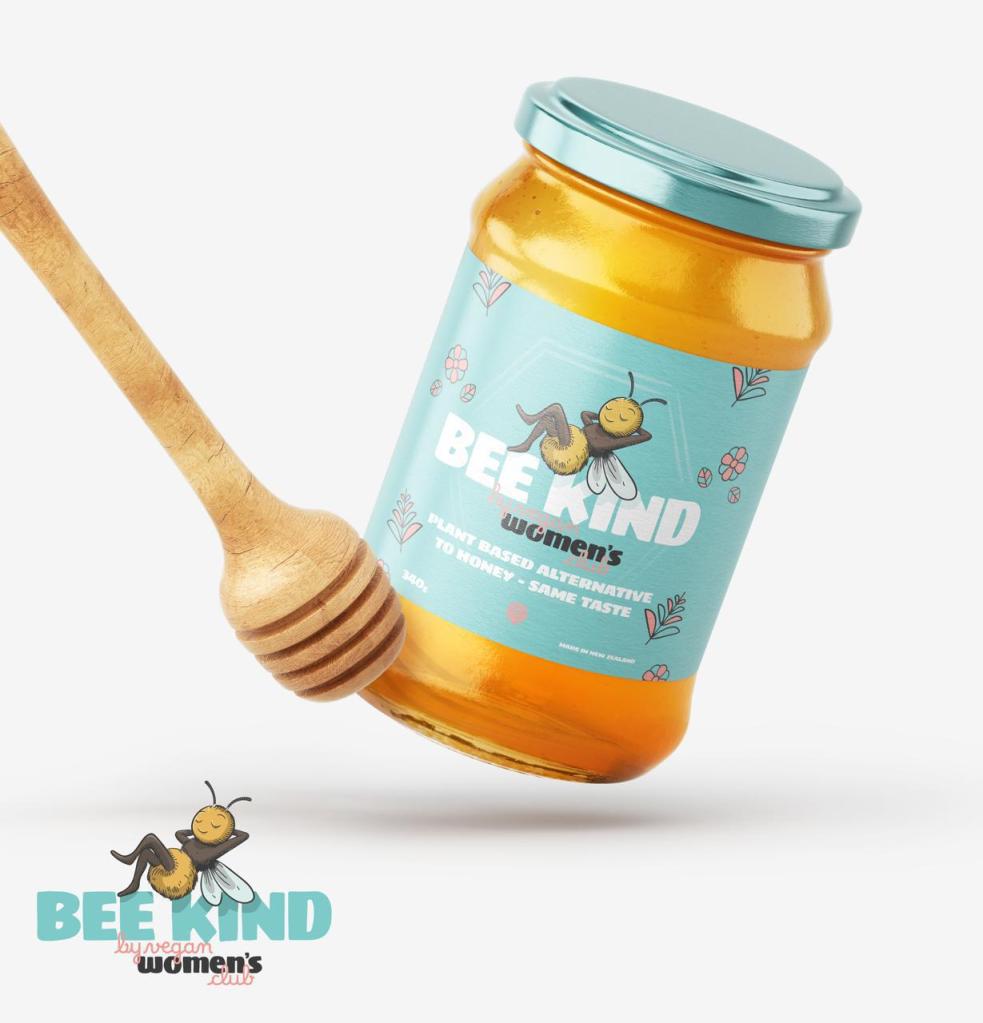
I just have to share something new and genuinely exciting — and trust me, you absolutely do not have to be vegan to enjoy this plant-based treat. I first tried it at the Vegan Women’s Club, casually spooned it onto something sweet, and by the end of the evening I was already plotting how to get more. Yes… vegan honey.
Before you ask — “Tell em about the honey mummy !” — let me say this straight away: this is a sexy little number, and once you try it, you’ll understand exactly what I mean. Nothing to do with the the Honey Monster or the serial.
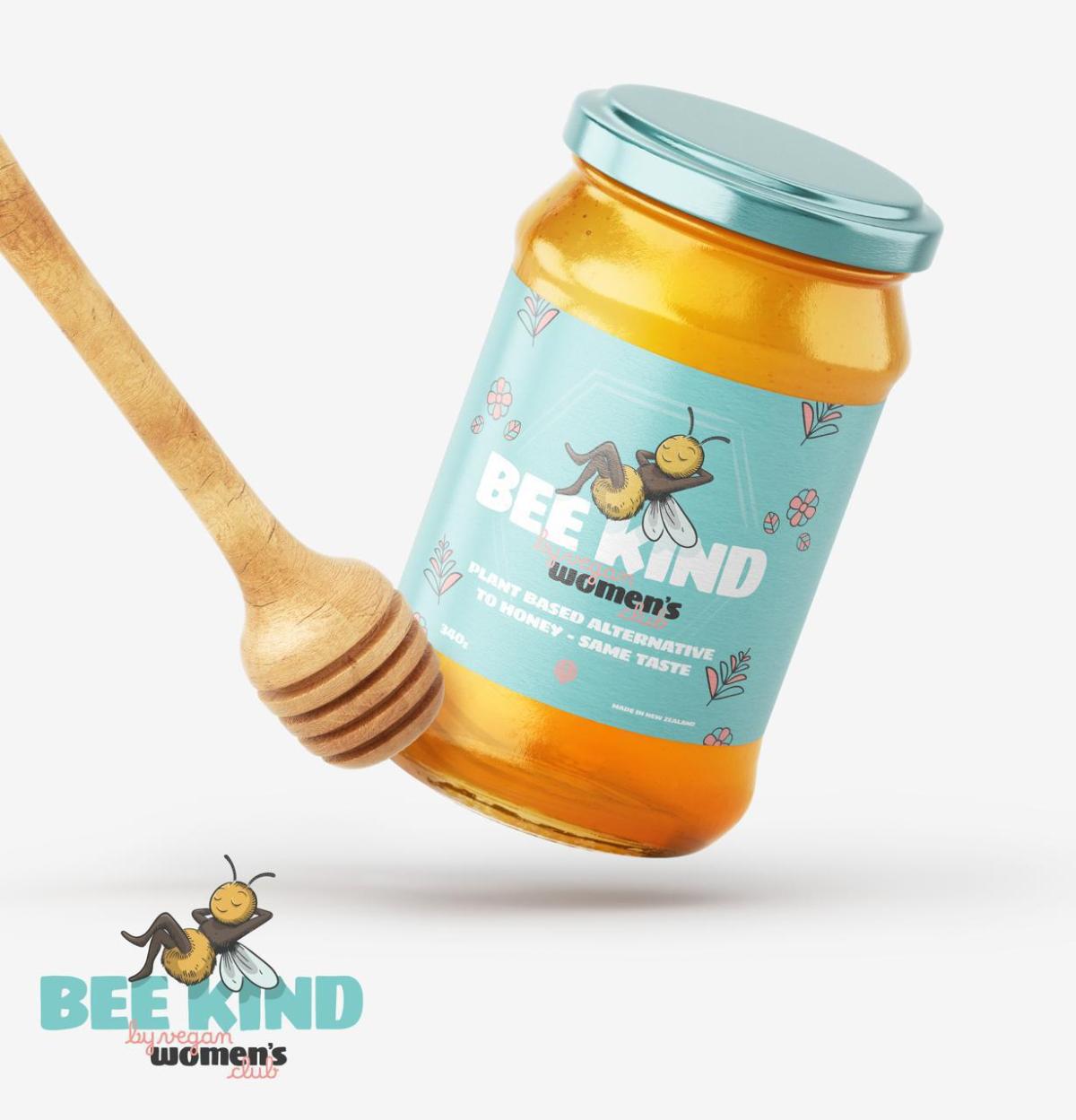
Bee Kind is a newly launched, plant-based alternative to honey that’s already creating serious buzz around the world. Crafted in small batches, Bee Kind is made from pine needles using traditional infusion methods that recreate the taste, sweetness, and mouthfeel of conventional honey — without harming a single bee. And astonishingly, it’s virtually indistinguishable from the real thing.
Available in Golden (Original), Creamed, and Horopito Chilli, Bee Kind delivers something for every palate. The Golden variety offers that familiar, comforting honey flavour we all know and love. The Creamed version has the same authentic taste but with a smooth, spreadable texture that feels luxuriously indulgent on toast or stirred through yoghurt. Then there’s the Horopito Chilli — a quietly confident blend of sweetness with a gentle, warming peppery kick inspired by the New Zealand pepper tree. It’s bold, unexpected, and utterly addictive.
What makes Bee Kind even more fascinating is its use of pine needles — an ingredient that has been consumed for centuries across many cultures and historically valued for its naturally occurring compounds. Bee Kind cleverly reimagines this heritage ingredient, transforming it into a modern, ethical alternative that feels both innovative and rooted in tradition.
There’s also a deeper story here. Commercial bee production often involves practices that place enormous stress on bees and are increasingly recognised as harmful. Bee Kind removes bees from the production process entirely, offering a more compassionate choice for those who want to enjoy honey-like sweetness without contributing to exploitation.
Despite being a recent launch, Bee Kind is already making serious waves internationally. Reviews have been glowing, and orders are coming in from as far afield as Israel, Dubai, and Belgium — clear proof that demand for thoughtful, plant-based alternatives is no longer niche but truly global.
Whether you’re vegan, plant-curious, or simply someone who appreciates good food made with integrity, Bee Kind is one of those discoveries that feels exciting to share. It’s indulgent without guilt, familiar yet refreshingly new — and once you’ve tried it, you’ll find yourself reaching for it again and again.
Bee Kind is available now via the Vegan Women’s Club, with an exclusive and generous discount for members. Consider yourself warned: one taste, and you may never look at honey the same way again. 🍯✨
I want to make one thing 120 per cent clear: I am absolutely in favour of physical self-improvement and anything that helps us feel good about ourselves, including anti-ageing treatments. After all, if your house starts to crumble or needs a repair, most of us don’t think twice about getting a tradesperson in to fix it. We patch, we paint, we renovate. So why should our faces, bodies, or confidence be treated any differently?
Fill your boots. Have the facial. Get the Botox. Try whatever makes you feel better when you look in the mirror. Confidence is attractive, and feeling good in your own skin can be genuinely life-enhancing. But—and this is the crucial bit—we also need to be careful. There’s a line where self-care quietly slips into obsession, and sometimes it isn’t your gorgeous face that needs work at all, but your mental health.
Age, after all, is just a number. Reaching 60 is not guaranteed. If you’re lucky enough to get there, rejoice—many don’t. Yet we live in a culture obsessed with youth, where growing older is treated as something faintly shameful rather than something earned. I constantly hear phrases like “age-appropriate dress” or “age-appropriate behaviour,” usually delivered with a raised eyebrow and a side-order of judgement.
Let’s be honest. If gravity has taken a firm grip and décolletage is mapped with red veins, tiny shorts and a boob tube probably won’t make you look younger—it’ll likely do the opposite. But equally, if you want to wear them, then shake it honey 🥾. Personal style should be about expression, not apology. Dressing “younger” doesn’t make you younger; dressing confidently makes you look alive.
What I genuinely struggle to understand is why so many people feel entitled to judge others for ageing gracefully. There’s a peculiar cruelty in sneering at someone who has chosen not to fight time with needles and fillers, as if dignity itself were an act of rebellion.
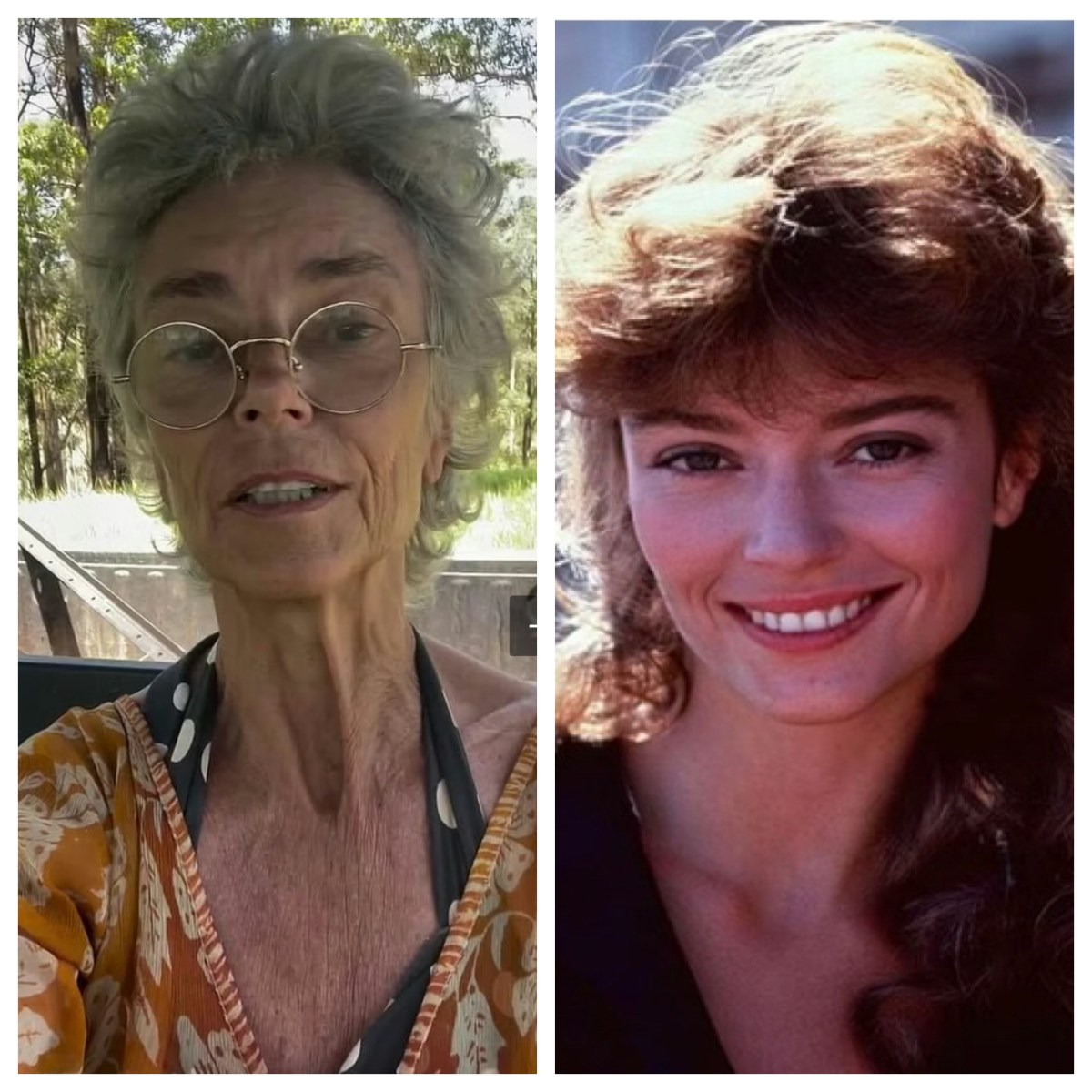
Take Rachel Ward, once heralded as one of the great beauties of the 1980s after her unforgettable role in The Thorn Birds. She could have spent decades trying to drag her face back to that era, chasing a frozen echo of her younger self. Instead, she chose something braver. She embraced her face in her sixties—lines, movement, expression intact—and looks refreshingly real. There’s no stiffness, no denial, just a face that tells a story. A face you want to know.
No frozen look here. Just confidence, character, and the quiet power of self-acceptance.
Perhaps that’s the real anti-ageing secret: not erasing who we’ve been, but owning who we are.
Re: The Beckhams
From “harmless mum dancing” to accusations of being overly controlling, the Beckhams have once again found themselves dominating headlines—at a time when the world is facing far graver realities. Bodies lie in the streets of Iran, conflicts rage across multiple countries, and yet we are invited to clutch our pearls over a family wobble involving a pop star, a dance floor, and a grown man with opinions.
Brooklyn Beckham, we’re told, had a tough childhood. Listen, pal—we all had to listen to your mum sing. Perspective is a wonderful thing.
But let’s be honest: no one truly knows what goes on behind those carefully curated, smiling family photographs. Families are complicated. Fame magnifies everything, distorts nuance, and turns private disagreements into public sport. Judging any family—famous or not—based on fragments and hearsay is a fool’s errand, and none of us are in possession of the full story.
What did give me pause, however, was DJ Fat Tony choosing to speak out. It was a paid gig. He was hired, did the job, and that should have been the end of it. Unless subpoenaed or dragged into court, discretion would have been the wiser—and classier—option. Airing opinions after the fact feels less like honesty and more like self-publicity. A whiff of Paul Burrell, if you will.
As for the rest of it, let’s calm down. If Victoria Beckham wants to dance in a way deemed “inappropriate” by the commentariat, someone could have gently steered her off the floor. It was hardly the crime of the century.
If anything, the whole saga has had the unintended consequence of resurrecting Victoria’s singing career—long thought buried—rising again like a bad smell. Some things, it seems, never stay dead.
Here’s hoping The Beckhams do what most families eventually manage: talk, regroup, and move on—preferably without the rest of us pretending it’s global news. However if mum or dad is nightmare I urge anyone to put boundaries down asap as it only gets worse .
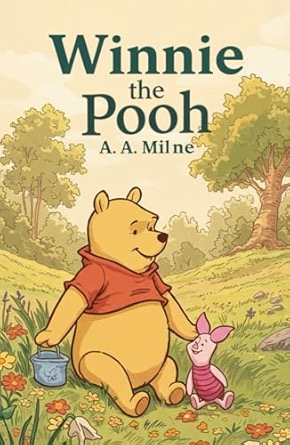
I have a very soft spot for Winnie-the-Pooh. My former partner of twenty years used to call me Tigger, after the ever-bouncy tiger, and over the years he sent me affectionate cards featuring Pooh and friends. One of the last films we saw together was Winnie-the-Pooh, and we loved it—gentle, comforting, and quietly profound.
Pooh and his friends beautifully emulate life itself. Eeyore carries his depression with weary honesty; Tigger bounces through the world with unstoppable enthusiasm; Piglet worries; Owl pontificates; and Pooh simply is. There’s something deeply enchanting about a group of characters who mirror our own emotional landscapes so tenderly, without judgement or pretence.
Created by A. A. Milne, Pooh gives us permission to slow down. In a world increasingly obsessed with productivity, achievement, and noise, the bear of very little brain reminds us that gentleness is a strength. He values friendship over status, kindness over cleverness, and a good walk in the woods over almost everything else—except, perhaps, honey.
For many of us, Pooh arrives early in life, read aloud at bedtime, his world drawn in soft, timeless lines by E. H. Shepard. But he grows with us. As adults, we return to the Hundred Acre Wood and discover unexpected wisdom in its simplicity: that it’s all right not to have the answers, that listening matters, and that being present is often enough.
Pooh’s importance lies in his humanity. He reassures us that you don’t need to be extraordinary to be loved, and that friendship—steady, imperfect, and loyal—is what truly carries us through life.
One hundred years on, Winnie-the-Pooh still whispers the same gentle truth: sometimes the smallest things take up the most room in your heart. 🍯💛
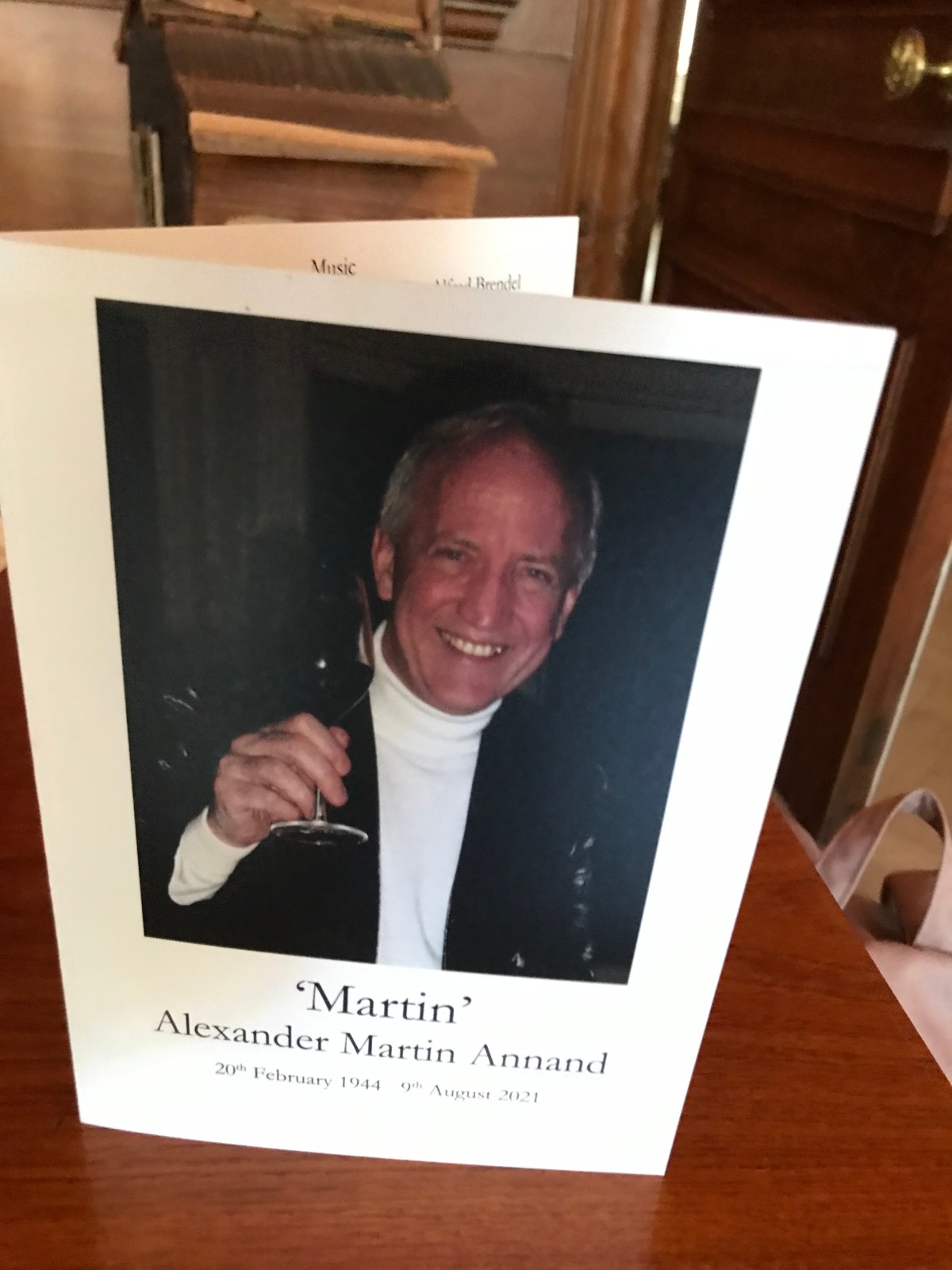
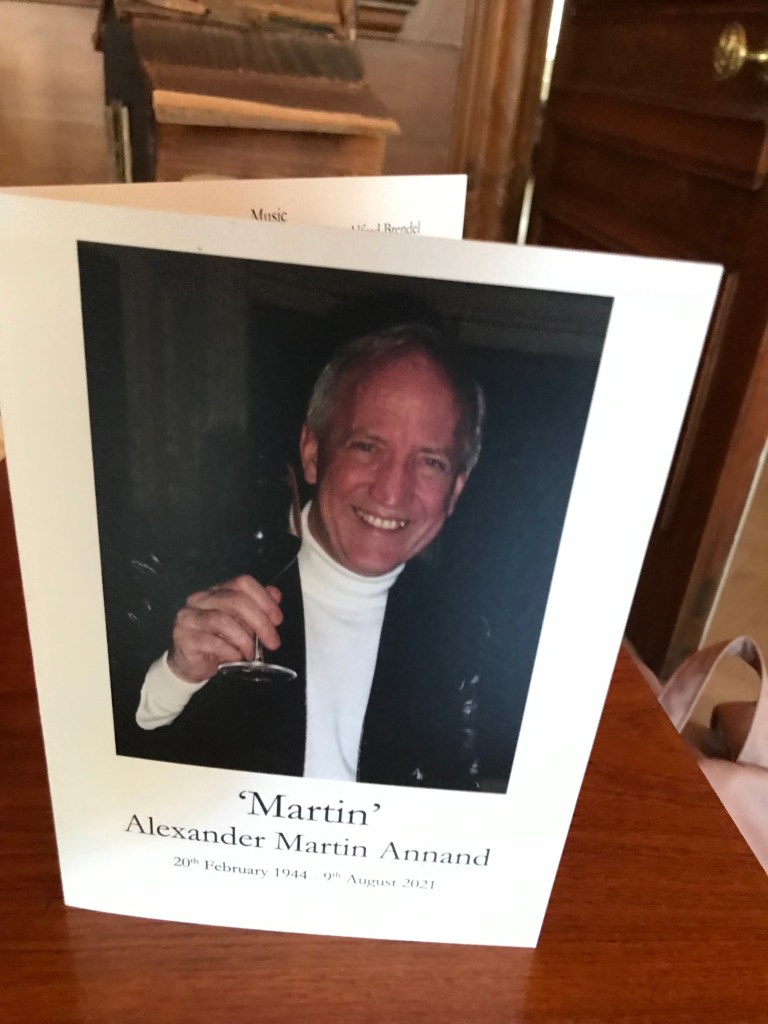
Other people’s issues. Martin and I had a beautiful relationship but there was always someone who had an issue with it . It may seem strange to start my story at the end of someone’s life to tell their tale. The remarkable Mr Annand was no ordinary man, so his journey should be told just as the curtain is about to fall on his extraordinary life, an existence that for most parts was never quite what it seemed to so many.
Mr Annand, or as we called him, Martin, looked up at me from the brown mobility chair, which he had become confined to during the day over the last few weeks of his life, his beautiful big blue eyes still reminding me of Jiminy Cricket from Pinocchio. Still full of hope, he smiled at me, pulled gently on my shirt and asked me to go and get a nice French bread stick – warm if possible – and some soup. He had been off his food for the last few days so it was a relief to hear him want something.
There was only one problem. We needed to hide the bread from Nicos, Martin’s Greek Cypriot trust fund civil partner, as gluten and bread were taboo in the soulless flat that they shared in trendy Bloomsbury. Though the wood and lighting were incredible, it resembled an art gallery with uncomfortable furniture. Nicos ruled the roost in this place and would become hysterical and cruel when not getting his own way. Even traditional cooking was banned for fear that it would cause damage to any of the many art works.
A splash of water, not wiped up from the sink tap, could cause a rage so powerful you would have thought you had flooded the flat.
Nicos had allowed me to take joint care of Martin with great reluctance; only after he had worked out the actual cost of private nurses did he reluctantly give in. At first it was only to be when Nicos was at cross fit for three hours a day, or when he had his own hospital appointments. However, the workload was constant and eventually I stayed there 24 hours a day, and for this I was grateful Nicos allowed me to do so as it was so painful not to be with Martin
It seemed odd to me: Nicos’ art collection in the UK and Cyprus had a value in the millions so if he had sold just one piece, it could have funded 24-hour private care. Martin always said that, despite Nicos’ wealth given to him by his father, he was incredibly tight.
Nicos had just left for a workout and was meeting a friend after. Dashing up Tottenham Court Road to M&S, I returned quickly with some of Martin’s favourite fruit jellies, two small warm bread flutes and heart-warming chicken noodle soup. Frantically I cut the bread up into small slices and buttered them cleaning up after myself for fear that crumbs would be found.
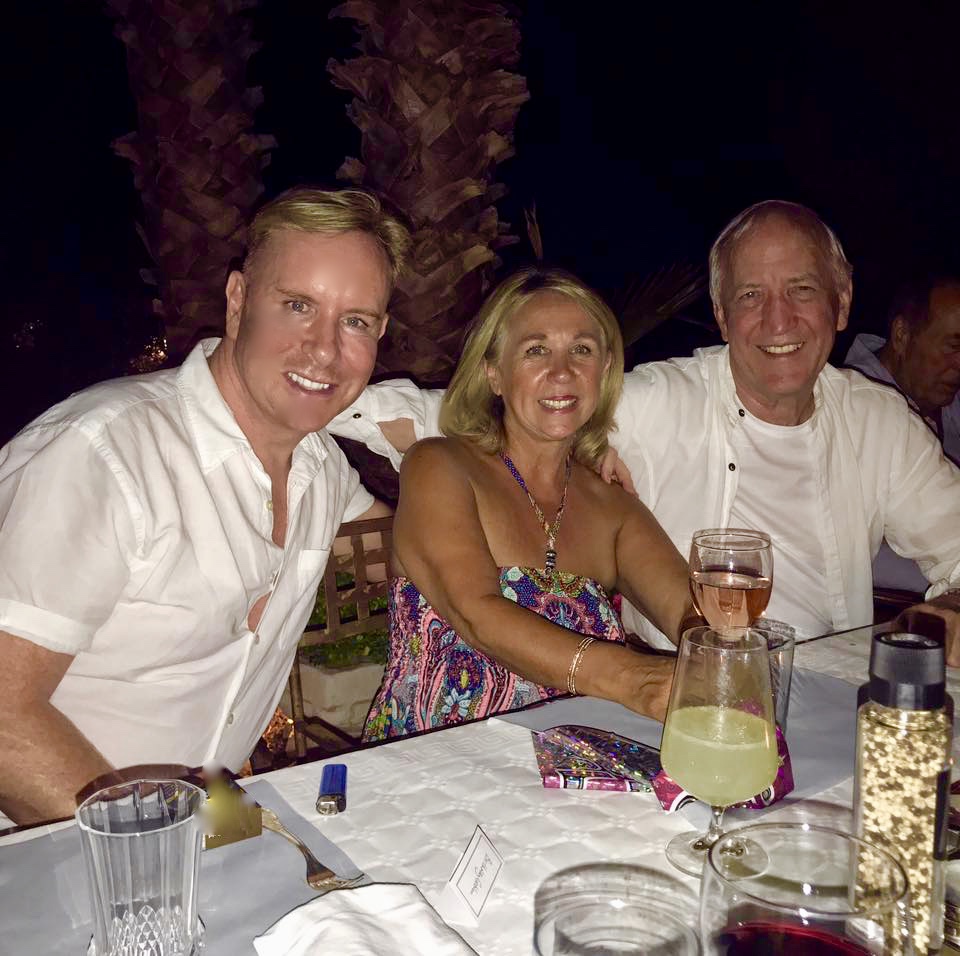
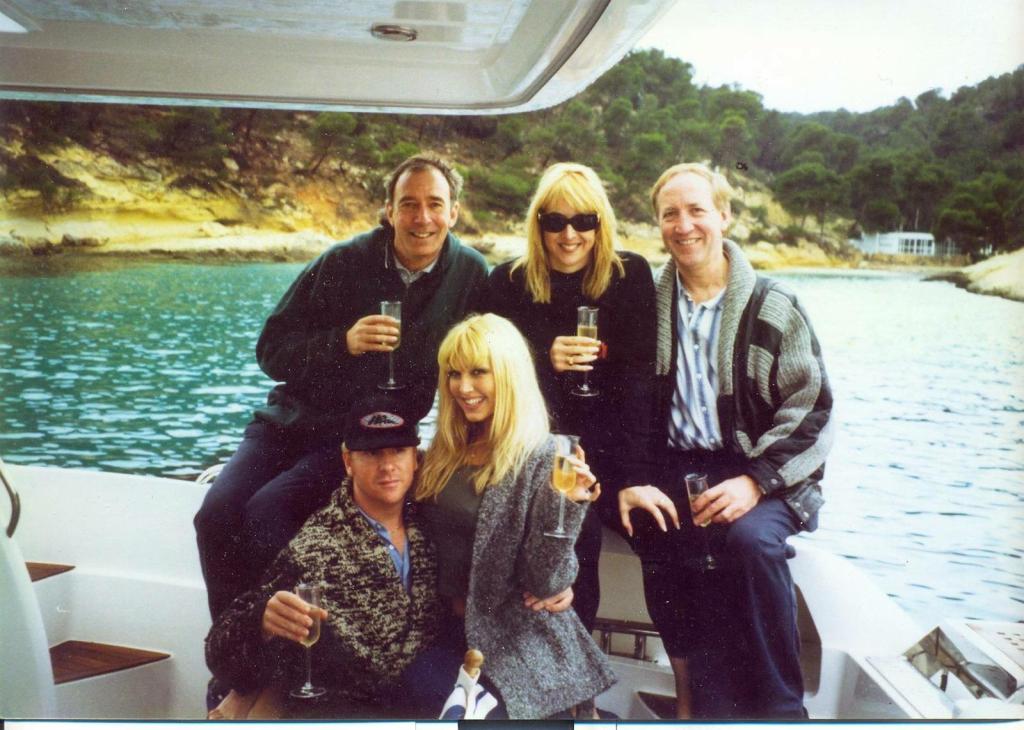
Martin Annand and Pam Sharrock and me in the South of France
The soup was being cooked in the microwave that was hidden so high up, cooking anything in it was a challenge. Even the kettle was in a cupboard to stop steam hitting any artwork that adorned the kitchen walls. Martin smiled as I brought it to him, “I am getting my appetite back”, he said, with some hope. Pointing out it was a good sign, I gave him a wink
. The man I had loved for forty years was dying and I was determined to keep my emotions in check and just be his rock. If I ever allowed the flood gates to open and show how I was feeling, my fear was that the tears would never stop, and that was the last thing he needed. Martin had a beautiful childlike quality that most people never got to see. He gave me a paw as I put the food down.
Of course, he only managed a little bread and some soup. Just as he was about to get me to take it away the door opened. Nicos was there. “All right my love, what’s that you have got there?” he enquired, with his eyes throwing daggers of steel towards me. Explaining that he really wanted a bread roll and some soup, strangely Nicos did not react, although I made a hasty retreat to the kitchen to discard the evidence out into the bin in the communal areas of the block.
There was only one flute of bread left by the side of the sink that was left to hide. Nicos had not gone to shower as he usually did on return from the gym and he was in the kitchen. To my amazement, he was cutting the spare French bread flute in to slices and covered them in strawberry Jam and organic Honey. Instinct told me to get out of the way to see Martin, and a wise decision it was.
Ten minutes later Nicos came charging down the wooden plank floors of the corridor towards the bathroom slamming the door. He spent twenty minutes in there inducing himself to vomit. Eventually he came out and marched up to Martin, shoving his hands that stunk of sick up into Martin’s pale face. “Look what you made me do bring that into our home!”
There was nothing I could do to stop Nicos. My heart often went out to him as he was so uncomfortable in his own body, I can only imagine what it must be like to wake up every day so unhappy in life. I do not think that I had ever seen him do a full day’s work in the twenty years I knew him. Martin wrote his correspondence for him, Nicos went for the odd meeting in Cyprus but for the most part, he went to the gym, shopped, attended gallery openings, and holidayed abroad a lot. What he devoted a lot of time to was sitting in judgement of other’s efforts, which he did with great ease. He really was the quintessential trust fund baby.
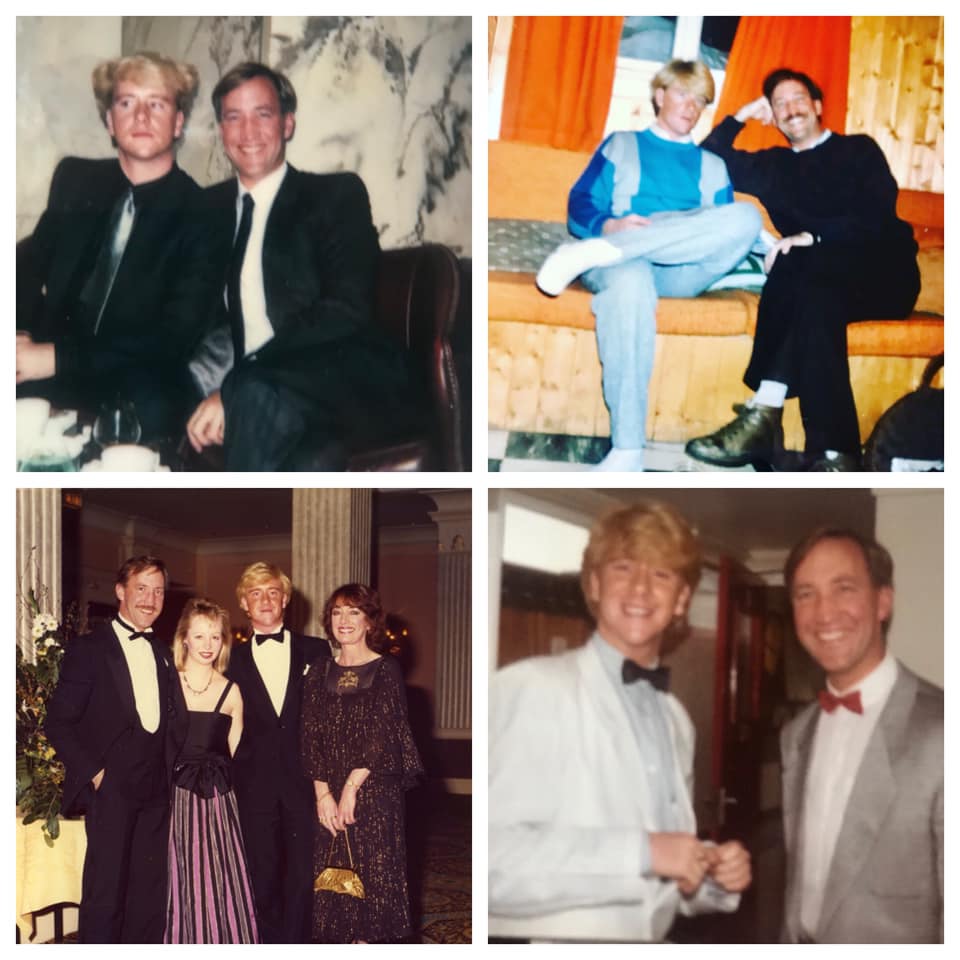
Though Nicos’ and my relationship made Joan’s and Bette’s look like an easy one, he always had the upper hand. At first I had liked him as he was amusing, witty and we shared many of the same interests. He clearly had huge mental health issues, so to take him on was a fruitless task and only caused issues with me seeing my ex-partner, Martin.
Over the years my radar went into no comment regarding his hatred of me, even during the campaign of daily phone text’s calling me every name you could imagine. Once he caught me off guard with the malicious comment, “No wonder your boyfriend killed himself and the latest is missing!” That text was a step too far and I threatened to call the police, although for the sake of Martin, we did eventually make up
. There was always someone who had an issue with my relationship with Martin. Nico’s just could not cope with the fact that Martin still loved me and him in different ways. It was not long before Nicos was in the kitchen and you could just tell he was looking for a fight. He was opening and closing drawers for no reasons when suddenly he spied a small amount of water that had escaped me whilst cleaning, next to the marble sink. That was it, he hit the roof. “YOU RESPECT THE QUALITY OF NOTHING!” he bellowed behind me as I made my excuses to Martin and decided to spend one night at my home let Nicos calm down. When an apologetic text from Nicos did come through, I told him all was fine.
Returning the next day at 6:30 I found there were two patients in bed: Nicos had piles and might need to go the hospital, possibly for four days. Nicos had fired four of the helpers the NHS had sent us. Looking after Martin really needed two, but the idea of spending some time with him was a relief to me. In the end Nicos just went to a specialist. Looking after Martin was not the hard part, though it was breaking my heart every day. Dealing with Nico’s, who was devious and underhand, was horrendous. He seemed obsessed with my every move.
However if you think he sounded bad, nothing could prepare you for his sidekick we will call “The Cousin”. A woman as equally uncomfortable in her own skin as Nicos, Martin had only known her for five years. On the face of it she seemed nice, with an air of the teacher about her. Nicos had decided that she was Martin’s replacement sister, as the relationship with his own sister Pen had become strained over the years due to her dominating girlfriend. Martin ‘just loved her’, Nicos would inform me with some command. Martin, though fond of her, did not see her that way.
She was a walking nightmare and expert on everything to do with cancer. My first hint that she needed to be stopped was when Martin called me telling she was trying to roll a tennis ball up and down his spine. Luckily, I got there in time to challenge her and that went down like a lead balloon.
The cousin had a habit of putting her hand up like she was teaching at school. I did not want Martin doing those exercise she was trying to make him do and reiterated that he had spinal cancer so his specialist would need to approve any exercise. If she was teaching or instructing, she was fine. Nicos went away for two weeks and left me with Martin. The Cousin started coming over bringing lots of sugary desserts, all well-meaning but not good for cancer and definitely not to Martin’s taste. It seemed well meaning so Martin would smile and say, “Save for later, yummy!” I would chuck them in the bin as soon as she left.
The first time she came over was to give me an hour off. Martin asked me to call and cancel her, he would be fine, but I felt it would be rude to do so, and if she did come, it would pacify Nicos and assure him that everything was ok. Politely, I thanked her for coming. “I was coming whether you wanted it or not”, she replied, with the coldness of a witch at midnight. “Nicos and I have a plan for Martin, so don’t you worry yourself”, she went on. People must have wondered why I did not tell her to go F— herself. Instead, I hid the various things she brought to roll on Martin. The last thing Martin needed was her exercises that still needed to be approved by a professional.
We nearly had words when she waltzed in all sweetness and light with more desserts. With her empathetic face she asked, “Anything I can do to help?” For once I was happy to oblige, asking if she minded making Martin’s bed. Her face fell as what she really had meant was if there was anything she could teach or instruct. Her face perked up as she replied, “I will teach you how to do it.” Of course, I declined.
There was zero empathy from Nicos when I explained Martin was not as keen on her visits as he thought. But more important please could he supervise her teaching exercises as she had zero experience. Having breast cancer did not make you an expert on all cancers. Nicos hollered, “She is like a sister to him!” Nicos had ostracised most of Martin’s close friends and substituted them with ones he approved of over the years they were together.
We were told by the nurse visiting Martin that under NO circumstances should he make any financial, work related or personal decisions at this stage. It became incredibly difficult to handle the Cousin and Nicos, as no matter what I suggested, it was wrong. Dr Prakash who had helped Martin with his injections and treated him privately for free was branded an idiot, whereas the cousin, who really needed locking up, was always right whatever she said.
To this day it is my belief that she helped speed the cancer up. I grieved for Martin deeply. When one considers grief, it is foremost for the person you have lost. You could not begin to comprehend how grief magnifies when also confronted with two such devious, plotting malcontents, whose subsequent aim was to erase me from Martin’s eulogy along with any memories we shared. But I’m getting ahead of myself.
Apart from a lunch with my dear friend Marieanne, I had been there with Martin for twenty four hours. However I had a doctor’s appointment that I could not miss, but the whole thing would take only four hours tops. Warning signs should have flagged in my brain as the pair seemed unusually enthusiastic about this and confirmed several times that I was still going. Despite the warning given by the professionals, whilst I was out they got the lawyers in and established power of attorney.
Worse still, in his weakened state, Martin signed standing orders to pay monthly into the joint bank account in the Isle of Man the sum of £10,000 from Princess Salimah Aga Khan’s bank account. When I returned, Nico’s was quick to tell me he had power of attorney and only he had the right to deal with things. But again he allowed me to stay. I only found out about the Princess Salimah standing order when she noticed it. It honestly finished Martin off, he was SO distressed. How could this ever have been allowed? Simple Greed on one person’s part. Salimah was distraught though she did attend the funeral by zoom.
My beautiful Martin Annand died in St Johns hospice on the 9th of August surrounded by his civil partner Nicos and myself, his lover and friend of forty years. I was wiping his mouth with a moist tiny sponge. He was ice cold, and I knew it was the end. He made a noise then went, Nicos screamed and ran to the door, missing the fact Martin had taken one more breath, and then the beautiful angel left us for good.
Martin and I had been of the same mind; if we took ill, we would go to Switzerland and end it with dignity. In hindsight it was easier said than done. Whilst Nicos was in Greece, Martin had all the details. He had gone on business to Geneva working with Salimah Aga Khan and had everything planned, it was just down to me to take him. He was having a bad day and was booking flights. Martin’s chemo had been tremendous, although his hair had stayed, and we were full of hope.
He would shower at night trying to ease the agonising pain, but he refused to take the morphine for fear of being hooked. The doctors said it was all down to the side effects of the radiation treatment. Believing them I begged him just to give it two more weeks, then we would go and Nicos would never need to know. But they were wrong, and the cancer had spread. I would not let a dog suffer the indignity my beautiful Martin went through. My deep regret is not saying yes and flying him down to Switzerland when he wanted to go. There was no time for me to grieve at the bedside
. Nicos was hysterical and threw himself on Martin’s body. It was the opposite of what Martin stood for. It was not long though before Nicos became aware of my obvious grief. “I am his civil partner and have rights!” he shrieked at the nurse. Not for one minute did I challenge that, even though Martin was in fact still legally married to an American and she never divorced him. For five minutes I excused myself and went to the bathroom, locked the door and broke down.
This was not what Martin would have wanted, so I stood up and went to aid Nicos. He was actually kind to me, thanked me, and he was full of questions. Martin would have wanted me to look after him and, as much as he would let me, I did. It did not take long for him to hit the phone. He asked The Cousin to meet him at the house.
He called Phillipa, a long-term friend in Cyprus that Martin and I both liked, and was furious that she could not come straight away. He turned to his old friend Tee, who was also in Cyprus. The pair had fallen out for years, but a mutual ailment had brought them back together, and that Tee did not like me was a huge bonus. He was flying over the next day. I offered to stay, but it was refused. Accompanying Nicos back home, I came up to make some tea.
It was not long before the cousin arrived, she was of course kind. To my horror they jumped into funeral arrangements. Worse still, “Has anyone told Danielle. Martin was very fond of her?” was the next question. They both knew that I had fallen out with Danielle as she had taken great advantage of Martin. He had paid for her partner to be flown from Cyprus as a medical emergency. He had set up a bank account up for her and had been paying the price. I saw her as a user although Martin said “She’s great at parties”. If I was throwing a party, number one on the guest list would certainly not have been Danielle. I realised that I was on a hiding to nothing and left the pair to it.
Though I had helped Nicos as much as I could, The Cousin quickly jumped in and took over; my little eulogy was judged too much about me by the pair and not used. The actual funeral had to be seen to be believed and if Martin had not been cremated he would have rolled in his grave. In fairness I was in the funeral procession car. Arriving at their home, Nicos was not there.
I was outside as the coffin pulled up and Nicos jumped from the car wearing ripped jeans, flanked by Tee and another friend, who both seemed to be dressed like crows. He fell onto the ground of the apartment steps, wailing, “My Martin is here!” calling up to Phillipa. Ironically it looked like a scene from Tosca, a favourite opera of Martin and I. Nicos saw me then and I thought he was coming to hug me, but instead all the drama was over. “You get in the second car”. It was a shape of things to come for the day. I was only allowed a few people as mourners. Nicos did not realise that Martin still had had a life with me and he saw people like Denise Welch and others when Nicos was not around. Still, I was not going to argue and held my head with dignity. Just as I was about to enter the crematorium at Golders Green on a beautiful sunny day, Nico’s whispered to me, “I am afraid I have been a bit selfish with the eulogy.”
Looking back at him, I replied I would not expect anything else. Nicos outdid himself with the downright pack of lies contained in the eulogy. Yes, there were moments of truth but it was hard for me to comprehend what was being read out. If there was any doubt that this was not a bad dream, the beautiful friends I shared with Martin, who were there to support me, gasped in places. Darling Marieanne, a long-term friend of Martin’s and my best pal at the time, squeezed my arm each time something was read out that made Nicos sound a hero and omitted my name completely. We were instructed not to look at Nicos as we left, but he should not have worried as there was absolutely no danger of that.
Walking through the crematorium doors into the beautiful memorial gardens, my numbness started to thaw out as one of my oldest friends exclaimed, “What the fuck was that?” Nicos had had the nerve to ring my kid sister in the US and ask her to watch. It was not long before she was on the phone to find out if I was ok. “Why did he say those things?!” She knew how humiliated I must have felt and said how restrained I had been. If she had been there in person with a baseball bat…
Do not think the thought had not passed my mind. However, holding my head high was what Martin would have wanted, not some ugly drama. His eulogy was heard by 42 people. A week later I released mine on the net and it has been seen by over 4000,000 people. Many of Martin’s family and friends asked why it had not been used. It is below. My hope is to hold a proper ceremony on the anniversary of Martin’s death.
The wonder that was Martin Annand A beautiful light has left the world. But I just know he is sparkling above us full of love. Martin Annand passed away at St John’s hospice London at 12.15 on the 9th of August 2021, with Mozart piano concerto 15 playing, and his civil partner Nicos Steratzias and his former partner Steven Smith lovingly by his side. https://www.stjohnshospice.org.uk/about/
Christopher Robin said to Winne the Pooh: “You’re braver than you believe, stronger than you seem, and smarter than you think.” Martin Annand was the quintessential Christopher Robin and he loved his eclectic friends, no matter their flaws, and he embraced their strengths. He would often joke, “I think he is having an Eeyore moment”, if a friend was down or not seeing the positive about something. He would reference more of Christopher’s pals, saying, “You’re very Tigger-y today”, if one of us was particularly bouncy, and even though Martin enjoyed a healthy lifestyle, he also empathised with Pooh, adoring a sneaky sweet or two. Martin was a true English gentleman, whose style and grace made him so wonderfully unique
. People just adored him as he made every person feel important, taking an interest in everyone he met. From classic cars to a hand of bridge, the latest song by the Pet Shop Boys, or even a glance at what Robbie Williams was wearing; Martin could talk about it all. He just loved everything in life. I would often laugh to myself when people thought Martin was “serious” and “a little unapproachable”
Martin with Ian Phillips Samantha Phillips and Emma Noble and me
. He was one of the funniest people I have ever met, bringing the phrase “Don’t judge the book by its cover” to mind. Martin’s inner child beamed out to those who knew him and took the time to see the beautiful man for who he really was. When I first met him, he told me a story that could only happen to Martin. He said, “I went to a dinner party last night. When I got there, the house was awfully dark. When I pressed the doorbell, the hostess answered in her night attire. “Oh, has the dinner been cancelled?” I enquired. “It was last week”, the hostess answered, wide mouthed. “And what is more, you came to it!”
Martin had the ability to laugh at himself. He was funny, sometimes forgetful and, what is a rare quality these days, loyal. Whenever you saw him, he opened his wide blue eyes and smiled, and he made you believe you could do whatever you wanted to do. He was fortunate enough to have danced with Princess Margaret, but always said he enjoyed dancing at his friend Denise Welch’s ball, with a group of bright young things, more than with Her Royal Highness. Martin just loved the dance of life and he threw himself into everything – whether it was captaining a boat or dancing the Conga in Rio de Janeiro.
Or partying in St. Tropez for his friend Pam Sharrock’s 60th. I recall him skiing down a black run in Klosters Ski Resort with such ease, leaving the soon-to-be-famous Denise Welch and myself way behind. Of course, Martin being Martin, he was straight back up the slope to come to the aid of his friends. There is so much to write on The Exceptional Mr Annand that it could fill two volumes. If there is a Heaven, he will be up there playing bridge and chatting to his friends who journeyed there before him. If he is looking down, all he would want for us is love, success and happiness, as Martin embodied in everything he did in life. But please continue reading as this is a story of one of the most glamorous, quintessential gentlemen, whose story will make you laugh, gasp and cry. He was the accountant for some of the world’s wealthiest and most famous people despite never training as an accountant. The man that could make you feel like you could fly…
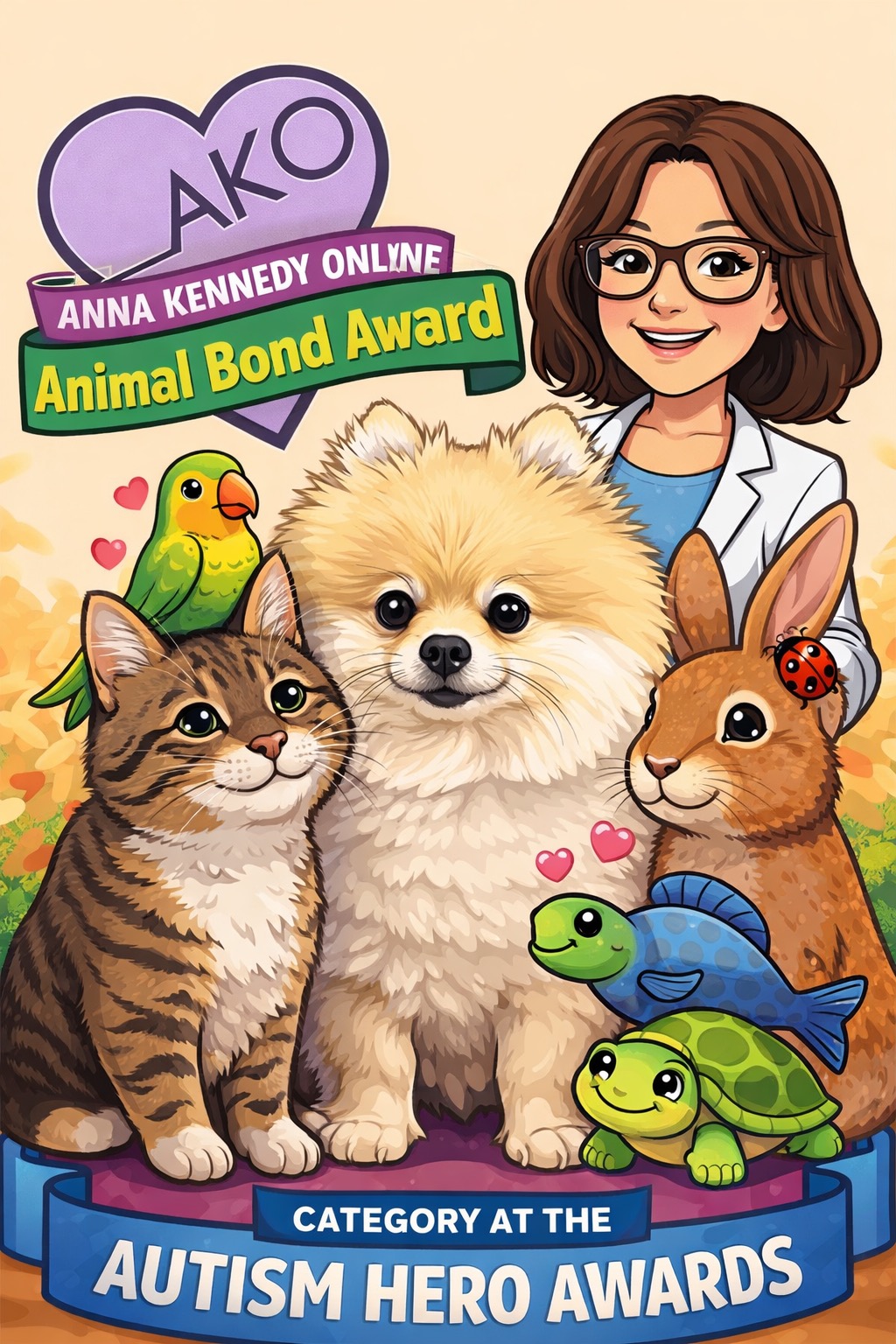
The Animal Bond Award at the Autism Hero Awards, organised by Anna Kennedy Online, is one of the most heart-warming and meaningful categories in the programme. It celebrates the profound and often life-changing relationships between animals and autistic individuals, shining a light on how these unique bonds enrich lives in extraordinary ways.
For many autistic people, animals provide comfort without judgement, routine without pressure, and companionship without expectation. Whether it is a loyal dog offering emotional regulation, a cat providing quiet reassurance, or another cherished animal companion helping to reduce anxiety and build confidence, these relationships can be transformational. The Animal Bond Award recognises those stories that demonstrate empathy, connection, and mutual understanding between humans and animals.
This special category is judged by a compassionate and experienced panel, including pet rescue star Wendy Turner Webster, alongside model and actress Victoria Featherstone Peace, and the talented Tess Eagle Swan who brings insight and authenticity to the judging process as ambassador of the charity. and her idea to add the category .
Tess with Kratu
Together, they celebrate stories that remind us how powerful kindness, trust, and unconditional love can be—proving that sometimes the strongest bonds are formed without words.
Please Nominate and come join us on the night the details below
Finding the perfect birthday experience for someone special is no small task—especially when expectations are high and the guest of honour is flying in from Lisbon with friends in tow. A month before the big day, my phone rang.
“Steven,” my best friend said, “I really want to do something fun for Hernando’s birthday. Something exciting. A show. There’ll be ten of us. What do you suggest?”
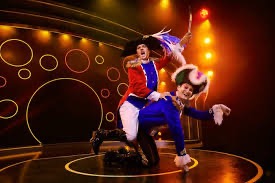
I’d been hearing whispers—more like delighted murmurs—circulating through my social circle about a production with just the right amount of cheeky X-factor. A show called SABRAGE. The reviews were glowing, bordering on evangelical, and once I looked further, the decision was made.
Described as an intoxicating collision of circus artistry, vintage glamour, high-octane acrobatics, and mischievous humour, SABRAGE promised far more than a conventional night out. It billed itself not merely as a show, but as an experience. And it
delivers—spectacularly.
On Saturday evening, we headed to King’s Cross, an area that has undergone one of London’s most impressive transformations over the past decade. Once gritty and utilitarian, it’s now a cultural and social hub buzzing with confidence. Lafayette, located just four minutes’ walk from the station, sits discreetly behind the main thoroughfare—an architectural gem that immediately sets the tone.
From the moment you arrive, the welcome is warm and efficient. Even security manages to be charming—no small feat. Before entering the theatre space, there are a few house rules. Chief among them: no photographs of nudity. This might raise an eyebrow or two, but rest assured—nothing here is gratuitous. Everything is artfully staged, elegant, playful, and firmly in good taste. If you’re easily offended, this may not be your night—but if you appreciate sensuality delivered with wit and intelligence, you’re in safe hands.
One of SABRAGE’s most impressive feats—aside from the performers themselves—is the seamless audience experience. Drinks and food can be ordered directly from your seat via a simple scan, and every member of staff we encountered was genuinely helpful, friendly, and clearly proud of the production.
The show opens with a theatrical pop—a sword cleanly slicing the cork from a champagne bottle—setting the mood instantly. Our hosts glide onstage, equal parts ringmaster and rogue, and from that moment, the audience is completely seduced.
Then comes the talent.
Almost immediately, the room developed a collective crush on Flynn Miller, whose high-flying aerial act is nothing short of breathtaking. There is a rare beauty in watching someone so utterly in command of their body, defying gravity with elegance, strength, and apparent effortlessness. His performance alone would be worth the ticket price.
But SABRAGE is far more than a one-man triumph. The cast—drawn from the very best international circus and acrobatic talent—deliver a relentless parade of jaw-dropping moments. There is danger, precision, laughter, and an undercurrent of delicious rebellion throughout. Vintage glamour collides with modern irreverence, and the result is electric.
What makes SABRAGE truly special is its balance. It knows exactly how far to push without tipping into excess. The humour is cheeky rather than crude. The sensuality is teasing, never tawdry. The spectacle is bold but controlled. Every act feels curated, every transition intentional.
By the end of the evening, our table of ten—birthday boy included—was unanimous. This wasn’t just a successful celebration; it was a night none of us will forget. SABRAGE doesn’t simply entertain—it exhilarates.
If you’re looking for something genuinely different in London, whether for a birthday, celebration, or simply because life deserves more champagne-fuelled circus brilliance, SABRAGE at Lafayette should be at the very top of your list.
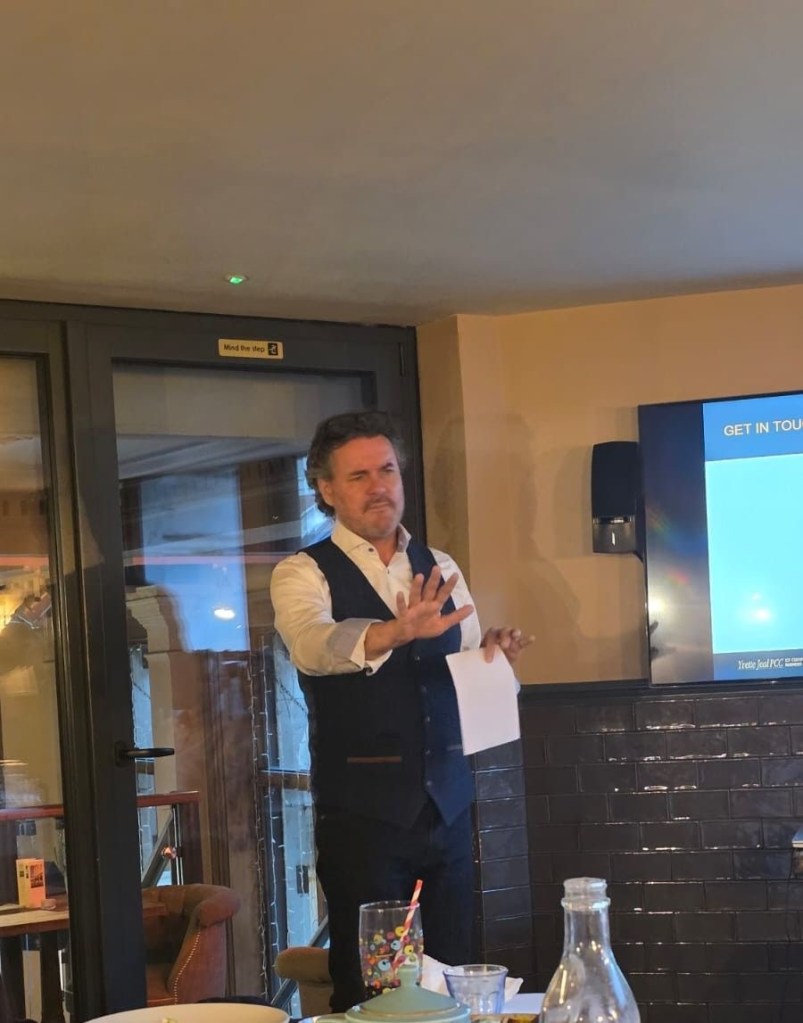
Well, I have just witnessed a man stand up and speak who could best be described as the prodigious love child of Keith Richards and Ricky Gervais—conceived, perhaps, through the mischievous spirit of Janet Street-Porter. Hilarious. Sharp. Fearless. Unapologetically himself.
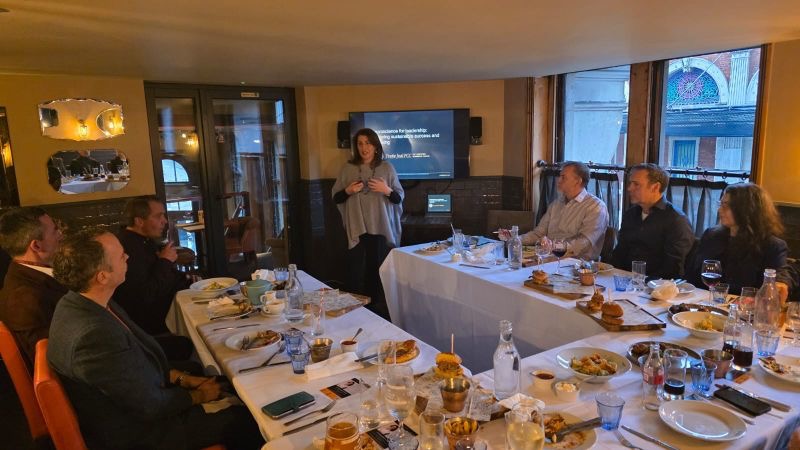
And yet, despite appearances, I was not tucked away in a comedy club. Instead, Anna Kennedy OBE and I had ventured somewhere altogether different, joining Pier Space Speakers Corner London for one of their celebrated lunches, held at the funky Balfour St Barts.
What struck me immediately was the atmosphere: a room buzzing with ideas, warmth, and possibility. This was not a classroom, nor a rigid corporate seminar. It was a gathering of diverse voices—entrepreneurs, creatives, leaders, advocates—coming together to share experiences across business, inspiration, leadership, and life itself. A place where stories mattered as much as strategies.
I am no stranger to speaking. I love radio and television, thrive in podcasts, relish a debate, and happily interview just about anyone. Give me a microphone and a subject and I’m entirely at home. But there is a lesser-known truth about me: when it comes to standing up and talking about myself, I freeze. I brick it, as we say. Confidence deserts me. Words scatter.
Yes, a couple of glasses of vino may occasionally loosen the tongue and—miraculously—result in a standing ovation. But that’s hardly a reliable strategy.
So when Anna suggested we both attend Speakers Corner London—not as performers, but as participants, learners, listeners—I jumped at the chance. And I am so glad I did.
Out and about with Anna Kennedy obe
This was the perfect antidote to fear: an environment that was supportive rather than judgemental, energising rather than intimidating. Not a “class” in the traditional sense, but something far more powerful—an inspirational space where you learn almost by osmosis, simply by being in the room with talented, generous people who genuinely want others to succeed.
Anna, of course, took to it like the Energiser Bunny discovering a microphone. Confident, articulate, and deeply authentic, she reminded everyone why her work in autism awareness and advocacy has made such a lasting impact. Watching her speak so naturally, so purposefully, was inspiring in itself.
The lunch marked a pretty epic kick-off to the 2026 events season, and it felt fantastic to be back among such a stellar group of speakers. The line-up read like a roll-call of insight and expertise: Paul Thomas, the “Sound of Success” specialist; Graham Norris, a future confidence guru; Phil Street FIH, hospitality podcaster extraordinaire; Gill Tiney, global collaboration champion and super-connector; Maria Pardo, marketing guru and Toastmasters president; Nic Marks, happiness author and statistician; Hulya Erbeyli PCC, an authentic leadership coach; Paul Cook, expert in change and transformation; and Trevor Folley, whose work on building cultures of trust resonated deeply.
A special mention must go to Yvette Jeal PCC, who opened the speaker spotlight slots for the year with a calm, confident and fascinating immersion into the neuroscience of peak performance. It was one of those talks that leaves you thinking differently—not just about leadership, but about how we show up every day. Felix Riley followed with a high-energy, often amusing and extremely useful set of ten tips for speakers, distilled from years of hard-won experience.
And then there was Zoie Golding MBE, sharing news of the Big Movement and its inspiring mission to get more men dancing for mental health—proof, if ever it were needed, that leadership comes in many forms, and impact is not confined to boardrooms.
By the end of the afternoon, I realised something important: this wasn’t just about learning how to speak better. It was about confidence, connection, and community. About giving people permission to find their voice—whatever that voice sounds like—and to use it with purpose.
So yes, Anna Kennedy OBE and I did venture out to do something different. And in doing so, I found myself quietly braver, unexpectedly inspired, and already looking forward to the next Speakers Corner London gathering in May.
Sometimes, the most powerful thing you can do is simply show up, sit among the experts, and allow yourself to learn.
There are nights out, and then there are nights that feel like a rite of passage. One such evening found artist Piluca and myself stepping through the doors of the legendary Royal Vauxhall Tavern, to witness the singular brilliance of David Hoyle—a figure who exists somewhere between performer, prophet, poet, and living artwork.
I once described Hoyle as the love child of Kate Bush and Lindsay Kemp, and I stand by it. He is not merely an accomplished performer—with a career spanning television, film, and theatre—but an artist who uses his entire being as medium and message. Last year alone he appeared on stage in an adaptation of Hedda Gabler, proving once again that he is as comfortable in classical reinterpretation as he is in anarchic cabaret.
Hoyle is, quite simply, a walking piece of art. He cuts a vein—metaphorical, emotional, spiritual—and allows the audience to witness everything that spills out: his fears, his hopes, his contradictions. There is no armour, no polite distance. When I interviewed him previously for FLUX magazine, it was immediately clear that what you see on stage is not an act but an extension of the man himself. His work screams originality. It declares, unapologetically: This is me. This is David.
The Royal Vauxhall Tavern functions as his church, and Hoyle its high priest. From the roof—sometimes literally—he preaches love, acceptance, beauty, and defiance. His congregation is as eclectic as it is devoted. On any given night you might find Princess Julia rubbing shoulders with City bankers, artists, drag legends, first-timers, and the gloriously undefinable. It would not be absurd to compare the atmosphere to Warhols Factory in its heyday: a collision of art, celebrity, and counterculture, bound together by a shared understanding that something special is happening in the room.
What is striking is the complete absence of age anxiety. Hoyle himself dismisses it with a wave of the hand: “Everyone is beautiful in the room.” And they are. Young and old gather as equals at the metaphorical fountain, drinking in his wisdom, his wit, and his generosity of spirit. The atmosphere is electric yet oddly intimate, like a secret shared by hundreds.
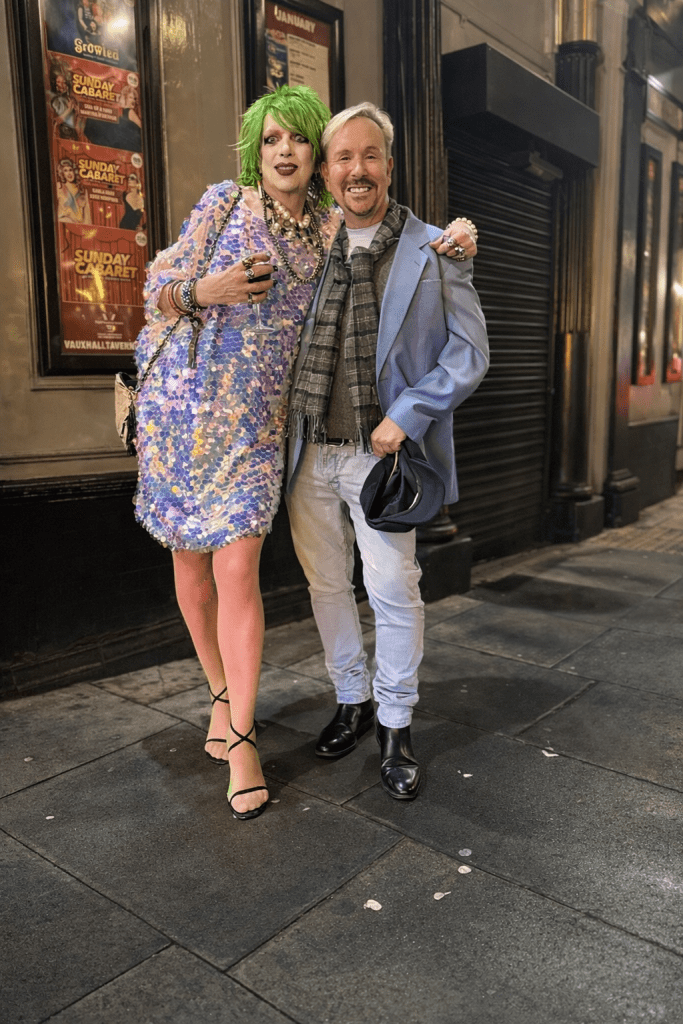
Piluca and me at The Royal Vauxhall Tavern
This is not to say the evening is solemn. Far from it. Hoyle’s humour is razor-sharp, his observations hilariously precise—particularly when directed at the audience. Sit front and centre and expect to become fodder. But crucially, he is never cruel. There is warmth beneath the provocation, and affection behind the mischief.
The man seated next to me informed me—without a hint of irony—that this was his 135th time seeing Hoyle perform. A true disciple. By contrast, my gorgeous friend Piluca—Spanish-born artist and creative force—was a virgin to the experience. I could think of no one better to introduce to what I consider a kindred artistic spirit.
Two incredible artist Piluca meets Hoyle
She was utterly blown away. The evening began with a film tribute to our shared hero, David Bowie, and Piluca leaned over to whisper, “It’s like being dipped in everything I love.” She could not wait to come back, already plotting a return before the night had even ended.
Adding to the richness of the evening, Pam—taking a brief pause from her charity work—took to the stage to read poetry. We were promised one poem and given two, a small but perfect act of generosity that felt entirely in keeping with the spirit of the night.
The show concluded with Hoyle playing cupid, creating a live portrait of two handsome men from the audience—art, flirtation, and theatre merging in real time. To be part of such an evening is to leave not only entertained, but altered. You walk out thinking differently, feeling differently, slightly braver perhaps.
This is not just a show. It is an experience—unique, communal, and deeply worthwhile. In a world increasingly starved of authenticity, David Hoyle remains gloriously, defiantly real.
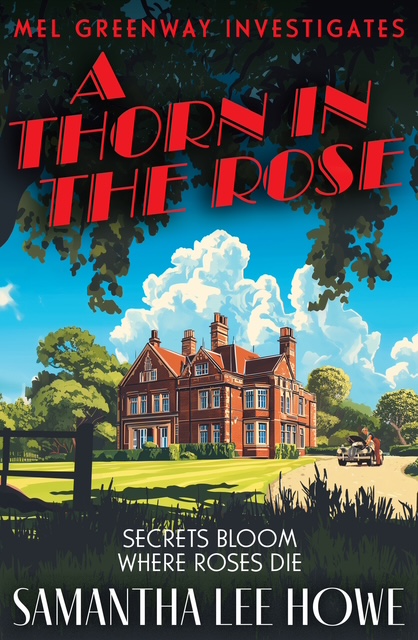
Samantha Lee Howe is an award-winning author, screenwriter, and broadcaster, known for her ability to craft gripping, emotionally rich narratives. Her latest release, A Thorn in the Rose, launches the Mel Greenway Investigates series, set in post-World War II Britain. The novel follows Lady Melinda “Mel” Greenway, a former army mechanic, who uncovers a body buried beneath the rose garden of the crumbling Avonby Estate. As Mel digs into the mystery, she faces a dangerous web of family secrets, class divisions, and unresolved romance, all while navigating the tensions between the estate’s wealthy residents and its resentful staff. Blending suspense with social history, Howe’s storytelling draws readers into a compelling world of intrigue and mystery.
Picture Annemarie Bickerton all make up Ayesha Baig
In celebration of her new book, Samantha shares her seven favourite things — offering a personal look into the inspirations and interests that fuel her creativity. From her fascination with forgotten histories to the quiet moments of reflection that help her develop unforgettable characters, Samantha’s list reveals the influences behind her writing and the passions that drive her. Whether it’s her love of storytelling, her advocacy work, or her dedication to unearthing hidden truths, Samantha’s journey as an author continues to resonate with readers worldwide. A Thorn in the Rose is just the beginning of an exciting new chapter in her career.
I have so many favourite things that this was a tough one. But in no particular order, here is my seven favourite things.
Ballgowns
Yes, I adore a fancy frock — particularly when there’s a suitably glamorous excuse to wear one. There is something wonderfully transformative about a ballgown: the weight of the fabric, the sweep of the skirt, the quiet confidence it lends the wearer.
My favourite gown was designed by the formidable businesswoman Heather Hardy, who owns the highly successful prom, wedding, and occasionwear shop Glitz and Glamour Boutique, where I regularly indulge my love of elegant dressing. Some time ago, Heather turned her considerable talent to creating her own VIP range — a venture that met with well-deserved success.
Most wonderfully of all, she designed a dress with my favourite style firmly in mind and even named it after me. It remains a deeply flattering honour — proof that sometimes a love of beautiful clothes can be rewarded with something truly personal and unforgettable.
My favourite wine is red, and I’m particularly partial to a good Malbec. Rich, smooth, and reassuringly full-bodied, it’s a wine I return to time and again. As a result, my go-to choice — reliable, consistent, and eminently quaffable — is Casillero del Diablo Malbec. It never disappoints, whether opened for a quiet evening at home or shared with friends.
They also produce a very fine Carménère, which I enjoy just as much — a slightly bolder companion with depth and character, perfect for lingering conversations and unhurried dinners.
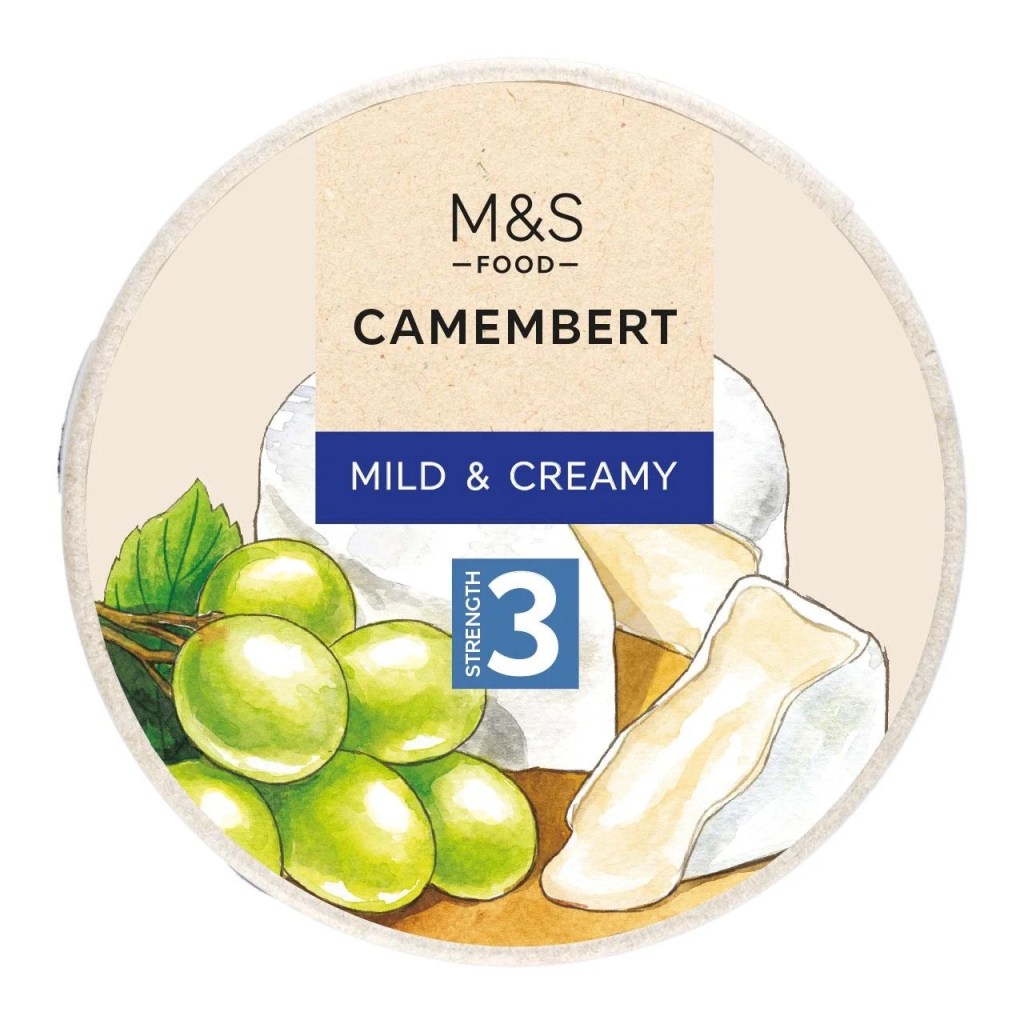
Cheese.
Self-indulgent, I know — but wine and cheese truly do belong together. I have a particular fondness for baked Camembert, especially since I first shared one with my husband, David, on our very first date. It was a long time ago now, yet it has never been forgotten. Even today, a Camembert still feels like a small celebration in itself, and I love to bring one out for us on special occasions, as a quiet reminder of where our story began.
Cats
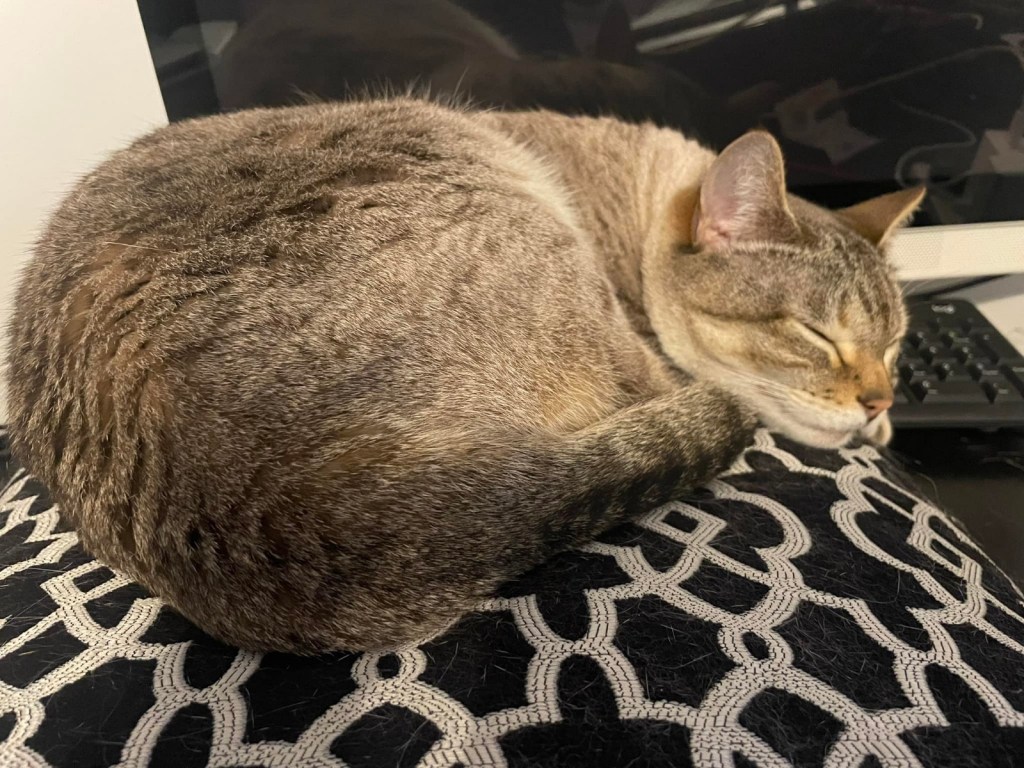
My beautiful furbaby, Skye, is my constant companion when I’m writing. Even now, she’s curled up against my leg as I type, quietly supervising proceedings in the way only a cat can.
What I love most about cats, in general, is their individuality. No two are ever quite the same; each has a personality entirely its own. Skye possesses the softest, sweetest nature, endlessly affectionate and reassuring — yet she also has a mischievous streak that appears whenever things fail to go her way.
Case in point: eating the fake snow off the Christmas tree, an act guaranteed to provoke a reaction from us and, I suspect, part of the appeal. It’s this blend of gentleness and gentle rebellion that makes her such a joy — and such an essential presence in my everyday life.
Skye the cat .
Birthday cake
I adore birthday cake, and the very best part is always the fondant icing. There’s something indulgent and irresistible about it — smooth, sweet, and unapologetically decadent. Still, I’m rather glad it only makes an appearance twice a year in our household, because it’s exactly the sort of pleasure one could develop a dangerous fondness for. Given half the chance, I suspect I could become thoroughly addicted
My Laptop
I honestly couldn’t live without my laptop. It’s an essential part of my daily life, serving as my main tool for work, communication, and social media. It’s where emails are written, ideas are shaped, and conversations are kept alive.
I don’t play computer games, but I do enjoy using it creatively — designing posters and banners, experimenting with layouts, and bringing ideas to life on the screen. Of course, it also has its less industrious moments. Every now and then, it becomes the perfect instrument for procrastination, doubling as a portal to streaming series when I really should be doing something else.
Practical, creative, and occasionally indulgent, my laptop has become far more than just a piece of technology — it’s a constant companion in both my working and wandering hours.
My Kitchen
As I love to cook, my kitchen is my favourite room in the house. It is also the hub of every party we have, and I’m always amazed by how everyone congregates in there each time. I take great pride in it too, and it always has to have clear and clean surfaces, ready, as I’m always saying, to cook the next meal.































 2Shades Magazine